Your Cart is Empty


TL;DR:
- When you need your voice back fast, you don’t have time for trial and error. This guide focuses specifically on the quickest and most effective singer voice recovery solutions — ranked by how fast they work, so you can take action immediately and get results.
Singer voice recovery solutions are scientifically supported practices that restore vocal function after strain, overuse, or damage to the vocal folds. The vocal folds are two small muscle bands in your larynx that vibrate to produce sound. When they swell, dry out, or suffer micro-trauma from heavy use, your voice becomes hoarse, thin, or unreliable. Clinical guidelines recommend combining structured vocal rest, systemic hydration, semi-occluded vocal tract (SOVT) exercises, and environmental care to restore full vocal health. Tmrgsolutions has spent 25+ years helping singers, actors, and speakers apply these methods with natural formulations and therapy kits built specifically for voice professionals.
Vocal rehabilitation is the clinical term for the structured process of restoring damaged or fatigued vocal folds. Singer voice recovery solutions draw from this field, combining rest protocols, hydration science, therapeutic exercises, and lifestyle adjustments. The goal is not just to silence symptoms but to repair the tissue and rebuild resilience so your voice performs at full capacity again.
Chronic vocal issues arise from cumulative micro-trauma and muscle tension rather than single isolated events. That means recovery is rarely a one-day fix. Singers who treat hoarseness as a temporary inconvenience and push through often develop chronic inflammation that is far harder to reverse.
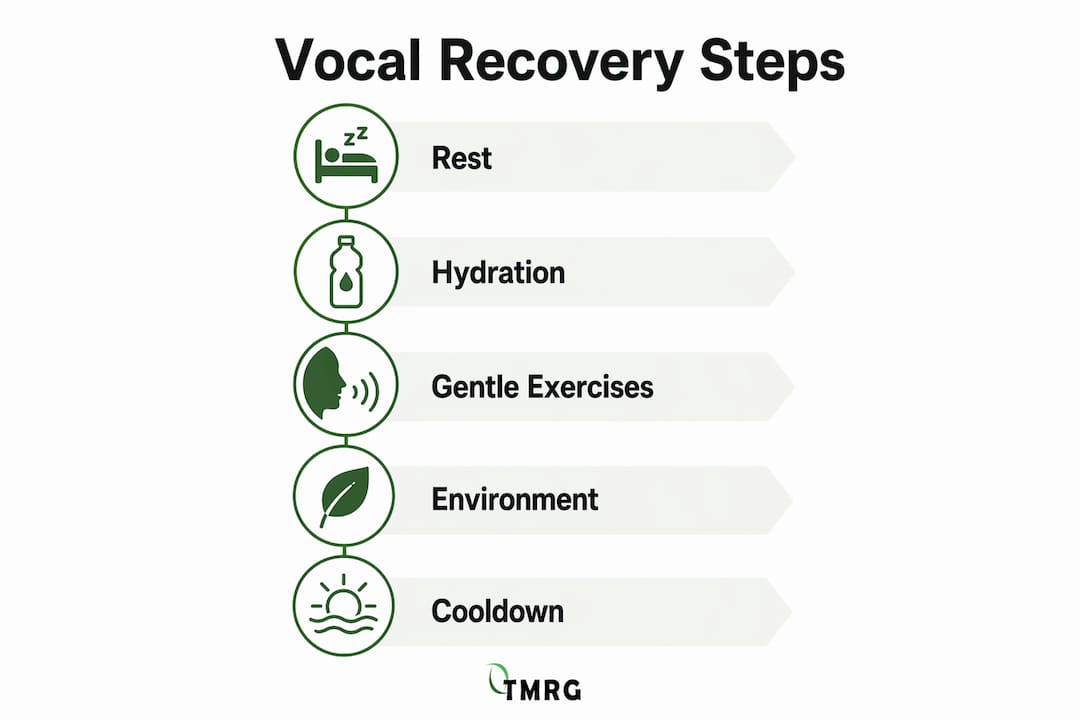
The most effective recovery plans address four pillars simultaneously: rest, hydration, gentle exercise, and environmental control. Skipping any one of them slows the others down. A singer who rests but stays dehydrated, for example, still has dry, stiff vocal folds that cannot heal efficiently.
Vocal rest is the deliberate reduction or elimination of voice use to allow inflamed or fatigued vocal folds to recover. True vocal rest means complete silence. No talking, no whispering, and no throat clearing. Whispering is a common mistake because it actually increases the collision force between vocal folds, making inflammation worse rather than better.
Clinical guidelines recommend 10 minutes of vocal rest for every 1 hour of speaking during active recovery periods. That ratio gives the tissue time to reduce swelling between demands. Combining this structured rest with gentle SOVT exercises produces faster recovery than rest alone.
For working singers who cannot go completely silent, modified rest is a practical alternative. Modified rest means cutting out all unnecessary speaking, avoiding loud environments, and reducing phone calls and social conversation to a minimum. The risk with modified rest is rebound strain, where singers feel better after a short break and immediately return to full performance intensity.
True vocal rest: No speaking, whispering, or throat clearing for the designated period
Modified vocal rest: Eliminate unnecessary voice use while maintaining essential communication
Avoid whispering: Whispering strains vocal folds more than soft, supported speech
Throat clearing: Replace with a silent swallow or a gentle, breathy cough to clear mucus
Rebound risk: Ease back into singing gradually after rest; do not jump straight to full volume
Pro Tip: After a rest period, start your return with five minutes of gentle humming before any full-voice singing. This warms the tissue gradually and prevents the rebound strain that catches many singers off guard.
Hydration is the most consistently underestimated factor in vocal recovery. The vocal folds rely on a thin layer of mucus to vibrate smoothly. When that layer dries out, friction increases, and the tissue becomes more vulnerable to damage with every phonation cycle.

Systemic hydration targets 8–10 glasses of room-temperature water daily to maintain mucosal lubrication. The key word is “systemic.” Water spread consistently throughout the day keeps the mucous membranes hydrated at the tissue level. Drinking a large amount of water immediately before a performance does almost nothing for vocal fold lubrication because the water never reaches the folds directly.
Topical hydration methods deliver moisture closer to the larynx and provide faster surface relief:
Steam inhalation: Breathe steam from a bowl of hot water or a personal steam inhaler for 10–15 minutes. This softens mucus and soothes irritated tissue directly.
Cool mist humidifier: Run one in your bedroom overnight to keep ambient humidity between 40–60%. Dry air is one of the fastest ways to undo a day of good hydration habits.
Nebulizer with saline: A saline nebulizer delivers fine mist particles deep into the airway, providing surface hydration that steam alone cannot always reach.
Room-temperature water: Sip throughout the day. Cold water causes vasoconstriction that reduces vocal flexibility and stiffens the tissue.
Avoid caffeine and alcohol during recovery. Both are diuretics that pull moisture from the body and counteract your hydration efforts. Herbal teas without caffeine, particularly those with anti-inflammatory properties like ginger or licorice root, support mucosal health without the dehydrating effect.
Pro Tip: Carry a water bottle and set a phone reminder to drink every 30 minutes during a performance day. By the time you feel thirsty, your vocal folds are already working with less lubrication than they need.
Active exercise is the part of vocal recovery that most singers skip because it feels counterintuitive to use your voice when it hurts. The science is clear: gentle SOVT exercises are considered the gold standard for vocal rehabilitation because they create back pressure in the vocal tract that massages the folds and reduces damaging collision forces during healing.
Semi-occluded vocal tract (SOVT) exercises partially close the front of the vocal tract while you phonate. This back pressure reduces the impact stress on the vocal folds with every vibration cycle. The folds still move and strengthen, but without the full collision force of open-mouth singing. Three SOVT methods work well for singers in recovery:
Straw phonation: Hum or sing through a thin cocktail straw. Start with simple pitch slides and work up to short melodic phrases over several days.
Lip trills: Blow air through loosely closed lips while vocalizing. This is gentler than straw phonation and a good starting point for very fatigued voices.
Humming with mouth closed: Produces mild back pressure and vibration without the full demand of open singing. Focus on keeping the sound easy and forward in the face.
Most singers warm up before performing but skip the cooldown entirely. Cooldown exercises using aspirated “ee” sounds reduce post-performance inflammation and help preserve vocal range over time. They also act as an early-warning system. If your voice feels unstable or strained during a cooldown, that is a signal to rest more before the next session rather than push through.
| Exercise type | Best use case | Intensity level |
|---|---|---|
| Straw phonation | Active rehabilitation, daily maintenance | Very low |
| Lip trills | Warm-up, early recovery stage | Low |
| Humming | Cooldown, gentle activation | Very low |
| Aspirated “ee” slides | Post-performance cooldown | Low |
| Supported speech exercises | Voice therapy, technique correction | Moderate |
Active, gentle recovery exercises disrupt inflammation cycles better than passive rest alone. Singers who combine daily SOVT work with structured rest recover faster and maintain more consistent vocal quality between performances.
One important caution: NSAIDs like ibuprofen are contraindicated for vocal fold inflammation because they increase the risk of vocal fold hemorrhage. Acetaminophen is the safer choice for pain relief during recovery when medication is needed.
Sleep is the most powerful recovery tool a singer has. Vocal folds repair tissue primarily during sleep, and 7–9 hours of quality sleep correlates with stronger vocal resilience. Fewer than 6 hours slows recovery and reduces immune function, which increases infection risk at exactly the wrong time.
Diet and acid reflux have a direct impact on vocal fold health that many singers overlook. Silent reflux, also called laryngopharyngeal reflux (LPR), causes morning hoarseness without the typical heartburn sensation. Stomach acid reaches the larynx during sleep and irritates the vocal folds overnight. Managing reflux through meal timing, avoiding food within three hours of bed, and sleeping with the head slightly elevated reduces this damage significantly.
Key environmental and behavioral adjustments that support vocal healing:
Air quality: Use a HEPA air purifier in rehearsal and sleeping spaces to reduce dust, allergens, and pollutants that irritate the larynx
Smoke avoidance: Cigarette smoke and secondhand smoke dry and inflame the vocal folds; avoid both during recovery
Posture and breath support: Poor posture compresses the diaphragm and forces the larynx to compensate, adding strain; stand tall and breathe from the belly
Behavioral voice use: Avoid shouting over loud music or background noise; use a microphone when possible rather than pushing volume
Persistent hoarseness: Hoarseness lasting more than 2–3 weeks may indicate silent reflux or another medical condition requiring a laryngologist evaluation
Effective vocal recovery requires combining structured rest, consistent hydration, gentle SOVT exercises, and environmental care rather than relying on any single approach alone.
| Point | Details |
|---|---|
| Rest with structure | Follow the 10-minute rest per hour of speaking ratio; avoid whispering during true vocal rest. |
| Hydrate systemically | Drink 8–10 glasses of room-temperature water spread throughout the day, not just before performing. |
| Use SOVT exercises | Straw phonation and lip trills reduce vocal fold collision forces and speed rehabilitation. |
| Prioritize sleep | 7–9 hours of quality sleep allows vocal fold tissue to repair; fewer than 6 hours slows recovery. |
| Control your environment | Manage reflux, avoid smoke, and maintain 40–60% indoor humidity to protect healing tissue. |
Singers consistently make the same mistake: they treat recovery as a passive event. They rest for two days, feel 80% better, and immediately return to full rehearsal intensity. That 20% gap is where chronic damage lives. The tissue that felt “almost fine” was not fully repaired, and the next performance pushes it back into inflammation. Over months, that cycle erodes vocal range and reliability in ways that take far longer to fix than the original injury.
The singers I have seen recover fastest are the ones who treat vocal maintenance like physical training. They do their SOVT exercises daily, not just when something hurts. They hydrate before they feel thirsty. They cool down after every session, even a casual one. They check in with their voice regularly and catch small warning signs before they become real problems.
The other thing I would tell any singer: do not underestimate the reflux connection. A surprising number of persistent hoarseness cases trace back to LPR rather than overuse. If your voice is consistently rough in the morning and clears up by midday, that pattern points to acid reaching the larynx overnight. Fixing your diet and sleep position can resolve hoarseness that no amount of rest or hydration was touching.
Recovery is not complicated, but it does require consistency. The singers who build these habits into their daily routine stop having vocal crises altogether. That is the real goal: not just getting your voice back, but keeping it.
— Golan
Tmrgsolutions has spent 25+ years developing natural vocal health products for singers, actors, and speakers who need reliable, professional-grade support.

The TMRG Voice Therapy Kit brings together the core tools for structured vocal rehabilitation in one place, including sprays, oils, and recovery drops formulated to complement rest and exercise protocols. For singers dealing with active hoarseness, the TMRG Defense Throat Spray delivers saline and herbal oils directly to the laryngeal area for targeted surface relief. If you want a complete picture of your vocal health needs before choosing a product, the vocal problems guide on the Tmrgsolutions website walks through common conditions and matching solutions.
The fastest recovery combines true vocal rest, consistent systemic hydration with 8–10 glasses of water daily, and gentle SOVT exercises like straw phonation. Rest alone is slower than rest paired with active rehabilitation exercises.
Whispering is not safe during vocal rest. It increases vocal fold collision force and can worsen inflammation compared to soft, supported speech or complete silence.
Most mild vocal strain responds to 24–48 hours of modified rest combined with hydration and SOVT exercises. Hoarseness lasting more than 2–3 weeks requires evaluation by a laryngologist to rule out underlying conditions like silent reflux.
Gentle SOVT exercises like straw phonation and lip trills help a strained voice by reducing collision forces on the vocal folds during healing. High-intensity singing or forced exercises cause further damage and should be avoided.
Vocal folds repair tissue primarily during sleep cycles. Getting 7–9 hours of quality sleep accelerates healing, while chronic sleep deprivation below 6 hours slows recovery and increases infection vulnerability.
