Your Cart is Empty


TL;DR:
- Vocal rest, hydration, environmental control, and gentle exercises are essential for recovering a lost voice caused by laryngitis.
- Persistent symptoms beyond three to four weeks require medical evaluation to exclude serious conditions.
Voice loss, clinically known as laryngitis, is defined as inflammation of the larynx and vocal folds that impairs or eliminates normal sound production. Knowing how to fix a lost voice starts with three non-negotiable steps: complete vocal rest, aggressive hydration, and removing every irritant from your environment. Acute laryngitis typically resolves within 1 to 2 weeks, but the first 24 to 48 hours of intensive rest are the most critical window for reducing swelling. Tools like a warm-mist humidifier, pectin-based throat lozenges, and a structured voice therapy plan from Tmrgsolutions can meaningfully shorten that timeline.
Your voice disappears because swollen vocal folds can no longer vibrate cleanly against each other. Under normal conditions, the two folds meet and separate hundreds of times per second to produce sound. When the laryngeal tissue becomes inflamed, that precise movement breaks down, producing hoarseness, a thin or scratchy tone, or complete silence.
The most common triggers fall into four categories:
One detail most people miss: whispering feels gentler than speaking, but it is not. Whispering increases vocal strain more than normal soft speech because it forces the laryngeal muscles into abnormally high tension. That means whispering to “protect” your voice actively slows healing.
If hoarseness or voice loss persists beyond three to four weeks, medical evaluation is recommended to rule out conditions such as vocal fold nodules, polyps, or, in rare cases, laryngeal cancer. Do not wait out a month of symptoms without seeing an ENT specialist.
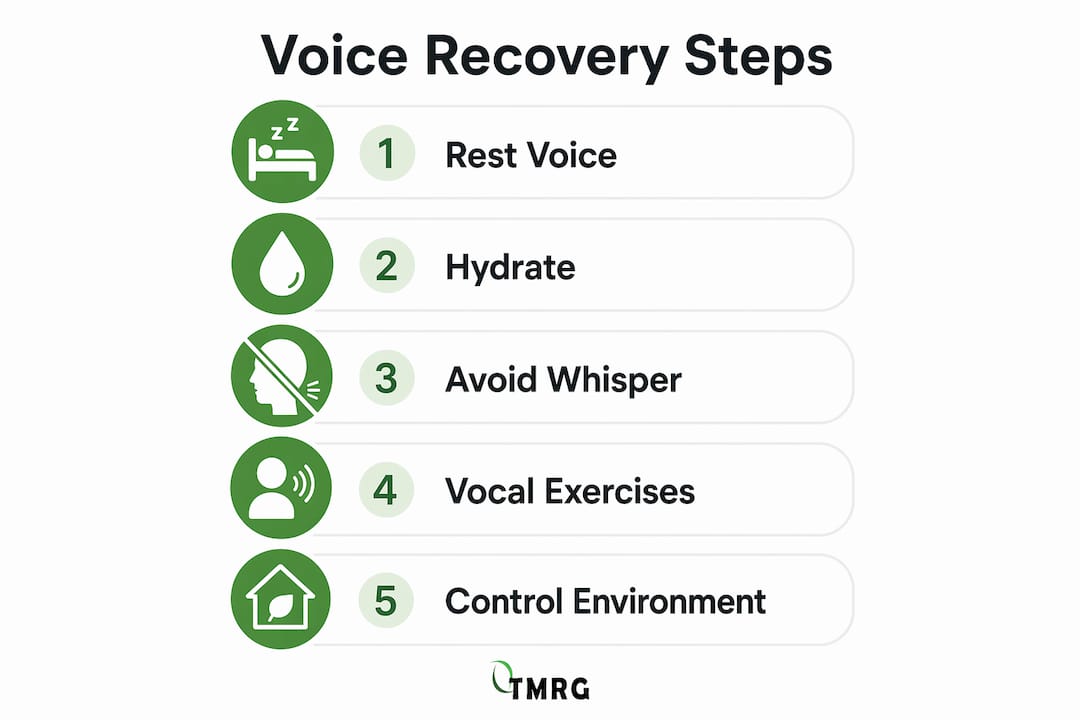
The following protocol is ordered by priority. Work through it systematically rather than picking one or two steps at random.
Pro Tip: Warm herbal teas with honey, such as chamomile or ginger, serve double duty: they hydrate and coat the throat simultaneously. Avoid peppermint tea, which contains natural menthol and can have a drying effect. Caribella’s guide on herbal recovery drinks offers useful parallels for soothing inflamed tissue.

Passive rest alone is less effective than most people assume. Combining vocal rest with gentle exercises acts like a therapeutic massage for the vocal folds, improving circulation and reducing stiffness faster than silence alone. The key is choosing exercises that stimulate without straining.
The most effective gentle exercises for early recovery include:
A practical vocal rest-to-use ratio is 10 minutes of complete silence for every 1 hour of speaking. This balance keeps the folds active enough to prevent stiffness while giving them adequate recovery time. Tmrgsolutions has a detailed breakdown of essential vocal recovery exercises that follow this graduated approach.
Avoid throat clearing entirely during recovery. Throat clearing forcibly slams the vocal folds together, causing repeated micro-trauma to already inflamed tissue. When you feel the urge to clear, sip water or swallow firmly instead. Both actions move secretions without the impact.
Your recovery speed is not determined by remedies alone. The environment you spend most of your time in has a direct effect on how quickly your vocal folds repair.
Noise is a hidden threat. Noisy environments cause unconscious loud speech, a phenomenon called the Lombard effect. When background noise rises, your brain automatically increases your speaking volume without you realizing it. If you are recovering from voice loss and spending time in a loud restaurant, open-plan office, or near a television at high volume, you are straining your vocal folds without knowing it. Move to quieter spaces whenever possible. This is explored in depth in Tmrgsolutions’ article on how environment affects vocal health.
Sleep is a recovery tool, not a luxury. Adequate sleep reduces systemic inflammation and supports the body’s tissue repair processes. Aim for seven to nine hours per night during active recovery. The larynx heals during sleep the same way a sprained ankle does: through reduced load and increased blood flow to the tissue.
Diet matters more than most people expect. Acid reflux is one of the most underdiagnosed causes of chronic hoarseness. Eating large meals close to bedtime, consuming spicy or fatty foods, and lying down after eating all allow stomach acid to reach the larynx. During recovery, eat smaller meals, avoid eating within three hours of sleep, and consider elevating the head of your bed slightly.
Pro Tip: If you work in a profession that requires daily voice use, such as teaching, coaching, or performing, consider using a personal amplification device during recovery. A small clip-on amplifier like the Chattervox or Amplivox allows you to be heard without raising your volume, protecting the folds while you heal.
Fixing a lost voice requires immediate vocal rest, consistent hydration, targeted exercises, and environmental control working together rather than any single remedy in isolation.
| Point | Details |
|---|---|
| Rest first, then exercise | Start with 24 to 48 hours of complete silence, then add gentle humming and lip trills to accelerate healing. |
| Hydrate to 64 oz daily | Eight cups of water per day maintains the mucosal layer that vocal folds need to vibrate cleanly. |
| Avoid whispering | Whispering increases laryngeal muscle tension more than soft normal speech and slows recovery. |
| Control your environment | Noisy rooms trigger unconscious loud speech; move to quieter spaces during active recovery. |
| See a doctor at 3 to 4 weeks | Persistent hoarseness beyond four weeks requires medical evaluation to rule out serious conditions. |
By Golan
The single most common mistake I see is people treating vocal rest as an all-or-nothing prescription. They either talk constantly because “it doesn’t hurt that much,” or they go completely silent for days and then jump back to full voice use without any transition. Both approaches extend recovery time.
What actually works is a graduated return. Think of it the way a physical therapist approaches a muscle injury: rest the acute phase, then introduce controlled movement to rebuild strength and flexibility. The straw phonation and lip trill exercises described above are not optional extras. They are the mechanism that moves recovery from passive waiting to active healing.
I also want to address the hydration point directly, because most people underestimate how much water they actually need. Drinking 64 ounces sounds straightforward until you track it for a day and realize you hit 32 ounces by evening. The vocal folds are covered in a thin mucous membrane that dries out faster than you think, especially in air-conditioned or heated spaces. Carry a water bottle. Set reminders. It is one of the highest-return habits in vocal health.
Finally, the environmental piece is genuinely underappreciated. I have worked with singers and speakers who did everything right medically but kept recovering in loud, dry, or smoky environments and wondered why progress was slow. Your surroundings are either supporting your recovery or working against it. Treat them as part of the treatment plan.
If symptoms are not improving after two weeks, or if you notice pain when swallowing, blood in mucus, or a lump sensation in the throat, see an ENT specialist. Those are not symptoms to manage at home.
— Golan

Tmrgsolutions has spent 25 years formulating natural vocal health products specifically for singers, speakers, actors, and anyone dealing with acute voice loss. The TMRG Loud & Clear Classic Voice Recovery Drops are designed to soothe irritated vocal folds and restore mucosal moisture, making them a practical complement to the rest and hydration protocol described above. For a more structured approach, the TMRG Voice Therapy Kit Standard pairs guided exercises with targeted remedies to support every stage of recovery. Whether you are dealing with a single episode of laryngitis or recurring vocal strain, Tmrgsolutions offers a product path matched to your specific situation.
Acute laryngitis typically resolves within 1 to 2 weeks. Starting intensive vocal rest within the first 24 to 48 hours significantly reduces swelling and shortens that timeline.
Whispering is not a safe alternative to silence. It places higher tension on the laryngeal muscles than normal soft speech, which means it actively worsens inflammation and delays healing.
Pectin-based or honey-based lozenges are the better choice for voice recovery. Menthol lozenges can dry and irritate the throat, which counteracts the soothing effect you need.
Schedule a medical evaluation if hoarseness or voice loss lasts longer than three to four weeks, or sooner if you experience throat pain, difficulty swallowing, or any unusual symptoms alongside the voice change.
Yes. Gentle exercises like humming and lip trills provide a therapeutic massage effect on the vocal folds and accelerate recovery compared to passive rest alone. Start them after the initial 24 to 48 hour rest period.
