Your Cart is Empty


TL;DR:
- Acute laryngitis, commonly called a “lost voice,” involves inflammation of the larynx and vocal folds, disrupting sound production. Recovery is best supported overnight through complete voice rest, hydration, humidified air, and avoidance of irritants, although full healing usually takes days to weeks. Recognizing the cause, whether viral, mechanical strain, or irritants, helps tailor appropriate remedies and prevents further injury.
Acute laryngitis is the clinical term for what most people call a “lost voice,” and it is defined as inflammation of the larynx and vocal folds that disrupts normal sound production. Knowing how to cure lost voice overnight starts with one honest fact: full recovery rarely happens in a single night, but you can dramatically reduce inflammation, ease discomfort, and wake up with a noticeably stronger voice by following a focused recovery protocol. That protocol centers on four pillars: complete voice rest, aggressive hydration, humidified air, and strict avoidance of irritants. Whether you are a singer with a performance tomorrow, a teacher facing a full classroom, or simply someone who needs to speak clearly at work, the steps below give you the fastest realistic path to overnight voice restoration.
Understanding why your voice disappears tells you exactly which recovery strategies will work and which will waste your time. The larynx sits at the top of your airway, and your vocal folds are two small bands of muscle and tissue inside it. When they swell or stiffen, they cannot vibrate properly, and your voice becomes thin, rough, or completely silent.
The most common causes of acute voice loss include:
The cause matters for recovery speed. Viral laryngitis typically resolves in one to two weeks with supportive care. Strain-related voice loss can improve within 24 to 48 hours if you stop the mechanical abuse immediately. Irritant-driven hoarseness improves as soon as the irritant is removed. Knowing your cause helps you set realistic expectations and choose the right remedies for lost voice from the start.
The fastest overnight recovery plan is built on evidence, not folklore. Voice rest, fluids, humidified air, and irritant avoidance are the four actions that Mayo Clinic and Yale Medicine both identify as the foundation of rapid symptom relief. Here is how to execute each one tonight.
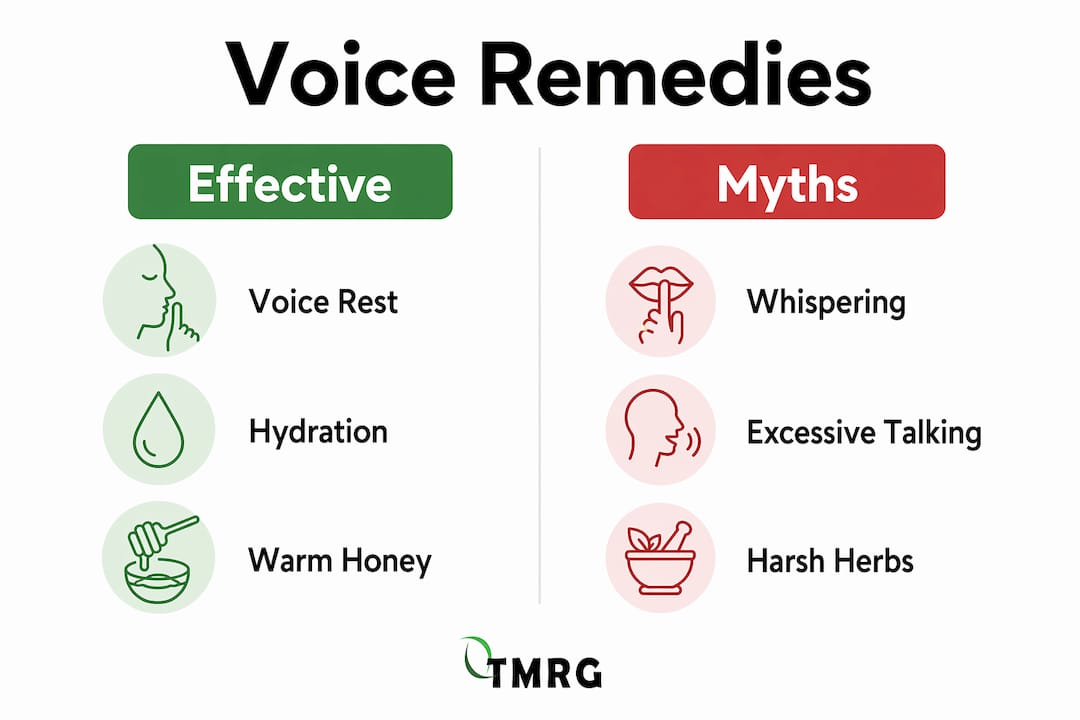
Pro Tip: If you absolutely must communicate verbally, use your normal speaking voice at low volume rather than whispering. Whispering forces the vocal folds into an unnatural position that actually increases mechanical stress and worsens inflammation. A quiet, relaxed speaking tone is far less damaging.

Not every remedy you find online delivers the same results. The table below compares the most common approaches based on available clinical evidence.
| Remedy | Effectiveness | Caution |
|---|---|---|
| Voice rest | Highest. Directly reduces mechanical strain on inflamed vocal folds. | Whispering does not count as rest. |
| Hydration (water, warm fluids) | High. Thins mucus and reduces vocal fold friction. | Avoid caffeinated or alcoholic drinks. |
| Humidifier or steam inhalation | High. Reduces inflammation and mucus by maintaining airway moisture. | Do not lean over boiling water without caution. |
| Saltwater gargling | Moderate. Soothes throat irritation but does not reduce vocal fold swelling directly. | Use warm, not hot, water. |
| Honey and ginger | Mild to moderate. Soothing effects on throat tissue are real, but rapid reversal of swelling is not. | Useful as comfort support, not a cure. |
| Antibiotics | None for viral laryngitis. No medication reliably cures viral laryngitis overnight. | Use only if bacterial cause is confirmed. |
| Corticosteroids | Limited. May reduce swelling in severe cases but require physician prescription. | Not appropriate for self-treatment. |
Slippery elm lozenges and licorice root teas are popular among singers and speakers for their coating and soothing properties. The evidence for these herbal options is anecdotal rather than clinical, but they carry minimal risk and many vocalists find them genuinely helpful for comfort. The natural recovery techniques used by performers often combine several of these mild remedies together for a cumulative soothing effect.
Pro Tip: Dissolve half a teaspoon of salt in eight ounces of warm water and gargle for 30 seconds before bed. This reduces surface bacteria and soothes inflamed throat tissue without any side effects. Repeat in the morning for added relief.
Most cases of acute laryngitis resolve on their own with supportive care. Some situations, however, require prompt medical evaluation. Recognizing the difference protects you from missing a serious underlying condition.
See a physician without delay if you experience any of the following:
A laryngoscopy, where a physician uses a small camera to view the vocal folds directly, is the standard diagnostic tool for persistent or unexplained voice loss. This procedure is quick, minimally uncomfortable, and provides definitive information about the condition of your vocal folds. If you have lost your voice multiple times in the past year, that pattern alone justifies a professional evaluation rather than repeated rounds of home treatment.
Recurrent voice loss often signals an underlying issue such as GERD, vocal fold nodules from chronic strain, or a structural problem that home remedies cannot address. Catching these conditions early leads to significantly better outcomes.
Overnight voice recovery is achievable through complete voice rest, consistent hydration, humidified air, and strict irritant avoidance, with full healing typically requiring several days to weeks.
| Point | Details |
|---|---|
| Voice rest is non-negotiable | Stop talking entirely and avoid whispering, which increases vocal fold stress. |
| Hydration accelerates healing | Drink warm fluids consistently to thin mucus and reduce vocal fold friction. |
| Humidification works overnight | Run a humidifier while you sleep to keep the airway moist and reduce inflammation. |
| Antibiotics do not help viral cases | Most lost voice episodes are viral; medication does not speed recovery without a bacterial cause. |
| Seek care after four weeks | Hoarseness persisting beyond four weeks requires laryngoscopy to rule out serious conditions. |
After working in vocal health for over two decades, I have seen one pattern repeat itself constantly: people expect overnight recovery and then damage their voice further by talking too soon. The overnight window is not about curing your voice. It is about giving your vocal folds the conditions they need to begin healing without interference.
The mistake I see most often is whispering. People believe it is a compromise between talking and resting. It is not. Whispering increases mechanical stress on the vocal folds and prolongs recovery. Write things down. Use your phone. Stay silent.
The second most common mistake is returning to full vocal use the moment the voice sounds better. A voice that feels 70% recovered is still inflamed. Pushing it at that stage often sets recovery back by two to three days. Gradual return to speaking, starting with short, low-effort conversations, is the right approach.
For professionals who depend on their voice, singers, actors, lecturers, and public speakers, the overnight plan is a starting point, not a complete solution. Combining rest and hydration with voice therapy exercises during the recovery phase rebuilds vocal strength without re-injuring the folds. Prevention matters just as much as treatment. Consistent vocal hygiene, staying hydrated daily, warming up before extended speaking, and avoiding environments with smoke or dry air reduces the frequency of voice loss significantly.
— Golan

Tmrgsolutions has spent 25 years developing natural, expert-backed products specifically for singers, speakers, and performers dealing with voice loss and hoarseness. The TMRG Voice Therapy Kit Basic gives you a structured starting point for recovery, combining natural herbal formulations with a guided care protocol that complements everything covered in this article. For performers and professionals with more demanding vocal needs, the Premium Voice Therapy Kit provides a more intensive recovery and maintenance program endorsed by vocal coaches and medical professionals. These kits are designed to work alongside rest and hydration, not replace them, giving your vocal folds the targeted support they need to recover faster and perform better.
Full recovery from acute laryngitis in a single night is not realistic for most people. You can significantly reduce symptoms and improve vocal function overnight through voice rest, hydration, and humidification, but complete healing typically takes several days to two weeks.
Whispering irritates vocal folds by creating turbulent airflow and increasing mechanical stress on the tissue, which is the opposite of rest. Use written communication or text messages instead.
Warm water with honey is the most effective single drink for overnight voice restoration. It hydrates the vocal tract, coats irritated throat tissue, and provides mild antimicrobial support without the drying effects of caffeine or alcohol.
Most cases of acute laryngitis resolve within one to two weeks with proper supportive care. Cases lasting beyond four weeks require medical evaluation to rule out underlying conditions such as vocal fold lesions or GERD.
Yes. Running a humidifier overnight maintains airway moisture, reduces vocal fold friction, and supports the healing process. Clinical guidance from sources including the NCBI identifies humidification as an effective component of laryngitis management.
