Your Cart is Empty


TL;DR:
- Natural singer voice support involves coordinated control of breath, posture, and vocal fold function to produce a resonant, fatigue-resistant tone without strain. Regular practice of semi-occluded exercises like lip trills and straw phonation, combined with proper posture and hydration, enhances breath support and reduces vocal strain. Consistent, gentle daily routines build lasting vocal coordination and health across all singing styles.
Natural singer voice support is defined as the coordinated management of breath, posture, and vocal fold function to produce a resonant, fatigue-resistant tone without muscular strain. In vocal pedagogy, this concept is often called “breath support,” and it serves as the invisible foundation beneath every note you sing. Breath support acts as the foundation for tone, pitch stability, and endurance, more so than innate talent alone. When your airflow is steady and your vocal folds close efficiently, your voice carries further, stays in tune, and lasts longer. Tmrgsolutions has spent 25+ years working with singers at every level, and the pattern is consistent: singers who build natural support habits early avoid the strain that derails careers.
Breath support does not mean pushing more air. It means managing airflow so your vocal folds receive a steady, controlled stream that they can work with efficiently. Singers who force air through their vocal folds create overpressure, which causes the folds to slam together and fatigue quickly. The goal is balance, not volume.
Semi-occluded vocal tract exercises, such as lip trills and straw phonation, create back pressure that optimizes vocal fold vibration with minimal effort. That back pressure acts like a cushion between your breath and your folds, reducing the collision force on every note. Straw phonation, in particular, gives you instant feedback: if your breath is uneven, the sound wobbles immediately.
The S-pulse exercise, also called the sustained hiss, is one of the most direct tools for diagnosing your breath control. Hiss exercises maintain consistent air pressure and engage the torso muscles that sustain airflow. If your hiss fades quickly or pulses unevenly, your support muscles are not yet coordinating well. Practice it daily and you will feel the difference within two weeks.
Good singing posture balances openness and alignment to maximize lung capacity and reduce tension. Stand with your feet shoulder-width apart, chest open, and shoulders relaxed. Collapsing the torso compresses your lungs and cuts your breath capacity before you even begin to sing.
Here is a daily breath support routine to build the habit:
Pro Tip: Place one hand on your lower ribs during the sustained hiss. If your ribs collapse immediately, slow the release. The goal is gradual, controlled engagement, not a sudden deflation.
Vocal coordination is the relationship between your breath and your vocal folds. Modern vocal pedagogy emphasizes laryngeal resistance for efficient vocal fold function rather than pushing for volume, which often causes strain. Laryngeal resistance means your vocal folds close with just enough firmness to vibrate cleanly without gripping or squeezing. Think of it as a handshake, not a fist.

Pitch instability is often caused by inconsistent breath support rather than a pitch problem itself. Steady subglottal pressure stabilizes vocal fold vibration, which means fixing your breath often fixes your tuning. Many singers spend months working on pitch when the real issue lives in their torso.
Singers also mistake jaw and tongue tension for breath problems. Targeting relaxation in the jaw and tongue can unlock freer vocal fold vibration and a richer tone. Drop your jaw gently, release your tongue to the floor of your mouth, and notice how the sound opens up without any extra effort.
Avoid these common strain causes:
Progress from exercises to actual songs gradually. Spend the first five minutes of every practice session on lip trills and hiss work before touching repertoire. Your folds will be warmer, more pliable, and better coordinated when you get to the music that matters.
Pro Tip: Record yourself during exercises, not just songs. You will hear breath inconsistencies in a sustained hiss that disappear from your awareness when you are focused on lyrics and melody.
A focused warm-up protects your voice and sharpens your coordination before any real singing demand. High-quality vocal warm-ups for five minutes have greater benefit for vocal coordination than longer sessions without technical focus. Five intentional minutes beats twenty unfocused ones every time.
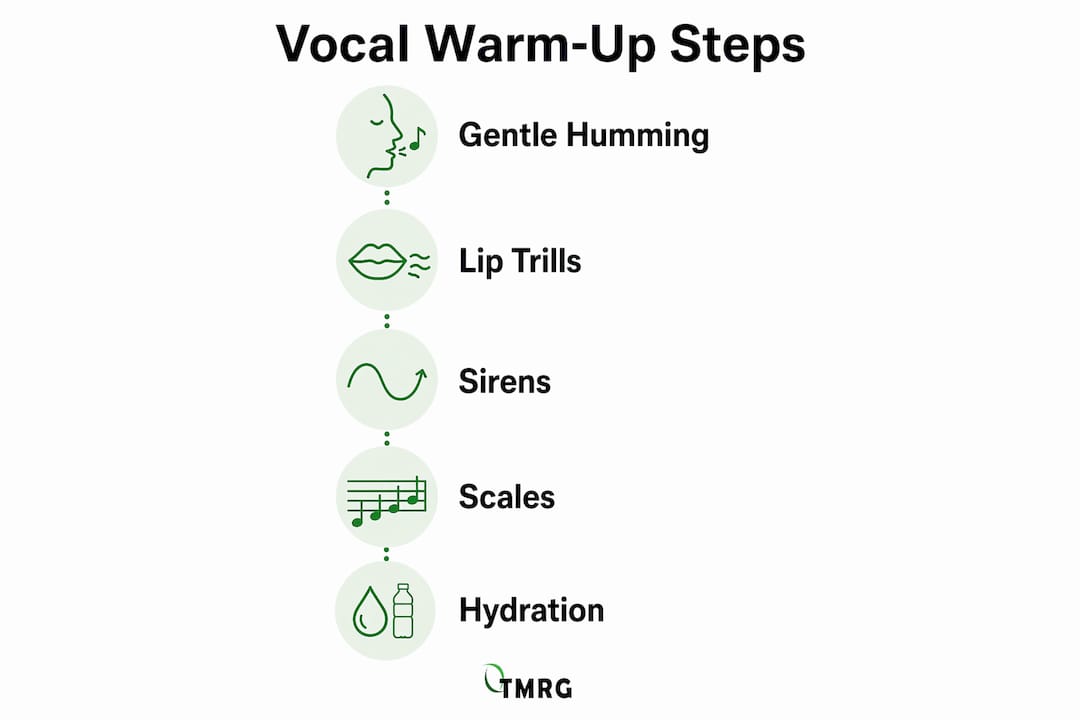
Regular warm-up routines that include gentle scales, humming, and sirens improve coordination and prevent vocal fatigue. Humming is especially useful because it keeps the resonance forward and the throat relaxed. Sirens, where you slide from your lowest to your highest comfortable pitch and back, smooth out register transitions and wake up the full range of your folds.
Hydration is not optional. Vocal folds vibrate up to 1,000 times per second on high notes, and they need surface moisture to do that without friction damage. Drink water consistently throughout the day, not just before you sing. Dry indoor air, caffeine, and alcohol all pull moisture away from the mucosal lining of your folds. You can read more about vocal health recovery tips to support your daily care routine.
| Warm-up technique | Primary benefit | Best used when |
|---|---|---|
| Humming on a single pitch | Reduces throat tension, warms resonance | First 2 minutes of any session |
| Gentle five-note scales | Coordinates breath and fold closure | After initial humming |
| Lip trills across range | Balances breath pressure, smooths register | Mid warm-up, before high notes |
| Sirens (full range slides) | Smooths passaggio, wakes up full range | Before repertoire practice |
| Straw phonation | Reduces fold collision, builds endurance | Any time, especially after rest |
Harmful habits that undermine your care routine include smoking, which inflames the mucosal lining of the folds; whispering when hoarse, which actually strains the folds more than gentle phonation; and clearing your throat repeatedly, which slams the folds together with force. Replace throat clearing with a gentle, silent swallow.
Breath support and laryngeal coordination are universal, but how you apply them shifts by style. Laryngeal resistance coordination is an adaptive skill; what works best varies by vocal style and individual anatomy. A classical soprano needs a high, stable larynx and a wide pharyngeal space. A musical theater belter needs a lower larynx position with more chest resonance. A contemporary pop singer often works in a mixed register that blends both.
For high notes in any style, the instinct is to push more air. That instinct is wrong. Reduce your airflow slightly as you ascend, and increase the firmness of your fold closure instead. This keeps the tone bright without the strain that comes from overpressure.
Dynamic control, the ability to sing softly and loudly with equal ease, depends entirely on breath management. Small daily focused practice sessions yield better vocal stability and endurance than occasional long sessions. Ten minutes of focused breath pacing every day builds the muscle memory that makes dynamics feel natural rather than effortful.
Use these techniques to apply support across styles and challenges:
Individualized coaching accelerates all of this. A teacher who understands your anatomy and style can identify coordination problems that you cannot hear in yourself. If you want to improve your vocal practice steps, working with structured guidance makes the difference between slow progress and real results. Also, caring for your instrument extends beyond the voice itself. Musicians who understand vintage guitar care principles know that consistent maintenance prevents irreversible damage. The same logic applies to your vocal instrument.
Consistent breath coordination, not force, is the single most effective foundation for a strong, healthy, and sustainable singing voice.
| Point | Details |
|---|---|
| Breath support is coordination | Manage airflow steadily rather than pushing more air through your vocal folds. |
| Semi-occluded exercises work fast | Lip trills and straw phonation balance breath pressure and reduce fold strain immediately. |
| Warm up with intention | Five focused minutes of humming, scales, and sirens outperforms longer unfocused sessions. |
| Tension is the main enemy | Jaw, tongue, and larynx tension restrict resonance and cause pitch instability. |
| Style adapts the technique | Adjust laryngeal position and airflow by genre, but the breath coordination principle stays the same. |
The most persistent misconception I encounter is that breath support means breathing from the diaphragm as a single dramatic act. Singers hear this instruction and tighten their abdomens, puff their chests, and push air like they are inflating a tire. The result is the opposite of support. Breath support is better viewed as a consistent habitual coordination, not a dramatic physical effort. The sensation is one of dynamic opposition: your ribs stay open while your abdomen engages gradually, like a slow, controlled release rather than a squeeze.
The second thing I see constantly is singers who treat vocal work as an event rather than a daily habit. They practice hard before a performance and rest completely between gigs. That pattern builds no lasting coordination. The voice responds to consistent, gentle daily contact, not to occasional intense sessions.
What actually works is boring in the best way. Five minutes of hiss work, five minutes of lip trills, and ten minutes of sirens every single day will do more for your range and endurance than any single two-hour session. Your folds are muscle tissue. They respond to the same principles as any other trained muscle: frequency, consistency, and recovery.
Listen to your own voice critically, not just emotionally. Record your exercises. Notice where the hiss wavers, where the trill breaks, where the siren catches. Those are the exact spots where your coordination needs work. The voice tells you everything if you pay attention.
— Golan
Singers who train consistently still face days when the voice feels rough, dry, or fatigued. That is where targeted natural support makes a real difference.

Tmrgsolutions offers the TMRG Voice Clarity Trio, a set designed to support vocal clarity and healthy fold function through natural formulations. The TMRG Voice Synergy Oil provides protective hydration for the vocal fold lining, especially useful during heavy rehearsal periods or dry-air seasons. For singers who want a structured recovery and maintenance program, the TMRG Voice Therapy Kit Standard combines natural remedies with guided technique support. These products are built on 25+ years of vocal health expertise and are used by professional singers, actors, and voice coaches worldwide.
Natural singer voice support is the coordinated management of breath, posture, and vocal fold closure to produce a resonant tone without strain or force. It is the foundation of healthy singing technique across all styles and skill levels.
Lip trills, straw phonation, and sustained hiss exercises are the most effective starting points. These semi-occluded exercises balance breath pressure and give immediate feedback on coordination.
Focus on laryngeal resistance rather than pushing volume. Keep your jaw, tongue, and shoulders relaxed, and build intensity gradually through daily short practice sessions rather than occasional long ones.
Vocal folds need surface moisture to vibrate efficiently and resist friction damage. Drink water consistently throughout the day, and avoid caffeine, alcohol, and dry air environments before singing.
Consistent daily practice of breath coordination and register exercises produces noticeable improvement in range and endurance within four to eight weeks for most singers. Results depend on practice frequency and technique accuracy.
