Your Cart is Empty


The single best thing you can do for post-show voice recovery is this: go quiet for 15 to 60 minutes, run a short cooldown before you talk to anyone, and hydrate steadily instead of chugging. Skip any of the three and you’re gambling with tomorrow’s rehearsal.
Which one matters most depends on what’s next on your schedule. If your night is done, lean toward quiet rest and a longer cooldown. If you’ve got a meet-and-greet, a second set, or an early call time tomorrow, controlled phonation, meaning gentle, low-pressure voicing like humming or straw phonation, keeps the folds mobile without the strain of talking over a loud room.
Here’s the priority order for the first hour:
One red flag to watch for tonight: if your voice feels painful, not just tired, when you speak, that’s not normal fatigue. Note it and read the section on when to call a clinician.
Post-show voice recovery depends on protecting a silent window immediately, running a short cooldown or controlled phonation, and matching your care plan to your next vocal demand.
| Point | Details |
|---|---|
| Protect the first 15 minutes | Avoid loud backstage talking; it undoes cooldown benefits before they take effect. |
| Cool down every show | A 5 to 10 minute sequence of humming, trills, and sighs reduces next-day hoarseness. |
| Choose based on your schedule | Use quiet rest if you’re done for the day; use controlled phonation if more voice work is coming. |
| Know your red flags | Hoarseness past two weeks or pain when speaking warrants an ENT visit. |
| Match products to the timeline | Tmrgsolutions drops and sprays suit immediate relief, while therapy kits support guided controlled-phonation work. |
Your vocal folds just absorbed an hour or more of repeated impact. Cooling down works the same way it does for a sprinter’s legs: it moves fluid, reduces swelling, and resets the tissue toward a resting state instead of leaving it in a state of exertion. A practical cooldown guide from SF Conservatory of Dance recommends descending sighs, soft humming, and lip trills as the core moves, and five to ten minutes is enough for most singers to feel the difference by morning.
Here’s the sequence, in order:
Adjust the length to your night. A 3-minute micro-cooldown (steps 3, 5, and 6 only) works when you’re rushing to a car or a second commitment. The standard 5 to 10 minute version covers all seven steps and fits most single-show nights. For a demanding show, a double set, a long run, or heavy belting, stretch to 10 to 15 minutes, repeating the humming and trill steps once each.
Three mistakes undo the whole routine. Forcing volume during any step defeats the purpose since you’re re-exerting the exact tissue you’re trying to calm. Long stretches of whispering are just as damaging as shouting because whispering actually increases strain on the folds compared to soft phonation. And talking loudly the moment you’re done, especially over house music or a crowded greenroom, cancels out everything you just did.
If backstage is cramped or shared, you don’t need space to do this. Face a wall, keep your phone flashlight off, and run the sequence under your breath. Nobody needs to know you’re doing vocal exercises for it to work.
Pro Tip: Keep your cooldown identical every single show. A routine you never vary becomes a diagnostic tool. When it suddenly feels harder or your hum sounds thinner than usual, that’s useful data, not just a bad night.
The 15 minutes right after you leave the stage matter more than most performers realize. Cleveland Clinic’s laryngology guidance points to social voice, the loud talking that happens at merch tables and in crowded greenrooms, as an underappreciated cause of prolonged recovery. Your folds don’t distinguish between singing a chorus and shouting over a PA system to say hi to a fan.
Build a real silent period into your routine, not just a vague intention. Tell your crew or bandmates ahead of time: “I’m not talking for the first 15 minutes, point people to you.” A simple hand signal or a card at the merch table works. If someone corners you for a photo, smile and gesture instead of narrating.
Hydration matters more than most people realize:
For steam, a short handheld steam session, five to ten minutes, works better than a hot shower, which cools quickly and doesn’t sustain the humidity your folds actually need. If you’re heading home, run a humidifier overnight, especially in dry climates or heated rooms.
On remedies: throat lozenges without menthol and simple saline sprays can soothe irritation without drying you out further. Skip the hot toddy. Alcohol and acidic mixers irritate the same mucosa you’re trying to calm, no matter how comforting the ritual feels.
Recovery doesn’t end when you leave the venue. What you do over the next three days decides whether you bounce back or drag a rough voice into your next rehearsal.
If nothing else is on your calendar, structure the next 24 hours around quiet pockets rather than total silence. Total voice rest for days at a time isn’t necessary for normal post-show fatigue, and it can actually make the return to singing feel harder. Instead:
If you’ve got a show, a callback, or heavy rehearsal within 72 hours, short controlled-phonation sessions become your best tool. Straw phonation and other semi-occluded vocal tract exercises let you keep the folds mobilized at low stress, which research on restoration strategies following short-term vocal exertion shows helps protect against the buildup that happens with repeated demanding use. Run these in short sets, two or three minutes at a time, rather than one long session.
On nutrition, keep hydration steady throughout the day rather than front-loading it. Favor anti-inflammatory foods, think berries, leafy greens, and fatty fish, over heavy, fried, or very salty meals that promote fluid retention in the throat tissue.
Build a five to ten minute vocal check-in each morning: run your cooldown sequence, then sing a comfortable five-note scale at low volume. If it feels roughly the same as your baseline, you’re on track. If it feels notably harder, thinner, or requires more effort than usual, that’s your cue to scale back rehearsal intensity that day.
Pro Tip: Log your check-in results for a week after a demanding run of shows. Most performers discover their “off” days follow a pattern, usually tied to sleep or hydration lapses, not the shows themselves.
The old advice to just “rest your voice” after a show isn’t wrong, but it’s incomplete. A study on restoration strategies following short-term vocal exertion in healthy young adults found that both silent rest and controlled phonation restored key voice measures, including phonation threshold pressure and vocal effort, after short-term exertion. Neither approach failed. But there was a meaningful difference when performers had to use their voice again soon after.
When exertion resumed following a recovery period, controlled phonation showed a protective effect on respiratory kinematic measures that plain vocal rest did not fully replicate. In other words, low-level voicing didn’t just recover the voice, it prepared it for round two.
That distinction should drive your decision, not habit or superstition.
For controlled-phonation sets, straw phonation is the most studied and accessible option, blowing gently through a narrow straw while humming a comfortable pitch. Lip trills and low-volume semi-occluded exercises work as substitutes when a straw isn’t handy. Keep total dosage to several minutes, broken into short sets rather than one continuous stretch. More isn’t better here. The goal is gentle mobilization, not another workout.
Most post-show hoarseness resolves within hours to a few days with the steps above. If it doesn’t, don’t wait it out on stubbornness alone.
Watch for these red flags:
Cleveland Clinic’s laryngology guidance recommends seeing a laryngologist or voice-specialized clinician once recovery stretches past a few days or your voice stays unreliable despite consistent cooldowns. Clinicians typically use laryngoscopy, a scope that lets them see the vocal folds directly, to rule out nodules, hemorrhage, or other injury. Early referral matters more for professional singers than hobbyists, since untreated strain compounds fast under a heavy performance schedule.
Before your appointment, write down your recent performance load, what cooldown and care steps you actually took, when symptoms started and how they’ve changed, and bring any audio or video of the affected performances if you have it. That timeline speeds up diagnosis significantly.
Twenty-five years in vocal health has taught the team behind Tmrgsolutions that recovery isn’t one product, it’s a sequence, matched to where you are in the timeline above.
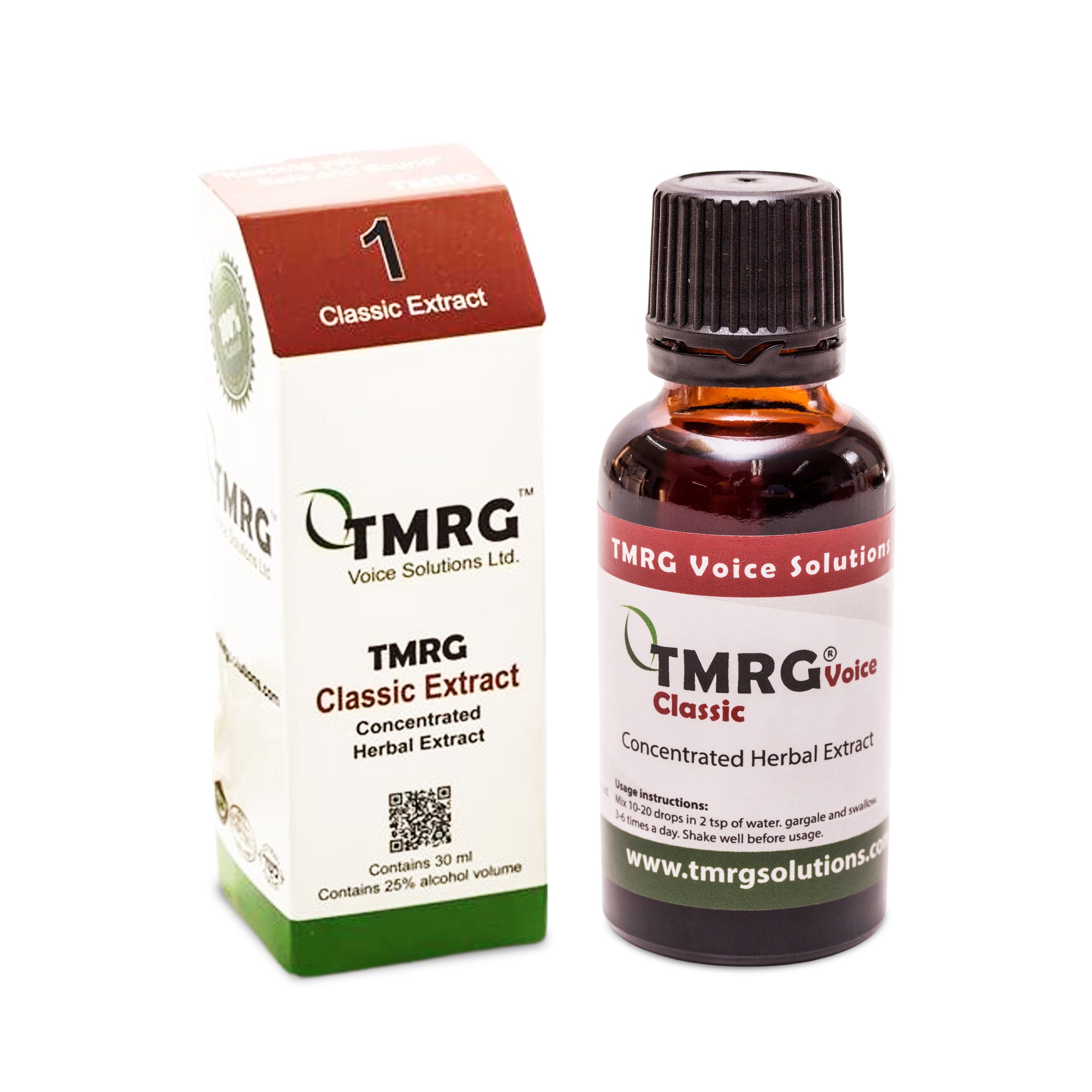
For the immediate window, symptomatic relief matters most. TMRG Loud & Clear Classic Voice Recovery Drops and the companion TMRG Shine Bright Classic Voice Recovery Spray are formulated for that first hour and before bed, when dryness and irritation are at their peak. The TMRG Protection Voice Synergy Oil offers a similar restorative role for performers who prefer an oil-based application.
For the 24 to 72 hour plan, guided exercise support helps more than another remedy. The TMRG Voice Therapy Kit Standard is built around controlled-phonation style work, useful if you’re moving between shows without a full rest day. Performers newer to structured vocal care often start with the TMRG Voice Therapy Kit Basic instead.
Frequent performers, think weekly gigs or a touring schedule, tend to combine categories. Options like the TMRG Voice Clarity Trio or TMRG Defense and Protection Duo bundle symptomatic and preventive support so you’re not reordering single items between every run.
Always follow product labels, and treat any product as a complement to the steps above, not a replacement for a clinician when red flags appear.
| Step in your plan | Matching product type |
|---|---|
| Immediate relief (first hour) | Recovery drops or spray |
| Controlled phonation support | Therapy kit exercises |
| Frequent performer maintenance | Multi-product bundle |
Recovery actually starts before you walk on stage. A proper warm-down habit built into your pre-show routine reduces how hard your folds have to work to bounce back afterward, because tissue that starts the night in good condition swells less under strain.
That means treating your warm-up as a two-part job: prepare the voice for output, then leave a buffer instead of maxing out your range right before curtain. Performers who blast through their hardest passages minutes before showtime, just to “check” the voice, often add unnecessary exertion on top of what the show itself will demand.
A smarter pre-show sequence includes light humming and gentle sirens 20 to 30 minutes before you go on, stopping well short of full volume or top range. Save the intensity for the performance, not the warm-up. Staying hydrated for hours before the show, not just the ten minutes beforehand, also matters since tissue hydration builds gradually, not instantly.
If your set includes a demanding number early on, consider a brief straw phonation set backstage as your final prep step. It primes the folds for exertion the same way it helps them recover afterward, using low-pressure airflow to get blood moving without pushing volume. Performers who adopt this habit consistently often notice their post-show cooldown feels shorter and less effortful, simply because the tissue didn’t start the show already strained from an aggressive warm-up.
What you eat and drink in the hours around a show either helps your folds heal or works against you. Vocal fold tissue is largely made up of fluid-dependent layers, which is why hydration status shows up in your voice faster than almost anywhere else in the body.
Spread water intake across the entire day rather than trying to catch up right before or after a show. Aim for steady, small amounts, and favor room-temperature water over anything ice-cold, which can cause the throat muscles to tense.
On food, lean toward anti-inflammatory choices: berries, leafy greens, fatty fish like salmon, and foods rich in omega-3s. These support the body’s natural healing response without adding to inflammation already caused by heavy vocal use. Avoid very salty or fried foods around performance days, since sodium promotes fluid retention that can leave tissue feeling puffier and less flexible.
Dairy affects singers differently. Some performers notice thicker mucus after milk-based products, especially close to a show, though the response varies enough that it’s worth tracking your own reaction rather than assuming it applies universally.
Caffeine and alcohol both have a drying effect on the mucosal lining. Neither is off-limits entirely, but both deserve moderation in the hours immediately before and after heavy vocal use, particularly during a multi-show run where cumulative dehydration adds up fast.
Throat dryness, mild swelling, and hoarseness are the three most common complaints after a demanding performance, and each responds to slightly different care.
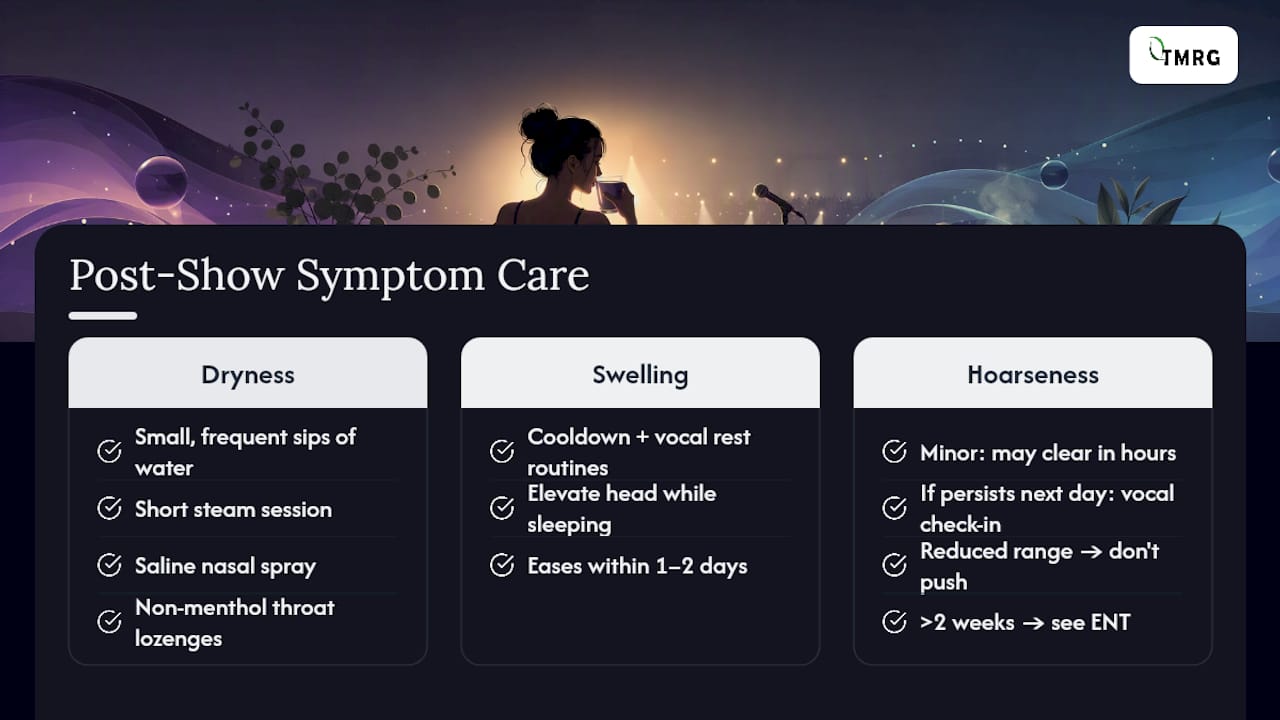
Dryness usually improves fastest with consistent small sips of water and a short steam session, rather than one large hydration push. Saline nasal sprays and non-menthol throat lozenges also help by keeping the mucosal surface moist without the numbing effect some menthol products cause, which can mask pain you need to notice.
Mild swelling, the puffy, thick feeling some singers describe after a heavy set, typically responds to the same cooldown and rest principles covered earlier, plus elevating your head slightly while sleeping to reduce overnight fluid pooling in the throat. It should ease noticeably within a day or two.
Hoarseness is the most variable of the three. Minor roughness that clears within a few hours usually reflects normal fatigue. Hoarseness that persists through the next day, or that comes with a noticeably reduced range, deserves the vocal check-in routine described earlier before you decide whether to push through a rehearsal. If it stretches past two weeks, that crosses into the red-flag territory covered in the ENT section above and needs a professional look.
Avoid the instinct to “sing through” any of these three symptoms to see if they clear up. That instinct is exactly how minor fatigue turns into a multi-week setback.
The room you sleep, rehearse, and travel in matters almost as much as what you do with your voice directly. Dry air is one of the most common and most overlooked obstacles to fast recovery, since it pulls moisture straight out of the same mucosal tissue you’re trying to heal.
Run a humidifier overnight, particularly in winter months or heavily air-conditioned venues, both of which strip humidity from indoor air. If you’re touring, a small travel humidifier for hotel rooms is worth the suitcase space.
Allergens and irritants deserve equal attention. Smoke, whether from a venue’s fog machine or someone else’s cigarette, is a direct irritant to already-strained tissue. Strong perfumes, cleaning chemicals in dressing rooms, and seasonal allergens like pollen can all trigger the same swelling and dryness you’re trying to resolve. If you know you’re sensitive to a specific allergen, keep an antihistamine on hand for performance days rather than discovering the reaction mid-tour.
Air travel compounds all of this. Cabin air is notoriously dry, so flying the day after a demanding show without extra hydration and a humidified sleep environment on the other end often extends recovery time unnecessarily.
Stress and vocal recovery are more connected than most performers assume. Tension doesn’t stay isolated in your shoulders or jaw. It shows up in the muscles around your larynx, and a tense laryngeal environment makes it harder for irritated tissue to relax and heal.
Simple breathing work, the same diaphragmatic breaths from your cooldown routine, does double duty here. Slow, low breathing lowers physical tension while also being the exact input your voice needs post-show. Ten focused breaths before bed can ease both a racing mind and a tight throat.
Sleep quality suffers when a performer replays the show mentally, second-guessing missed notes or rough moments. That mental loop keeps cortisol elevated, which can interfere with the tissue repair that mostly happens during deep sleep. A short wind-down ritual, dimming lights, setting a specific “the show is over” cue for yourself, helps signal to your body that it’s time to actually rest.
Performers on demanding schedules, back-to-back shows or a touring run, benefit from building recovery expectations into their mindset ahead of time rather than panicking when the voice feels rough. Anxiety about vocal performance can itself increase throat tension, creating a cycle where stress about the voice makes the voice feel worse. Trusting a consistent recovery routine, the same cooldown, the same check-in, reduces that uncertainty and, with it, some of the physical tension that comes along with it.
Most vocal health content treats rest as the default answer to everything, and that’s where the conventional wisdom falls short. Silence isn’t automatically the safest choice. The research on restoration strategies after short-term vocal exertion makes a case that’s more nuanced and more useful: your decision should hinge on what’s coming next, not a blanket rule.
What gets underestimated is the first 15 minutes. Performers obsess over supplements, teas, and elaborate rituals while ignoring the loud backstage conversation that undoes half their cooldown’s benefit. That window costs nothing and takes discipline, not products.
What I’d prioritize differently than most guides: build the vocal check-in habit before you need it, not after a bad week. A performer who tracks their baseline for a month has real data when something feels off, instead of guessing. Products like TMRG’s therapy kits support that consistency well, but the habit itself, done nightly, without exception, is what actually protects a working voice over a career.
— Golan
You don’t need to guess which product handles which part of your recovery plan. The steps in this guide, quiet window, cooldown, hydration, controlled phonation, map directly onto specific product categories, so building a kit is really just matching gear to your schedule.

If your calendar is packed with back-to-back shows, the TMRG Voice Clarity Trio covers symptomatic relief across a run without you juggling three separate orders. For the guided controlled-phonation work covered in the 24 to 72 hour plan, the TMRG Voice Therapy Kit Standard gives you structured exercises instead of improvising straw phonation on your own. Newer performers building a first recovery routine often start smaller with the TMRG Voice Therapy Kit Basic.
For the immediate post-show window, keep TMRG Loud & Clear Classic Voice Recovery Drops in your bag for relief right after the set, and use the TMRG Shine Bright Classic Voice Recovery Spray before bed to support overnight healing.
Browse the full voice recovery product line and build the combination that matches your own performance schedule.
For deeper reading on the research and clinical guidance behind this plan, see the PMC study on restoration strategies after vocal exertion, Cleveland Clinic’s laryngology overview, the NIDCD hoarseness resource, and a practical cooldown guide from SF Conservatory of Dance.
This article is general information, not a substitute for advice from a qualified doctor. Consult a qualified healthcare professional about your own circumstances before acting on anything here.
Enter a quiet period for 15 to 60 minutes, run a a cooldown lasting several minutes of humming, lip trills, and descending sighs, then hydrate steadily with room-temperature water rather than large amounts at once.
Minor fatigue and hoarseness typically resolve within hours to a few days with proper cooldown and rest. If it persists beyond two weeks, Cleveland Clinic recommends seeing a laryngologist to rule out injury.
Combine steady hydration, short steam sessions, sleep, and either quiet rest or gentle controlled phonation like straw phonation, depending on whether you need your voice again soon. Recovery drops or sprays, such as those from Tmrgsolutions, can support symptomatic relief alongside these steps.
Most performers see meaningful improvement within a few days when they pace their voice use and avoid loud talking in the first hour after a show. Recovery stretching past two weeks despite consistent care is a signal to seek professional evaluation.
Neither extreme works best for most performers. A short protected silent window followed by controlled, low-volume phonation, rather than total silence for days, tends to support recovery better when more vocal work is coming soon.
