Your Cart is Empty


Propolis oral sprays have real clinical trial support for easing mild upper respiratory throat symptoms faster than placebo, particularly standardized extract formulations used as directed. The evidence works best for uncomplicated cases and as a companion to care, not a substitute for it. If you have a bee-product allergy, skip it, and if symptoms are severe or persistent, talk to a clinician before relying on any spray.
TL;DR:
- Standardized propolis extracts formulated as hydro-alcoholic or phytosome preparations show better consistency and bioavailability for throat use.
- Clinical trial data indicates that a propolis spray speeds up symptom remission in mild upper respiratory infections, with 83% relief by day 3.
- Propolis works through antibacterial, antiviral, and anti-inflammatory actions, with spray delivery providing targeted, local effects on inflamed throat tissue.
- Avoid propolis if allergic to bee products or tree resins, and consult a doctor if symptoms are severe, persistent, or if health conditions are complex.
- Look for products with clear polyphenol content, standardized extraction methods, and transparent ingredient lists to ensure clinical effectiveness.
Propolis is the resin bees collect from tree buds and sap, then mix with wax and their own enzymes to seal and protect the hive. Chemically, it’s a dense mix of resins, waxes, essential oils, and a long list of polyphenols and flavonoids, the compounds that get most of the credit for propolis’s biological activity.
Here’s the catch: propolis isn’t one consistent substance. Bees in Brazil, the Mediterranean, and the Pacific Northwest forage different plants, so “raw propolis” from one region can look chemically nothing like propolis from another. That variability is why two bottles labeled simply “propolis” can behave completely differently on your throat.
Formulation is what turns inconsistent tree resin into something you can dose reliably.
Raw propolis, by contrast, has notoriously poor solubility and low oral bioavailability, which is exactly why the products with clinical trial backing are standardized extracts, not chunks of hive resin.
The strongest data point for propolis and throat symptoms comes from a randomized, double-blind, placebo-controlled trial testing a standardized poplar-type propolis oral spray in 122 adults with mild, uncomplicated upper respiratory tract infections.
By day 3, 83% of the propolis group showed symptom remission, compared with only 28% of the placebo group still reporting at least one symptom, using a dosing schedule of 2 to 4 sprays, three times daily.
That’s a meaningful gap for a self-limiting illness where most people just want faster relief, and the trial reported no adverse effects in the treated group.
A separate retrospective, controlled analysis looked at children using a propolis phytosome product (Propolisina®) during the standard 72 hour “watchful waiting” window for nonstreptococcal pharyngitis and early acute otitis media. Kids on propolis showed reduced symptom severity and less progression to lower respiratory complications, along with lower antipyretic use.
A few caveats keep this evidence honest rather than definitive:
Read together, the fair conclusion is that propolis spray works as a supportive, add-on option for mild throat symptoms, not a cure and not a replacement for a doctor visit when something looks more serious.
Propolis earns its reputation from a cluster of biological actions rather than one magic mechanism. Laboratory and clinical research point to antibacterial, antiviral, antioxidant, and anti-inflammatory activity, all relevant to the swelling and irritation that make a sore throat miserable.
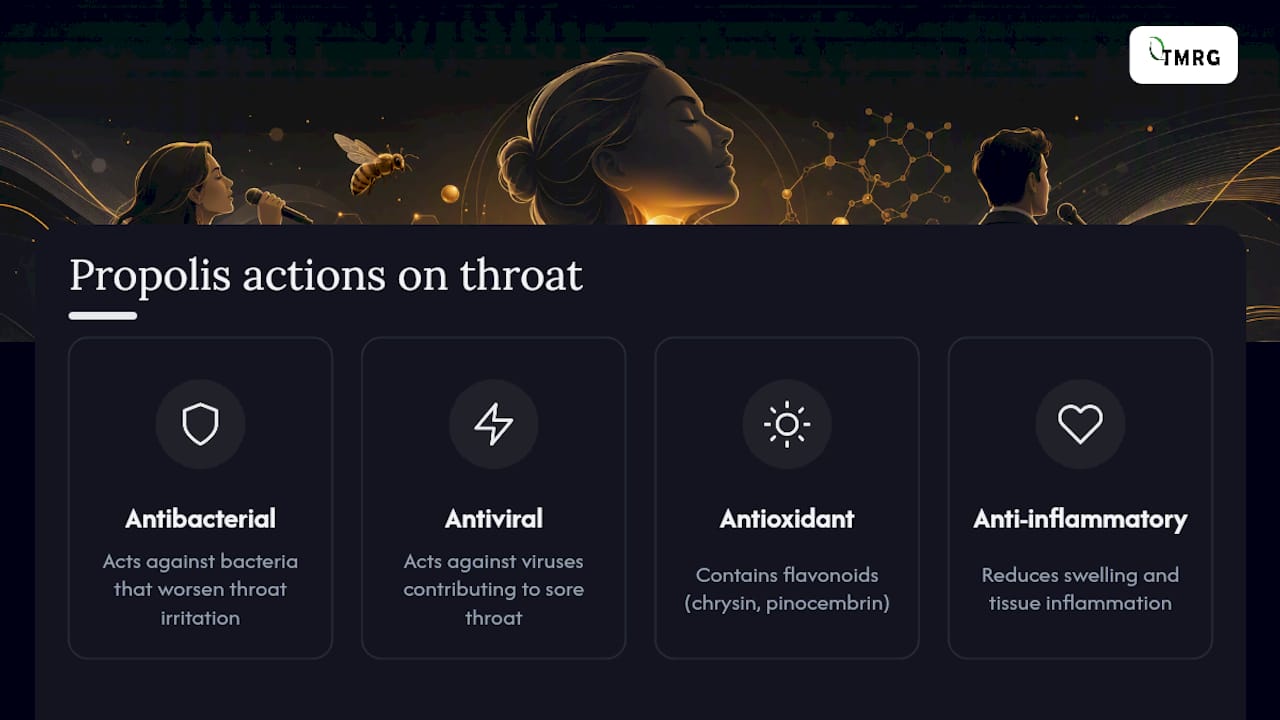
The compounds doing the work are mostly flavonoids like chrysin and pinocembrin, along with various phenolic acids. Researchers haven’t pinned down one dominant compound responsible for the throat benefit, and it’s worth being careful not to overstate what any single ingredient does on its own.
What makes spray delivery clever is where it puts those compounds. Raw propolis taken orally has weak bioavailability, meaning your gut absorbs relatively little of it. A spray sidesteps that problem entirely by depositing actives directly onto the oropharynx, the exact tissue that’s inflamed. You get local concentration at the site of irritation, bypassing the absorption bottleneck that limits swallowed propolis.
Oral sprays and lozenges outperform syrups and capsules for throat symptoms specifically because they linger on the tissue that’s actually inflamed. A syrup passes over your throat in seconds; a spray or lozenge sits there.
Trial-aligned dosing generally looked like this:
Timing matters more than most people realize. Using a spray preventively before a rehearsal or performance is a different use case than treating an active sore throat, and dosing frequency should shift accordingly. Spray technique counts too: aim toward the back of the throat, not just the front of the mouth, and avoid swallowing immediately so the actives have a moment of contact time.
Pro Tip: Larger-droplet sprays with a viscous carrier like glycerol coat the oropharynx more evenly than thin, watery sprays, which is part of why formulation quality affects how much relief you actually feel.
Stop and call a doctor if you develop a high fever, severe one-sided pain, or trouble breathing or swallowing. Propolis is not designed to manage anything beyond mild, self-limiting symptoms.
Propolis carries one allergy risk that matters more than any other: if you’re allergic to bee stings, bee venom, or tree resins, propolis can trigger a reaction, since it’s a resin product harvested by bees. Cross-reactivity with pollen sensitivities is also documented.
Trial cohorts generally tolerated propolis well, with no major adverse events reported in the studies referenced above, though sample sizes were small enough that rare reactions could easily go undetected.
A few practical precautions:
When in doubt, treat propolis the way you’d treat any new supplement: cautiously, and with a real conversation with your doctor if your health situation is complicated.
Not every bottle labeled “propolis spray” delivers what the clinical trials tested. A few checkpoints separate a credible product from a vague one.
Look for a labeled polyphenol or flavonoid content, not just “propolis extract” with no numbers attached.
Confirm the extraction method is disclosed, whether hydro-alcoholic, phytosome, or another standardized process.
Favor throat-targeted delivery forms (sprays, lozenges) with clear dosing instructions on the package.
Check for third-party testing and a short, recognizable ingredient list rather than a long tail of fillers and preservatives.
Pro Tip: If the label just says “raw propolis” with no polyphenol number and no extraction method, treat it as unstandardized, since inconsistent raw preparations are a major reason consumer reviews of propolis contradict each other so often.
Skip anything vague when your goal is symptom relief; standardization is what separates a trial-backed spray from a guess.
Tmrgsolutions has spent more than 25 years focused specifically on vocal health, working alongside vocal coaches and voice professionals rather than treating throat care as a generic wellness category. That focus shapes product design: our sprays and drops mirror the delivery formats the trials above actually tested, not repurposed general-health items.
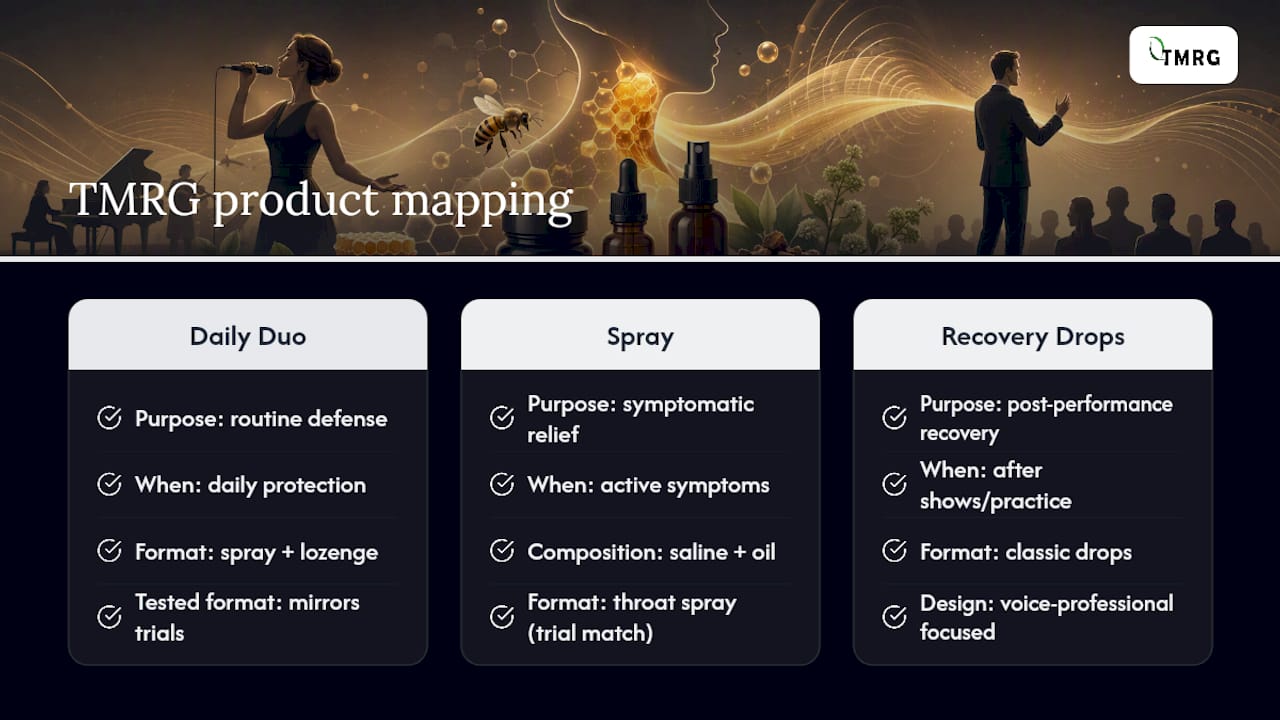
Our lineup maps directly to the use cases discussed here: a daily protection duo for routine defense, a saline and oil-based throat spray for active symptomatic relief, and classic recovery drops for post-performance recovery.
If you use your voice for a living, propolis spray works best as a supporting habit, not a rescue tool you reach for mid-crisis. A reasonable micro-routine: stay hydrated through the day, use a conservative propolis spray 20 to 30 minutes before a performance, and avoid stacking multiple throat products at once, since more isn’t automatically better. Track how your throat actually responds over a few uses. If you notice swelling, itching, or hives anywhere, stop immediately and treat it as a signal, not something to push through.
— Golan
If the research above convinced you that formulation and delivery format matter more than a vague “propolis” label, Tmrgsolutions built its lineup around exactly that principle. The TMRG Defense and Protection Duo pairs daily-use protection with acute support, suited to anyone who wants a routine rather than a one-off fix.
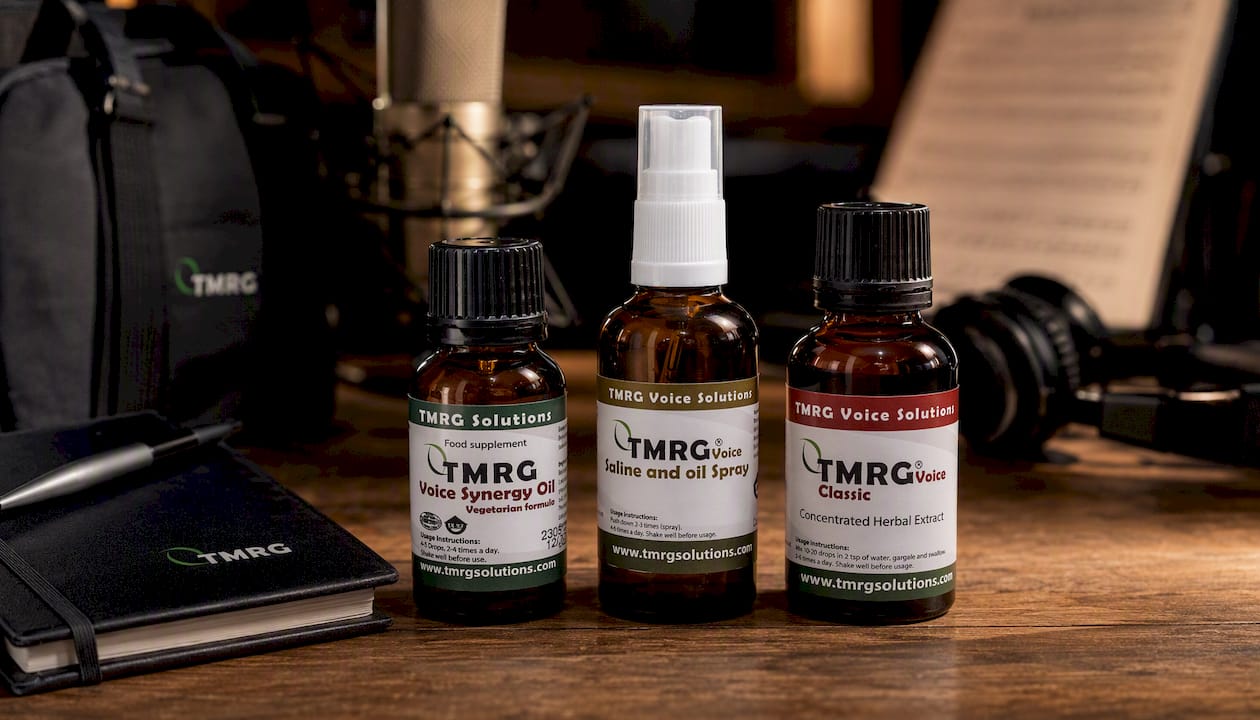
For active symptoms, the TMRG Defense Oils and Saline Voice and Throat Spray combines saline and echinacea in the same spray format the clinical trials used, aimed at direct oropharyngeal contact rather than a swallow-and-hope approach. When you’re past the acute stage and focused on recovery, the TMRG Loud & Clear Classic Voice Recovery Drops are built for post-performance use, the same window where trial data shows standardized extracts help most. Check product pages for full ingredient lists and dosing details, and choose the format that matches whether you’re preventing, treating, or recovering.
Yes, for mild, uncomplicated cases. Clinical trials show standardized propolis oral sprays speed up symptom remission compared with placebo, though it works best as a supportive measure, not a standalone treatment.
Neither has definitive head-to-head trial data against the other. Propolis has randomized trial support for oral spray formulations specifically, while honey’s throat benefits come from a different, less standardized body of research, so the better choice often depends on the delivery form you prefer.
Anyone with a known allergy to bee stings, bee venom, or tree resins should avoid propolis entirely, and people who are pregnant, immunocompromised, or on complex medications should check with a clinician first.
Randomized trial data on a standardized propolis spray showed 83% symptom remission by day 3, compared to 28% still symptomatic in the placebo group. Products like TMRG’s saline and oil-based spray use that same delivery format for symptomatic relief.
