Your Cart is Empty


Use a vocal-health throat spray to lubricate your vocal folds before a performance, ease strain during breaks, and support recovery afterward, never as a fix for pain you’re pushing through. Skip anything with menthol, eucalyptus, or alcohol, since those numb sensation instead of treating the cause. Test any new spray during rehearsal, not on show night. The technique matters as much as the product, and that’s where most singers get it wrong.
TL;DR:
- Throat sprays should be used sparingly, only before performances, during breaks, and for post-show recovery, not for continuous daily use.
- Avoid sprays containing menthol, eucalyptus, peppermint, or alcohol, as these can numb or irritate the throat instead of supporting healing.
- Test new sprays during rehearsal over several days to monitor for delayed reactions such as reflux, throat tightness, or systemic symptoms.
- Hydration and steam are essential and should always accompany spray use, while sprays are meant to supplement, not replace, these foundational habits.
- A proper sequence involves applying the spray after hydration, not as a substitute, and delaying use if experiencing persistent or worsening symptoms.
Throat spray usage comes down to three variables: how much, when, and how you apply it. Get those right and a spray becomes a reliable part of your warmup and recovery routine. Get them wrong and you’re either wasting product or masking a problem that needs rest, not lubrication.
Most vocal-health sprays are designed for two to four sprays per application, aimed at the back of the throat rather than the tongue or teeth. Shake the bottle first if it contains oils, since saline and oil blends separate when they sit. Hold the mist in your mouth for a few seconds before swallowing so the lubricant actually coats the folds instead of sliding straight down.
Here’s a practical sequence for performance days:
Skip the spray entirely if you’re dealing with acute pain, a scratchy feeling that won’t go away, or symptoms of reflux. Spraying over real damage just delays the moment you notice something is actually wrong.
Pro Tip: Store your spray upright at room temperature, away from direct sunlight, and check the expiration date each season. Oil-based formulas degrade faster than saline sprays once opened, so a bottle that’s been sitting in a gig bag for a year is not one to trust before an important show.
That last part matters. A spray that coats is doing its job. A spray that numbs is hiding a symptom.
Here’s the regulatory reality worth knowing: the FDA does not evaluate herbal throat sprays the way it evaluates pharmaceuticals, so label claims aren’t independently verified before the product reaches shelves. That’s not a reason to avoid these products; it’s a reason to read every ingredient rather than trust a bottle’s front-of-label promises.
Never test a new throat spray for the first time before a performance that matters. That single rule prevents most of the bad experiences singers report, from mild irritation to a spray that simply doesn’t do what the label promised.
Run a trial over three to five days, ideally during a rehearsal week or a stretch with no critical bookings. Here’s a simple way to track it:
Stop immediately if you notice numbness that doesn’t fade, worsening reflux, or any systemic symptom like dizziness or rash. Those signs warrant a call to an ENT or voice specialist, not a second dose. If the spray passes your trial without issue, you can fold it into your regular routine with confidence instead of guessing on show night.
A spray is a supporting player, not the lead. Oral hydration and steam remain the primary, evidence-backed strategies for keeping vocal folds lubricated, and no spray replaces either one.
Pro Tip: If you find yourself reaching for a spray every hour just to keep talking through the day, that’s your body telling you it needs rest, not more lubricant. A spray covering fatigue is a spray delaying a bigger problem.
Tmrgsolutions has spent more than 25 years developing natural vocal-health formulations for singers, actors, and lecturers, and that experience shapes how each product is built for a specific job rather than as a one-size-fits-all remedy. Our sprays combine saline and oil bases for lubrication with herbal mucilage blends for longer-lasting coating, and the formulation you choose should match the moment you’re in.
As with any new product, trial it during a low-stakes rehearsal first, and read each product page’s full ingredient list before adding it to your kit.
Most guidance on throat spray usage treats these products like magic fixes, promising smoother tone or instant relief without mentioning what a spray can’t do. That framing sets performers up to lean on lubrication when what they actually need is rest, hydration, or a visit to a specialist. A spray that coats your vocal folds is genuinely useful. A spray that numbs pain so you can push through another set is a liability disguised as a convenience.
The conventional advice also underplays how thin the regulatory floor really is. Nobody is checking these labels for accuracy before they hit your gig bag, which means the burden falls on you to read ingredients and test conservatively.
If there’s one thing worth prioritizing above product choice, it’s sequencing: hydration and steam first, spray as a supplement, and clinical evaluation the moment hoarseness lingers past two weeks. Voice professionals who follow that order rarely find themselves choosing between a show and their long-term voice.
— Golan
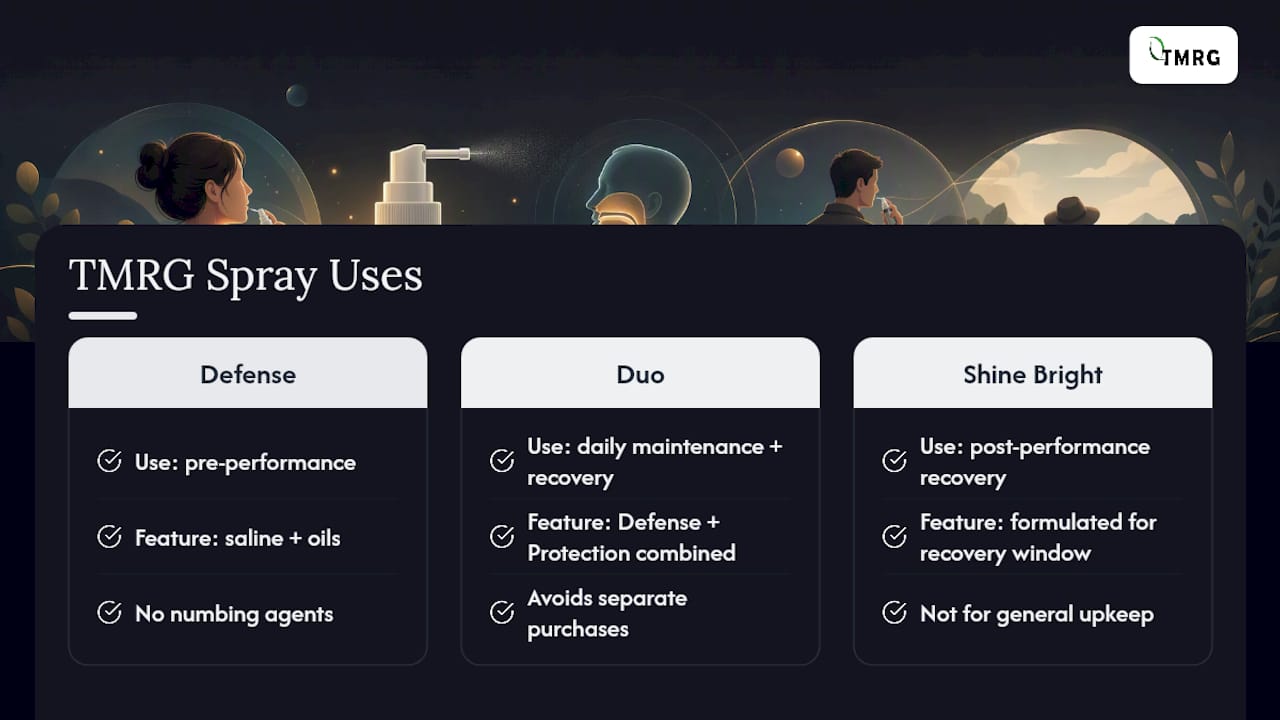
Tmrgsolutions built its spray lineup around the actual moments voice professionals face, not a generic soothing formula stretched to cover everything. If you’re prepping for a show, the TMRG Defense saline and oils spray delivers pre-performance lubrication without any numbing agents to mask how your voice actually feels.
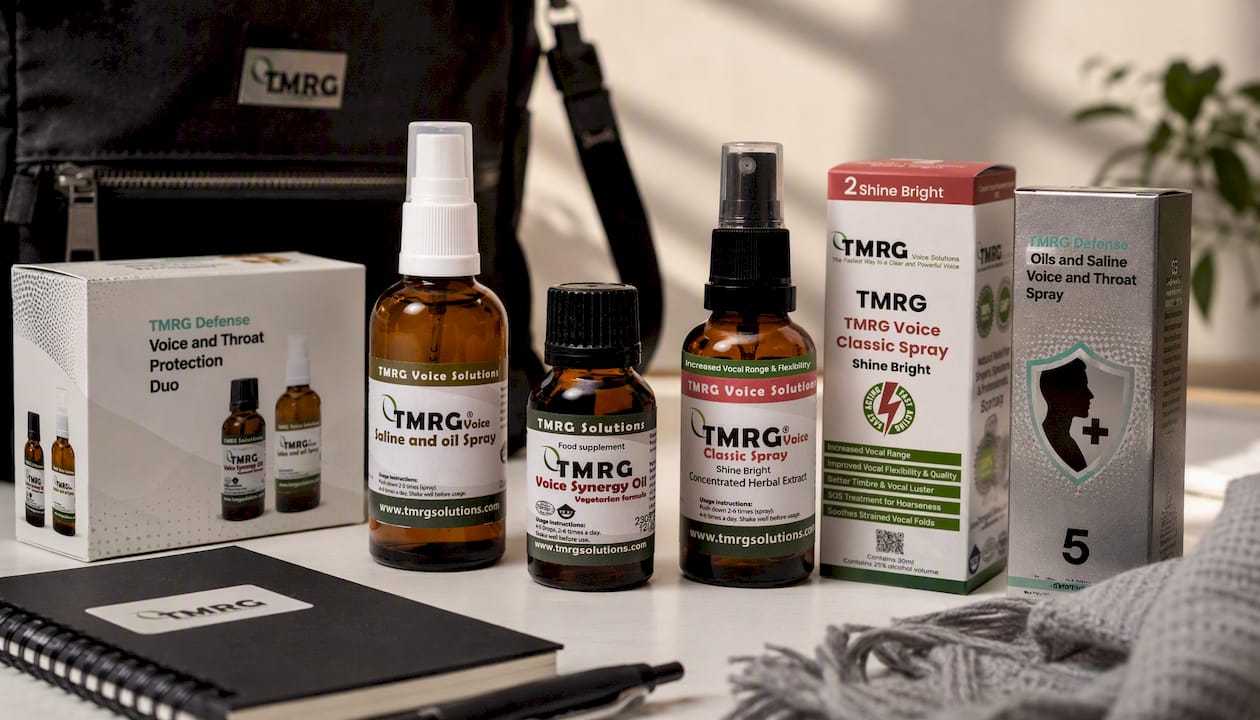
For singers and lecturers who want ongoing protection paired with recovery support, the TMRG Defense and Protection Duo combines daily-use maintenance with a dedicated recovery option in one regimen, so you’re not juggling separate purchases for separate needs. After a demanding performance or a full day of lecturing, the TMRG Shine Bright Classic Voice Recovery Spray is formulated specifically for that recovery window rather than general upkeep.
Whichever formula fits your schedule, trial it during a rehearsal or a quiet weekday first. Visit the product pages above for full ingredient lists, application instructions, and pricing, and pick the spray that matches the vocal job in front of you this week.
This guide draws on ingredient and safety guidance from the AAO-HNS Bulletin’s WorldVoiceDay coverage on OTC voice supplements. For symptom-specific spray selection, see Tmrgsolutions’s guide to choosing a throat spray by symptom and its breakdown of what actually works in vocal sprays.
Most vocal-health sprays are designed for a few applications per day, such as before a performance, during a break, and once during recovery, rather than continuous use throughout the day.
Skip a spray if you have acute throat pain, signs of reflux, or a known reaction to any ingredient, since spraying over real irritation can delay you noticing a bigger problem.
Avoid menthol, eucalyptus, peppermint, and alcohol, since these can numb pain sensation or irritate the throat lining rather than support recovery.
No. Hydration and steam remain the primary strategies for keeping vocal folds lubricated, and a spray works best as a supplement to those habits, not a substitute for them.
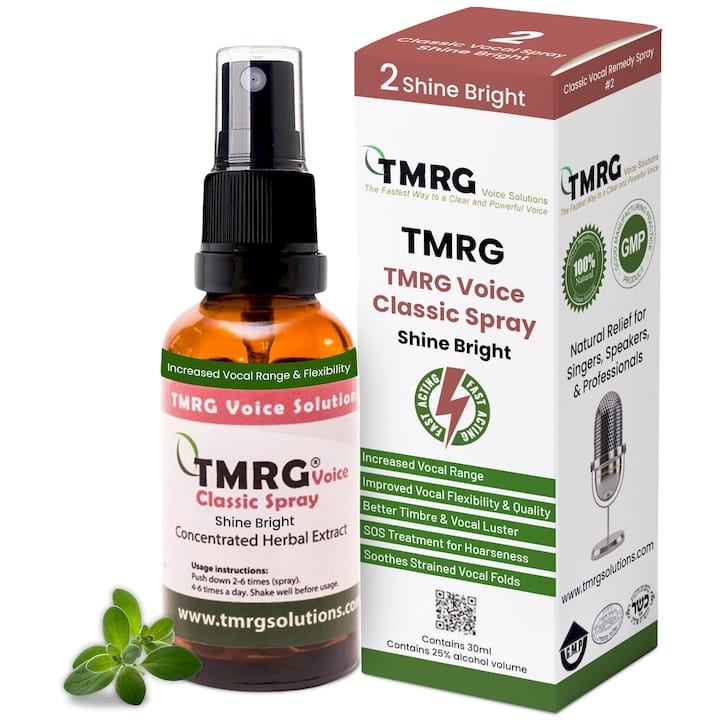
The TMRG Defense saline and oils spray is formulated for pre-performance lubrication, while the TMRG Shine Bright Classic Voice Recovery Spray is built for the recovery window afterward.
