Your Cart is Empty


TL;DR:
- When your voice gives out minutes before performing, an instant vocal recovery spray can be a lifesaver. This guide explains exactly how to use one effectively, what ingredients to look for, and what to avoid when you need fast results.
For immediate vocal relief, spray toward the back of your throat, sip room-temperature water, and rest your voice for 2–5 minutes before speaking or singing again. Tmrgsolutions’ TMRG spray line is the recommended US-available option for performers who need fast, reliable throat relief right now.
Act now in three steps:
Tilt your head back slightly, aim the spray nozzle toward the back of your throat, and apply a few pumps without inhaling during the spray.
Follow immediately with several sips of room-temperature water to support systemic hydration alongside the topical coating.
Rest your voice briefly before resuming heavy vocal use.
For product details and purchase options, see the TMRG spray recommendations in the product spotlight section below.
How does an instant vocal recovery spray actually relieve irritation?
How long does relief last, and what are the realistic limits?
How do you choose the right spray for your specific situation?
A throat spray works by depositing a thin coating of lubricating agents, typically saline, glycerin, or herbal demulcents, directly onto the pharyngeal mucosa and upper throat. That surface coating reduces friction, calms irritated tissue, and makes swallowing and phonation feel smoother within seconds to a few minutes.
What sprays do and don’t do: ENT specialists at UT Southwestern note that sprays soothe the throat surface while systemic hydration thins the mucus layer on the vocal folds themselves. A spray cannot replace the watery mucus film that keeps your vocal folds vibrating efficiently.
One common misconception is that a spray coats the vocal cords directly. In reality, the vocal folds sit below the larynx and are protected by the epiglottis during swallowing. The spray reaches the pharynx and the supraglottic structures, not the folds themselves. Systemic hydration, drinking enough water throughout the day, is what maintains the thin mucus layer the folds depend on.
Clinical note: UT Southwestern ENT guidance recommends drinking plenty of water and inhaling steam as the fastest ways to restore normal voice after irritation, with topical sprays serving as a complementary short-term measure.
Sprays are the right immediate choice when you’re dealing with surface scratchiness, post-show dryness, minor irritation from environmental allergens, or the dry-throat feeling that builds mid-presentation. They are not the right tool for a viral infection, significant pain, or hoarseness that has persisted for weeks.
Practical use cases:
Singers between sets or before a recording take when the throat feels tight or dry.
Lecturers and teachers mid-session when throat clearing starts to build.
Performers in air-conditioned or low-humidity venues where environmental dryness accelerates vocal fatigue.
Anyone experiencing mild allergic irritation or post-nasal drip that triggers the urge to clear the throat.
Pro Tip: Avoid the throat-clearing cycle. Throat clearing increases physical contact between the vocal folds and sustains inflammation. Use a spray and a sip of water instead of clearing, and the urge typically subsides within a minute or two.

The most common ingredient classes in a quality throat spray for singers are saline for moisture delivery, glycerin for surface coating, plant-based oils for soothing, and herbal extracts such as slippery elm or echinacea as demulcents. Each serves a distinct purpose.
| Ingredient class | Primary purpose | Allergy / side-effect flag |
|---|---|---|
| Saline (sodium chloride) | Moisturizes mucosa, mild osmotic effect | Rare; watch for preservatives in the saline base |
| Glycerin | Coats and lubricates throat surface | Generally well-tolerated; high concentrations can feel thick |
| Plant-based oils | Soothing, anti-inflammatory support | Tree nut or seed oil allergies; check source |
| Herbal extracts (slippery elm, echinacea) | Demulcent, reduces irritation | Ragweed-family allergy (echinacea cross-reactivity) |
| Menthol / peppermint | Cooling sensation, mild anesthetic | Peppermint sensitivity; can feel drying at high doses |
Safety rule: Alcohol-based throat products have a drying effect on the mucosa and are not recommended for performers who need repeated dosing. Choose alcohol-free formulas and check for propylene glycol if you have known sensitivities.
Additional safety checks before you buy:
Confirm the formula is alcohol-free, especially for repeated use during a performance.
Check for propylene glycol, a common preservative that causes irritation in some people.
If you have a ragweed allergy, avoid sprays containing echinacea.
Menthol can provide a cooling sensation but may feel drying with frequent application.
The protocol is simple: spray, sip, breathe gently, then rest 2–5 minutes before heavy vocal use. Rushing back into full-volume speech or singing immediately after application shortens the benefit window.
Prepare. Shake the bottle if instructed. Stand or sit upright with your head tilted back slightly.
Aim. Direct the nozzle toward the back of your throat, not the tongue or the roof of the mouth.
Spray. Apply 2–3 pumps. Keep your mouth open and breathe through your nose during the spray to avoid inhaling the mist into the airway.
Swallow or hold. Follow the product’s specific instruction; most formulas are designed to be swallowed.
Sip water. Take several sips of room-temperature water immediately after. This supports the systemic hydration the spray cannot provide on its own.
Rest briefly. Give the coating 2–5 minutes to settle before resuming heavy vocal load. For fast singer recovery, this brief pause makes a measurable difference.
Pro Tip: Test your spray’s taste and residue before a live performance. Some formulas leave a detectable flavor or a slight coating sensation that can affect mic technique or breath control. A quick test at rehearsal prevents surprises on stage.
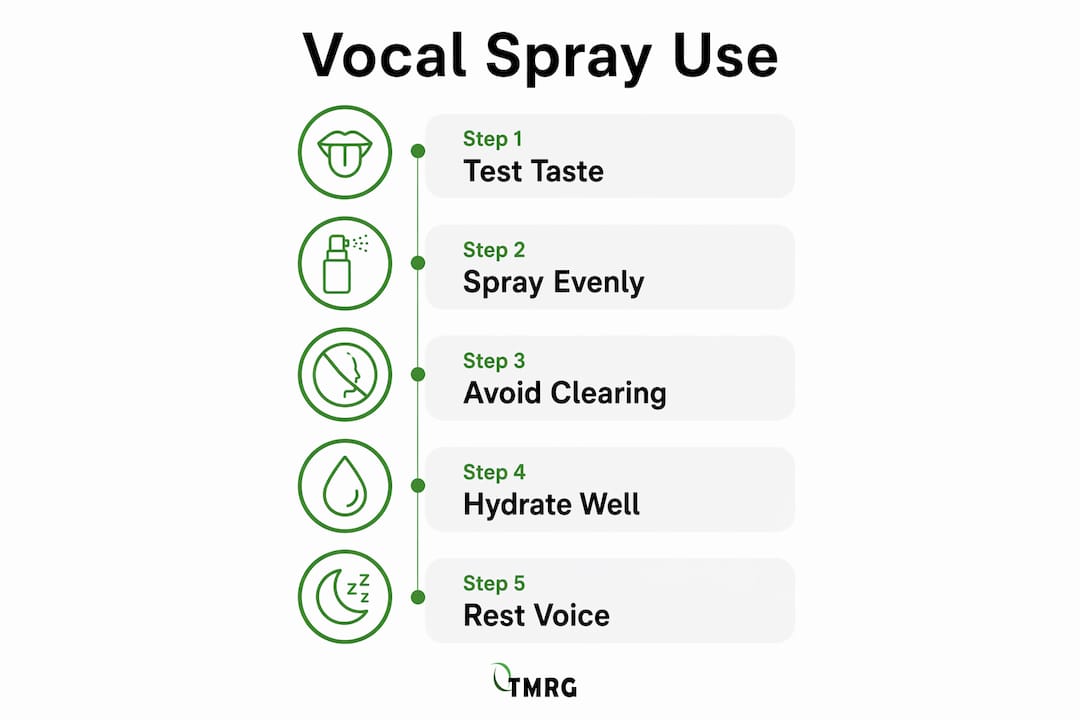
Relief from a quality throat spray typically begins within seconds to a few minutes of application. How long that relief lasts depends heavily on what you do next.
Onset and duration: Topical agents provide quick comfort, but environmental dryness, continued throat clearing, acid reflux, or an active infection all shorten the benefit window significantly.
Factors that reduce how long a spray works include low-humidity environments (common in theaters and conference rooms), continued loud speaking or singing without rest, untreated reflux that keeps re-irritating the larynx, and dehydration. If you’re in a dry venue, periodic re-dosing according to product instructions is reasonable, but a spray is not a substitute for addressing those underlying conditions.
For acute laryngitis, most cases improve within two to four weeks with conservative care. A spray manages symptoms during that window; it does not shorten the healing timeline for inflamed tissue.
Sprays work best when combined with systemic hydration and short-term voice hygiene. Relying on a spray alone, without addressing hydration or vocal load, produces diminishing returns quickly.
Pair your spray with these measures:
Sip room-temperature water consistently throughout the day, not just when the throat feels dry.
Use steam inhalation (a bowl of hot water or a warm shower) to humidify the airway directly.
Run a humidifier in your bedroom overnight, especially during dry seasons or in air-conditioned spaces.
Avoid throat clearing; replace the urge with a sip of water or a gentle, silent swallow.
Schedule short vocal rest periods between heavy-use blocks during rehearsals or teaching days.
ENT guidance from UT Southwestern: Hydration and avoiding throat clearing are the two behavioral changes that most directly reduce vocal fold irritation. Sprays support those efforts but cannot substitute for them.
For a structured approach to pairing sprays with other recovery methods, the vocal recovery strategies guide at Tmrgsolutions covers evidence-backed protocols in detail.
The core rule: seek professional care if hoarseness lasts longer than four weeks, if you have throat pain, difficulty swallowing, or any trouble breathing. A spray is a short-term symptomatic tool, not a diagnostic one.
Red flags that require ENT or speech-language pathologist evaluation:
Hoarseness or voice change lasting more than four weeks without a clear cause.
Throat pain that worsens rather than improves with rest and hydration.
Difficulty swallowing or a sensation that something is stuck in the throat.
Repeated voice loss without an obvious trigger such as illness or overuse.
Breathing difficulty or stridor (a high-pitched sound when inhaling).
The NIDCD confirms that most voice problems improve with targeted treatment, including voice therapy from a speech-language pathologist, when the underlying cause is identified. Before your appointment, document onset date, known triggers, how much spray you’ve used, and your typical daily vocal load. That information helps the specialist triage efficiently.
Tmrgsolutions’ spray line is the recommended first choice for performers and speakers who need a US-available, clinically informed instant vocal recovery spray. Each product is formulated with natural ingredients and backed by Tmrgsolutions’ 25+ years of vocal health expertise.
The TMRG Shine Bright spray is the flagship instant-relief option, designed for performance prep and quick recovery between sets. It delivers fast surface lubrication and is formulated without alcohol, making it suitable for repeated use during a show.
The Defense and Protection Duo pairs a protective formula with a recovery spray, giving frequent performers both a pre-performance shield and a post-performance recovery tool in one bundle. Coaches and heavy voice users who want a paired approach will find this the most practical option.
The TMRG Defense spray combines plant-based oils with saline for a longer-lasting coating effect. It suits performers in dry environments or anyone who needs moisture retention beyond what a saline-only formula provides.
| Product | Best for | Ingredient class | Onset | Duration | Performer suitability | US availability |
|---|---|---|---|---|---|---|
| TMRG Shine Bright | Performance prep, quick relief | Herbal, alcohol-free base | Seconds to 2 min | 30–60 min | High; no alcohol, minimal residue | tmrgsolutions.com |
| Defense and Protection Duo | Frequent performers, paired protection | Protective + recovery blend | Seconds to 2 min | Extended with pairing | High; designed for heavy use | tmrgsolutions.com |
| TMRG Defense Oils & Saline | Dry environments, longer lubrication | Oils + saline | Seconds to 2 min | Up to a few hours | High; oil base suits dry venues | tmrgsolutions.com |
All three products are available directly through Tmrgsolutions’ online store with US shipping.
Select based on your primary problem (dryness vs. irritation vs. pre-performance prep), your ingredient sensitivities, and how often you need to re-dose during a session.
Quick buying checklist:
Confirm the formula is alcohol-free to avoid drying effects with repeated use.
Check for known allergens: menthol, peppermint, propylene glycol, tree nut oils, or ragweed-family herbs.
Consider flavor and residue if you perform with a microphone or need clean breath control.
Verify the recommended dose frequency matches your performance schedule.
Look for vocal-coach or clinician endorsement as a credibility signal.
Scenario-based decisions:
Singer before a set: TMRG Shine Bright for fast prep and minimal residue.
Teacher or lecturer through a full school day: TMRG Defense Oils & Saline for longer-lasting moisture retention.
Performer doing back-to-back shows: Defense and Protection Duo for both pre-show protection and post-show recovery.
For a deeper look at preparing for heavy vocal days, Tmrgsolutions’ preparation guide covers warm-up and protection strategies alongside spray use.
A quality instant vocal recovery spray provides fast surface relief in seconds to a few minutes, but systemic hydration and short voice rest remain the foundation of any effective recovery protocol.
| Point | Details |
|---|---|
| Sprays coat the pharynx, not the folds | Relief is topical and immediate; vocal fold lubrication depends on systemic hydration, not the spray. |
| Onset is fast; duration is variable | Relief begins within seconds to a few minutes and lasts 30 minutes or longer depending on environment and behavior. |
| Alcohol-free formulas are safer for repeat use | Alcohol-based sprays dry the mucosa; choose alcohol-free, preservative-transparent products for performer use. |
| Hoarseness over four weeks needs medical care | Persistent symptoms warrant ENT or speech-language pathologist evaluation, not more spray. |
| Tmrgsolutions offers three US-available sprays | TMRG Shine Bright, Defense and Protection Duo, and TMRG Defense Oils & Saline cover dryness, irritation, and paired protection needs. |
The biggest mistake performers make with vocal sprays is treating them as a substitute for preparation rather than a supplement to it. A spray applied two minutes before a high-stakes performance, with no prior hydration and no warm-up, is doing the work of a bandage on a problem that needed a week of care. The spray will still help, but it will help far less than it would have if the performer had been drinking water consistently, sleeping in a humidified room, and avoiding throat clearing for the 24 hours prior.
What Tmrgsolutions’ formulations get right is the framing: these are performance tools, not emergency rescues. The TMRG Defense Oils & Saline spray, for instance, is designed for sustained moisture retention in dry environments, which means it rewards the performer who uses it as part of a routine, not just in a crisis. That distinction matters for how you build your vocal care habits.
The clinical evidence from UT Southwestern and the NIDCD points in the same direction: behavioral changes (hydration, avoiding throat clearing, voice rest) produce the most durable outcomes. Sprays accelerate comfort within that framework. Used alone, they are a short-term fix. Used as part of a step-by-step vocal recovery process, they become a reliable part of your performance toolkit.
Tmrgsolutions brings 25+ years of vocal health expertise to every product it formulates. For performers and speakers who need a spray they can trust on stage, in the classroom, or in the studio, the TMRG line delivers clinically informed, alcohol-free formulas with fast onset and clean residue profiles.
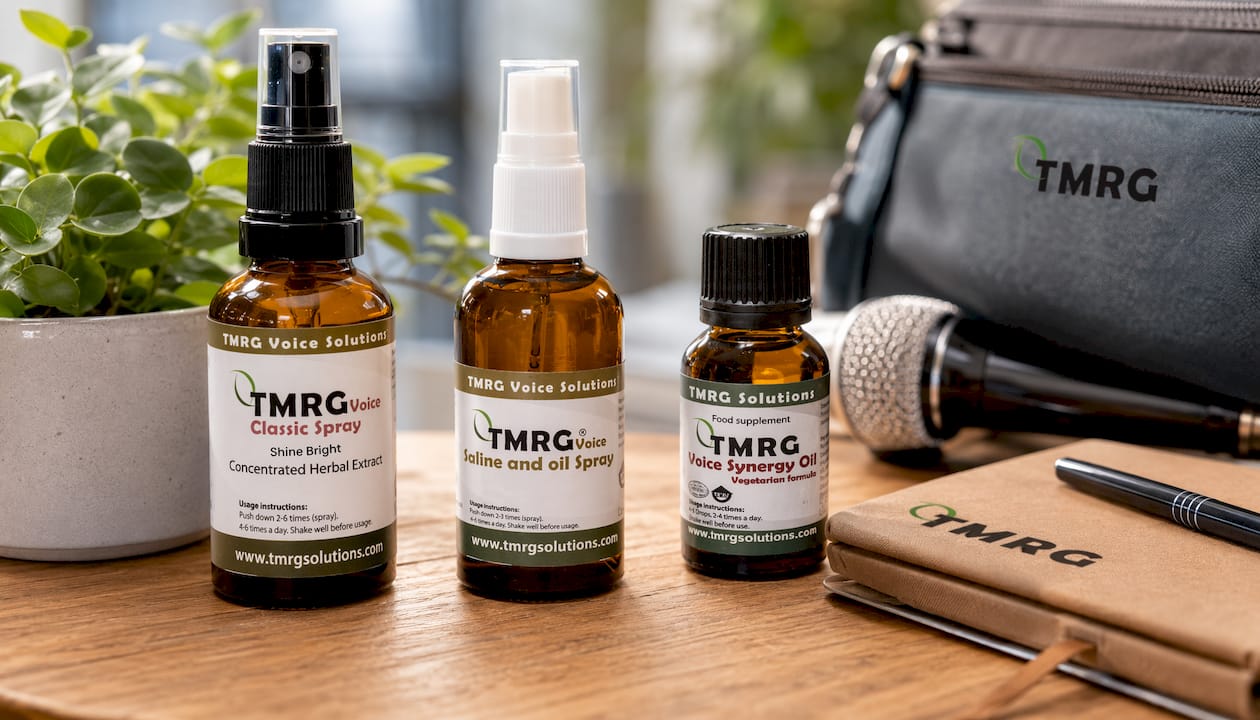
The three recommended options are available now through Tmrgsolutions’ US store:
TMRG Shine Bright for fast performance prep and quick relief.
Defense and Protection Duo for performers who want both pre-show protection and post-show recovery in one bundle.
TMRG Defense Oils & Saline for dry-environment lubrication and longer-lasting moisture retention.
Visit Tmrgsolutions’ product pages to review full ingredient lists, usage instructions, and ordering details. Your voice is worth the preparation.
This article provides general information about vocal health and spray products. It is not a substitute for professional medical advice. Consult an ENT specialist or speech-language pathologist for your specific situation.
Taking Care of Your Voice | NIDCD — Primary clinical reference on voice therapy, behavioral care, and when to seek professional evaluation.
Voice Care: Sorting Fact from Fiction | UT Southwestern Medical Center — ENT guidance on hydration, throat clearing, and the role of topical sprays versus systemic care.
Laryngitis: Why You Lose Your Voice and What Helps | Yale Medicine — Clinical overview of laryngitis timelines, conservative care, and red-flag symptoms.
Home Remedies: Helping a Hoarse Voice | Mayo Clinic News Network — Practical self-care checklist for hoarseness, including humidification, hydration, and voice rest.
Why Do You Lose Your Voice? And How to Fix It | Cleveland Clinic — Accessible clinical explanation of vocal fold inflammation and recovery timelines.
TMRG Shine Bright — Classic Voice Recovery Spray | Tmrgsolutions — Product page for the flagship instant-relief spray.
TMRG Defense and Protection Duo | Tmrgsolutions — Product page for the paired protection and recovery bundle.
TMRG Defense — Oils and Saline Voice and Throat Spray | Tmrgsolutions — Product page for the oil-and-saline formula for dry-environment use.
Most throat sprays begin providing surface relief within seconds to a few minutes of application. Duration varies based on environmental humidity, vocal load, and whether you pair the spray with adequate hydration.
No. Sprays soothe the pharyngeal surface and reduce discomfort, but they do not treat the underlying inflammation. Most laryngitis cases resolve within two to four weeks with rest, fluids, and humidification.
For alcohol-free formulas like the TMRG sprays, periodic re-dosing during a performance is generally reasonable. Always follow the specific product’s dosing instructions and pair each application with a sip of water.
Tmrgsolutions formulates its sprays without alcohol, with transparent ingredient lists, and with performer-specific needs in mind, including residue profile and repeat-dosing safety. The product line is backed by 25+ years of vocal health expertise and endorsed by vocal coaches.
Seek ENT or speech-language pathologist care if hoarseness lasts longer than four weeks, if you have throat pain, difficulty swallowing, or breathing trouble, or if you lose your voice repeatedly without a clear cause.
Vocal Spray for Singers: Secret to Fast Vocal Recovery Revealed - TMRG Solutions
Singer Vocal Recovery Spray: Your 2026 Voice Guide - TMRG Solutions
Advanced Vocal Recovery Guide for Singers: Fast Results - TMRG Solutions
Vocal spray for singers: natural relief & vocal health explained - TMRG Solutions
