Your Cart is Empty


TL;DR:
- Regular vocal exercises strengthen and maintain the voice, reducing fatigue, hoarseness, and strain for professionals who speak frequently. A structured routine including diaphragmatic breathing, lip trills, resonance focus, and articulation practice improves clarity and projection within minutes daily. Consistent maintenance and intentional pacing enhance speech effectiveness and overall vocal health over time.
Vocal exercises for speaking are targeted routines that prepare, strengthen, and maintain your vocal folds for clear, confident, and fatigue-free speech. Whether you teach a classroom of thirty students, present quarterly results to a boardroom, or deliver keynote addresses, your voice is your primary professional tool. Neglecting it carries real consequences: strain, hoarseness, and lost credibility. The good news is that a structured daily practice, covering diaphragmatic breathing, lip trills, and articulation drills, can transform your vocal performance in weeks, not months.
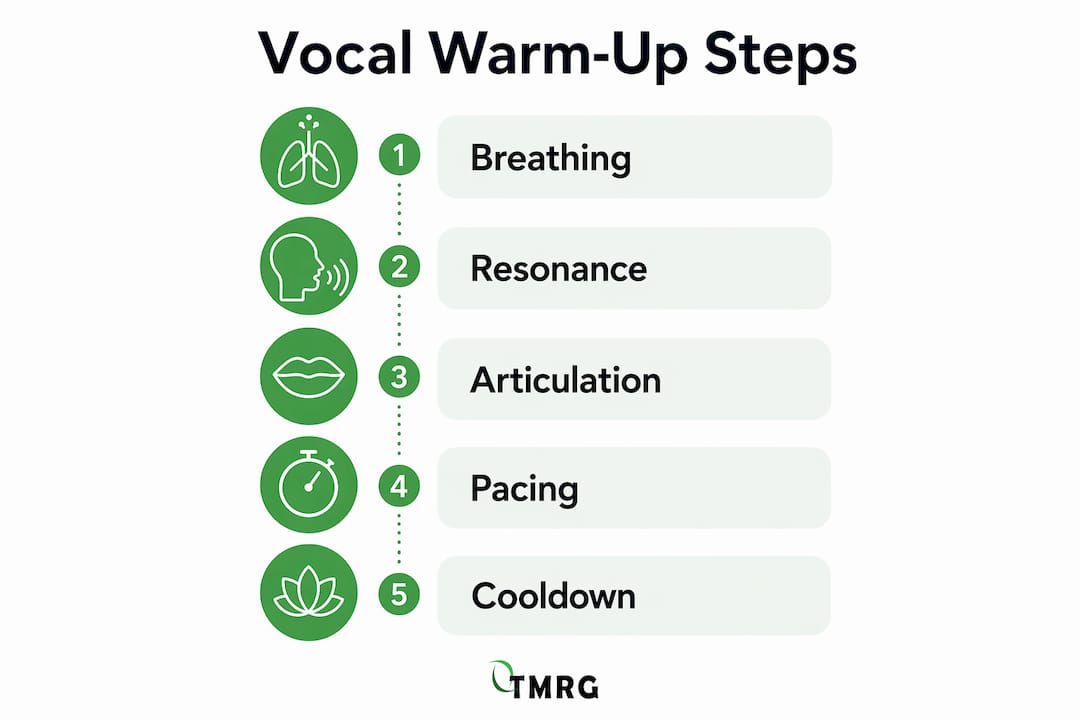
Vocal technique for speakers rests on four pillars: breath support, resonance, articulation, and pacing. Each pillar addresses a distinct mechanical function of the voice, and training them together produces compounding results. Here is a research-backed sequence you can begin today.
Diaphragmatic breathing. Place one hand on your abdomen and inhale slowly through your nose. Your belly should expand outward before your chest rises. Exhale on a sustained “sss” sound for 10 seconds, then extend to 15. This breathing exercise for voice builds the airflow pressure that powers every word you speak. Without diaphragmatic support, your throat muscles overcompensate, which is the primary cause of vocal fatigue.
Lip trills. Press your lips lightly together and blow air through them to create a motorboat vibration while sustaining a pitch. This gentle resistance exercise warms the vocal folds without overexertion. Vocal warm-up success depends on low-effort exercises like lip trills precisely because they activate the cords without forcing range or power.
Humming with resonance focus. Hum on a comfortable pitch and feel the vibration move forward into your lips and cheekbones. This forward placement reduces throat tension and gives your voice a fuller, more projected quality. Spend 60 to 90 seconds moving the hum up and down your natural pitch range.
Tongue twisters for articulation. Start with “red leather, yellow leather” or “unique New York” at a pace slow enough that every consonant is crisp. Tongue twisters practiced slowly prevent poor speech habits from becoming ingrained. Speed comes later. Clarity comes first.
Pacing control. Record yourself reading a paragraph aloud and count your words per minute. The ideal speaking pace for professional contexts is 130 to 150 words per minute, with technical explanations delivered closer to 120 to 130 words per minute. Practicing at 70 to 80 percent of your natural pace trains your mouth to articulate fully rather than swallow syllables.
Pro Tip: Practice the siren exercise, gliding your voice from your lowest comfortable pitch to your highest and back down, for 3 minutes before any articulation work. A 9-minute daily sequence of sirens, lip trills, and yawn-sigh exercises produces noticeable vocal quality improvements within weeks.

A structured voice warm-up routine is not optional for professionals who speak intensively. Think of it the way an athlete thinks of stretching before a run. Skipping it does not feel catastrophic in the moment, but the cumulative damage compounds over months and years.
A foundational warm-up for public speakers runs 5 to 10 minutes and follows a specific sequence. That sequence matters because each phase prepares the body for the next. Jumping straight to articulation drills without relaxing the jaw first is like sprinting before your muscles are warm.
Here is a practical daily structure:
On days when your voice has been unused for several hours, extend the breathing and resonance phases by two minutes each. On high-demand days, such as before a full-day training or a keynote, add a yawn-sigh exercise: open your mouth wide as if yawning, then release a gentle sigh from the top of your range downward. This releases the soft palate and opens the resonance cavities.
Pro Tip: Record your warm-up voice and your post-presentation voice once a week. Comparing the two reveals exactly which exercises are producing results and which phases you are rushing through.
You can find a detailed breakdown of proper warm-up sequencing at Tmrgsolutions, including timing adjustments for educators and business presenters.
The misconception that vocal exercises are only for singers leaves many professionals unprotected. Teachers, lawyers, corporate trainers, and sales professionals face vocal demands that rival those of performers, yet most receive no formal voice training.
Vocal exercises reduce tension and improve vocal cord vibration efficiency, directly preventing the fatigue, hoarseness, and strain that accumulate from daily heavy speaking. This is not a minor benefit. Vocal fatigue impairs speech clarity, reduces listener confidence in the speaker, and, left unaddressed, can progress to nodules or chronic dysphonia.
The most common challenges professionals report include:
Vocal exercises as daily hygiene is the right frame. Just as you would not skip dental care because you are not a professional model, you should not skip vocal care because you are not a professional singer. The stakes for your career are equally real.
For educators specifically, Tmrgsolutions covers vocal care strategies that address the unique demands of classroom speaking across a full school day.
The most common reason professionals skip vocal exercises is time. A 10-minute routine sounds manageable in theory but disappears under back-to-back meetings and early morning calls. The solution is not motivation. It is design.
Pro Tip: Set a calendar block labeled “Voice” for 8 minutes before any presentation or meeting that runs longer than 30 minutes. Treat it with the same discipline you give to slide preparation.
Listeners evaluate pacing, pauses, and emotional intention unconsciously. Slow, deliberate pacing signals authority and connection more effectively than speed alone. That insight alone is worth building a practice around.
Consistent vocal exercises for speaking, built around breath support, resonance, articulation, and pacing, are the most direct path to a clearer, more durable professional voice.
| Point | Details |
|---|---|
| Breath support is foundational | Diaphragmatic breathing prevents throat strain and powers clear, projected speech. |
| Warm up in sequence | Move from jaw release to breathing to resonance to articulation for maximum benefit. |
| Pacing controls clarity | Target 130 to 150 words per minute; slow practice builds accurate articulation habits. |
| Daily hygiene prevents damage | Consistent warm-ups reduce hoarseness, fatigue, and long-term vocal cord injury risk. |
| Apply principles beyond exercises | Using diaphragmatic support in everyday speech compounds the gains from formal practice. |
I spent years watching professionals walk into high-stakes presentations with no vocal preparation at all. They had rehearsed their slides, their talking points, their Q&A responses. But they had done nothing for the instrument delivering all of it. By the second hour, the voice was thin, the energy was dropping, and the audience was working harder to stay engaged.
The turning point for me was recognizing that vocal preparation is not a performance ritual. It is maintenance. A teacher who speaks for six hours a day without warming up is accumulating micro-trauma in the vocal folds every single day. The damage does not announce itself immediately. It builds quietly until a bout of hoarseness forces a rest day, or worse, a medical visit.
What I find most underappreciated is the pacing dimension. Most professionals speak too fast under pressure. They equate speed with confidence when listeners actually read deliberate pacing as authority. Slowing down by even 15 percent, while keeping breath support engaged, changes how a room receives you. The voice sounds fuller. The pauses land. The message sticks.
The professionals I have seen make the fastest gains are not the ones with the most natural talent. They are the ones who treat their daily vocal care routine with the same seriousness they give to physical fitness. Ten minutes a day, done consistently, compounds into a voice that can carry a full day’s work without strain.
Start small. Do the breathing. Do the lip trills. Record yourself once a week. The improvement will be audible within a month, and that feedback loop is what makes the habit stick.
— Golan

Vocal exercises build the foundation, but even disciplined practitioners benefit from targeted support, especially after heavy speaking days or during periods of vocal stress. Tmrgsolutions has spent 25 years developing natural voice therapy solutions for speakers, educators, and performers who need reliable recovery and maintenance tools. The TMRG Voice Therapy Kit Basic is a strong starting point for professionals adding structured vocal care to their routine. For those with higher vocal demands, the Premium Voice Therapy Kit pairs natural herbal formulations with a full care protocol designed for intensive voice users. Exercises and professional-grade care work best together.
Diaphragmatic breathing, lip trills, humming with forward resonance placement, and slow tongue twisters form the core of an effective speaking voice routine. Practiced daily in sequence, these exercises build breath support, reduce tension, and sharpen articulation.
A foundational warm-up runs 5 to 10 minutes, covering jaw release, breathing, resonance, and articulation in sequence. On high-demand days or after extended vocal rest, extend the routine by two to three minutes.
Vocal exercises reduce tension and improve vocal cord vibration efficiency, directly lowering the risk of hoarseness and fatigue. Consistent practice, combined with diaphragmatic breath support in everyday speech, offers the strongest protection.
The target pace for professional speaking is 130 to 150 words per minute, with technical content delivered closer to 120 to 130 words per minute. Practicing at 70 to 80 percent of your natural pace trains cleaner articulation habits.
Attach a 3-minute emergency warm-up to your pre-meeting routine, use AI tools like BoldSpeak for objective self-assessment, and apply diaphragmatic breathing during everyday conversations. Consistency across short sessions outperforms occasional long ones.
