Your Cart is Empty


Teachers are among the most voice-dependent professionals in any workforce, yet voice disorders affect 33–67% of educators at some point in their careers. That number is two to three times higher than the general population. Most educators push through hoarseness, throat clearing, and fatigue without ever connecting those symptoms to a real clinical problem. This article explains why your voice is under constant pressure, what the research says about protecting it, and which strategies actually work for long-term vocal health.
| Point | Details |
|---|---|
| High prevalence in educators | Teachers experience voice problems at two to three times the rate of the general population. |
| Preventive care is crucial | Protective actions like singing, training, and microphones can lower voice disorder risk. |
| Early intervention prevents harm | Seeking help at the first sign of symptoms can stop serious or lasting voice damage. |
| Personal strategies matter | Tailoring vocal care to individual needs and job requirements provides the best long-term outcomes. |
To understand how vocal care helps, first consider how common and serious voice issues are for teachers. The numbers are striking. Studies report vocal symptom prevalence ranging from 33% over a career and 25% yearly in New Zealand, to 68% in Germany and 60% in Saudi Arabia. These are not minor inconveniences. They represent a pattern of chronic overuse that builds quietly over months and years.
| Region | Reported prevalence | Notes |
|---|---|---|
| New Zealand | 33% career, 25% yearly | Self-reported symptoms |
| Germany | 68% | Includes mild and severe cases |
| Saudi Arabia | 60% | Higher in female teachers |
| General population | ~11–16% | Baseline comparison |
What makes this worse is that most cases go unaddressed. Research on fatigue subtypes in educators shows that roughly 75% of affected teachers never receive a formal diagnosis. Primary school teachers carry the highest risk, likely because they use more expressive, high-energy vocal delivery throughout the day. Individual variability matters too. Two teachers in the same classroom can have very different outcomes based on technique, hydration, and vocal habits.
“The majority of educators experiencing vocal symptoms never seek clinical evaluation, allowing treatable conditions to become chronic problems.”
For educators who want to build resilience before symptoms appear, exploring vocal longevity strategies is a practical first step.
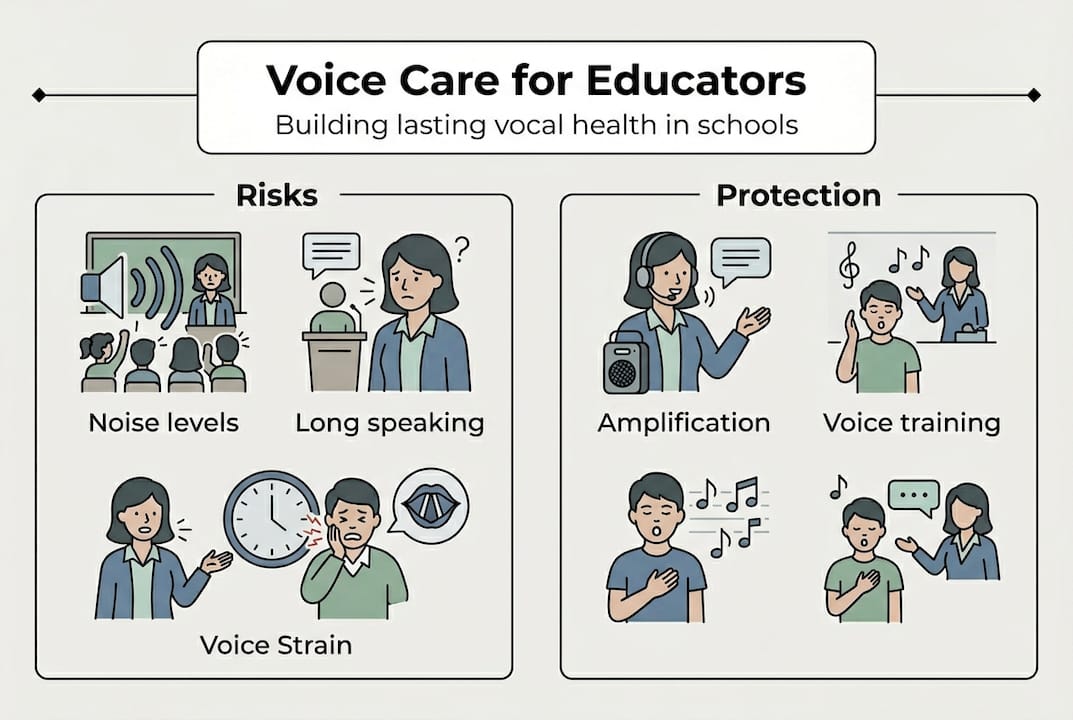
Now that you know how widespread the issue is, let’s examine what makes teachers particularly susceptible. The core problem is sustained phonation under difficult conditions. Most teachers speak for four to six hours daily, often in rooms with poor acoustics, background noise from HVAC systems, and no amplification support.
When you raise your voice to compete with ambient noise, your vocal folds (the two small tissue bands in your larynx that vibrate to produce sound) are forced to work harder and collide with greater impact. Over time, this leads to swelling, stiffness, and reduced vocal range. The voice becomes thin, effortful, or unreliable.

Research on vocal mechanics and therapy emphasizes that lasting improvement comes from addressing the physiologic root causes, not just managing symptoms. Techniques like semi-occluded vocal tract exercises (SOVT) and vocal function exercises (VFE) build coordination between breath, phonation, and resonance. Symptomatic fixes like throat lozenges or whispering offer short-term relief but do not correct the underlying strain pattern.
Key vulnerability factors for educators include:
Addressing these factors directly is the foundation of preventing vocal fatigue before it becomes a clinical problem.
Understanding what makes educators’ voices so vulnerable reveals why vocal health matters for more than just comfort. When your voice is unreliable, your teaching suffers. You may avoid calling on students, reduce classroom discussion, or rely more heavily on written materials. These are not just inconveniences. They directly affect student engagement and learning outcomes.
The long-term career consequences of untreated vocal disorders include absenteeism, reduced teaching hours, and in some cases, early career exit. Research confirms that vocal care is essential for career longevity and that prioritizing voice training early produces better outcomes than trying to recover after years of exposure damage.
Here is a realistic picture of how untreated vocal problems escalate:
“Vocal health is not a luxury for educators. It is a professional necessity that directly shapes how effectively you can do your job.”
Personal well-being is also at stake. Chronic vocal strain creates a feedback loop of physical discomfort, anxiety about speaking, and mental fatigue. Many educators report feeling self-conscious or stressed about their voice, which compounds the physical problem. Investing in professional voice care is an investment in your overall quality of life, not just your classroom performance.
Given these real-world consequences, what can educators do to actively protect their voices? The good news is that several strategies have solid research support.
Protective factors identified in the research include regular singing, formal voice training, and the use of classroom microphones. Each of these reduces the mechanical load on your vocal folds in a different way.
| Strategy | Evidence level | Practical benefit |
|---|---|---|
| Classroom amplification | Strong | Reduces loudness demand directly |
| Regular singing | Moderate to strong | Builds vocal fold flexibility and endurance |
| Formal voice training | Strong | Improves breath support and resonance efficiency |
| Hydration protocols | Moderate | Maintains mucosal lubrication |
| Vocal rest periods | Moderate | Allows tissue recovery between teaching blocks |
| Symptomatic remedies only | Weak | Masks symptoms without addressing cause |
Pro Tip: If your school does not provide amplification, a portable personal amplifier worn around the neck can reduce your vocal output by 20 to 30 percent. This single change can dramatically extend how long your voice holds up during a full teaching day.
Building a sustainable routine means combining several of these strategies rather than relying on one. Professional vocal training teaches you how to use your breath and resonance more efficiently, so your vocal folds do less work for the same volume. Pairing that with expert strategies for vocal fatigue gives you both the technique and the recovery tools you need.
Additional habits worth building:
Even with preventive strategies, some problems need outside help. Knowing when to act is critical. The most important warning signs are hoarseness lasting more than two weeks, pain or discomfort during speaking, sudden voice loss, or a significant change in your vocal range or quality.
Despite these clear signals, 75% of educators with vocal symptoms never receive a formal diagnosis. This is one of the most damaging patterns in the profession. Waiting too long allows reversible conditions like vocal fold edema (swelling) to become structural problems like nodules, which require more intensive treatment.
Pro Tip: If your voice has not returned to its normal quality within two weeks of rest and hydration, book an appointment with an ENT (ear, nose, and throat specialist) or a laryngologist. Do not wait for the problem to resolve on its own.
Common mistakes educators make:
Your voice is a precision instrument. Treating it that way, with consistent care, informed habits, and timely professional support, is what separates educators who thrive vocally for decades from those who struggle through every semester.
At TMRG Solutions, we have spent 25+ years working with voice professionals who face exactly the challenges described in this article. Whether you are managing early fatigue or recovering from persistent hoarseness, the right support makes a measurable difference.

Our range of natural vocal health products, including herbal sprays, voice therapy kits, and dietary guides, is designed to complement the evidence-based strategies outlined here. These are not generic wellness products. They are formulated specifically for educators, singers, actors, and anyone whose voice is their professional tool. Explore our full catalog at tmrgsolutions.com and find the support that fits your vocal needs and teaching schedule.
Teachers speak for extended periods in challenging acoustic environments, which places sustained mechanical stress on the vocal folds. Voice disorder prevalence in educators is two to three times higher than in the general population as a result.
Persistent hoarseness, pain during speaking, or voice loss lasting more than two weeks are clear indicators. Individual fatigue modeling shows that most educators delay seeking help, which increases the risk of permanent damage.
Yes. Regular singing and training build vocal fold flexibility and improve breath-phonation coordination, both of which reduce the risk of developing voice disorders over a teaching career.
Absolutely. Classroom amplification is one of the most evidence-supported interventions available. Microphone use reduces strain by lowering the loudness demand placed on the vocal folds during instruction.
No. While primary teachers carry higher risk due to more expressive vocal demands, educators at every level are vulnerable and benefit from consistent preventive strategies.
