Your Cart is Empty


TL;DR:
- Proper vocal warm-ups, based on evidence-based exercises like VFE and SOVT, prepare the voice and prevent injury.
- A routine of 5 to 15 minutes that follows a body-to-breath-to-voice sequence optimizes performance and vocal health.
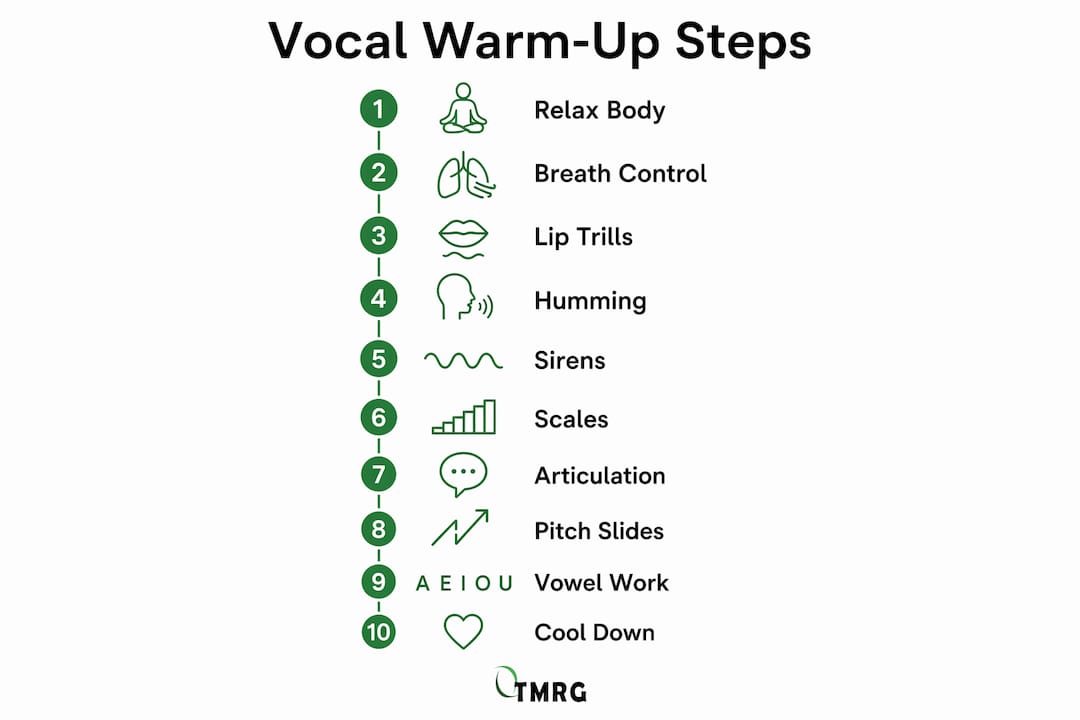
Every singer needs a reliable pre-show routine, and these ten exercises form the core of one that actually works. Grounded in evidence-based protocols like Vocal Function Exercises (VFE) and semi-occluded vocal tract exercises (SOVT), they prepare your vocal folds, release tension, and set a healthy baseline before you step onstage.
Each exercise takes roughly 1–2 minutes. A complete run through all ten fits comfortably within the 5–15 minute window that researchers at the University of Miami Miller School of Medicine identify as optimal for most singers.
The sequence of your warm-up matters as much as the exercises themselves. Jumping straight into scales on a cold voice is like sprinting before you stretch. Follow this stepwise order: body relaxation first, breath activation second, vocal sound production last.
Pro Tip: Keep your volume at a moderate to low level throughout the entire warm-up. Warming up at low volume increases blood flow to the larynx without burning out the voice before the show even starts. Sensation, not volume, is the goal.
Singers performing in genres with heavy belt or extended high-range demands may need a slightly longer session, up to 20 minutes, but only if the voice feels genuinely free and responsive, never as a default. Adapt the routine to what your voice tells you that day.

Warming up does two things at once: it prevents injury and establishes a daily vocal baseline. That second function is underappreciated. When you warm up consistently before every show, you learn what your voice feels like when it is healthy, rested, and ready. Any deviation from that baseline, a rough patch on a particular note or unusual fatigue in the upper register, signals that something needs attention before you perform.
The physiological case is equally clear. Your vocal folds are muscle tissue covered by a delicate mucous membrane. Cold muscles are less pliable and more prone to micro-tears under impact stress. Warming up increases blood flow to the larynx and the surrounding muscles, raising tissue temperature and improving elasticity before you demand full-range phonation.
Tension in the jaw, tongue root, and neck is one of the most common barriers to vocal freedom. Targeted release work during warm-ups, jaw massage, tongue relaxation, and neck stretches, clears that tension from the vocal tract so your resonance can move freely. A tight tongue root, in particular, pulls the larynx upward and narrows the pharynx, which thins the tone and increases strain.
Warm-ups also support registration integration. Gentle sirens and VFE glides train the cricothyroid and thyroarytenoid muscles to transition smoothly through the passaggio, the register shift zone, so you are not negotiating that coordination for the first time mid-song. Researchers at the Miller School found that 5–15 minutes is the optimal warm-up window for most singers, with longer sessions reserved for intensive concert or studio work.
Most singers make at least one of these errors, and some make all of them.
A good vocal health routine treats warm-ups as a diagnostic tool, not just a ritual. If your voice is not responding normally after a careful, low-volume warm-up, that is information worth acting on.
Warm-ups prepare the voice. What you do in the hours before and after a performance determines how well it recovers.

Tmrgsolutions brings over 25 years of vocal health expertise to performers who need more than exercises alone. The TMRG Voice Therapy Kit pairs natural herbal formulations with a structured recovery protocol, endorsed by vocal coaches and medical professionals, to soothe the vocal folds after demanding use. For targeted pre-show support, the TMRG Loud & Clear Voice Recovery Drops help lubricate and calm the vocal tract so your warm-up starts from a healthier baseline. These are not replacements for proper technique. They are the natural complement to the routine you have already built.
Most singers need 5–15 minutes of warm-up before a performance. Reserve longer sessions only for intensive concert or studio work, as excessive warm-ups can cause muscle fatigue.
Start with body relaxation (neck rolls, jaw massage), move to breath activation (diaphragmatic breathing), then progress to soft phonation (lip trills, humming) before adding scales and range work. This stepwise sequence prevents strain on cold vocal folds.
Semi-occluded vocal tract exercises, like straw phonation and lip trills, reduce collision force on the vocal folds compared to open-vowel singing. They are among the safest and most effective exercises to include at the start of any warm-up routine.
Stop immediately if you feel scratchiness, tightness, or any strain in the throat. Pushing through discomfort during warm-ups risks acute vocal fold injury and can compromise the entire performance.
Yes. Products like the Tmrgsolutions voice recovery drops and therapy kits use natural herbal formulations to lubricate and soothe the vocal folds, complementing a proper warm-up routine before and after performances.
A complete pre-show vocal warm-up takes 5–15 minutes, follows a strict body-to-breath-to-voice sequence, and stays at low volume throughout to protect the vocal folds and maximize performance readiness.
| Point | Details |
|---|---|
| Optimal warm-up duration | Research supports 5–15 minutes for most singers; beyond 15 minutes risks muscle fatigue before the show. |
| Correct sequence | Always progress from body relaxation to breath activation to soft phonation before adding range work. |
| Volume discipline | Warm up at low to moderate volume to increase blood flow without straining the vocal folds. |
| Stop at first sign of strain | Scratchiness or tightness during warm-ups signals you should stop and reassess, not push through. |
| Tmrgsolutions vocal support | The TMRG Voice Therapy Kit and recovery drops provide natural, expert-backed support to complement your warm-up routine. |
