Your Cart is Empty


TL;DR:
- A glottal attack occurs when vocal folds close tightly before airflow begins, creating a percussive burst. Repeated hard onsets can cause tissue trauma, nodules, and long-term vocal damage if untreated. Controlled, quick onsets used intentionally can support certain singing styles, but habitual use risks strain and injury.
A glottal attack occurs when your vocal folds close tightly before airflow begins, causing subglottic pressure to build until it forces the folds apart in a sharp, percussive burst. Clinically, this is recognized as a form of vocal misuse when repeated habitually. The short verdict: a controlled, occasional glottal onset can serve a stylistic purpose in certain genres, but frequent hard attacks put real strain on your voice and, over time, risk lasting damage.
The glottis is the space between your two vocal folds. During normal, balanced phonation, airflow and fold closure happen nearly simultaneously. In a glottal attack, the folds adduct fully before airflow starts, sealing the airway. Pressure builds beneath them until it overcomes their tension and blows them apart, initiating vibration with a hard, clicking onset.
Voice scientists measure this timing using vocal attack time (VAT), the interval between the start of airflow and the start of vocal fold vibration. A hard glottal onset produces a negative VAT, meaning vibration begins before measurable airflow. Research from Watson et al. (2016) reports representative VAT values near one to a few milliseconds for unaspirated onsets and longer values for aspirated ones. Electroglottography (EGG) can visualize the contact pattern in real time, making it a useful clinical tool for identifying excessive closure.
| Onset Type | VAT (approx.) | Airflow Pattern | Perceived Sound |
|---|---|---|---|
| Hard (pressed) | Negative | Blocked then burst | Sharp click or pop |
| Balanced (normal) | 1 ms | Simultaneous | Clean, clear tone |
| Aspirate (breathy) | — | Airflow precedes closure | Soft, breathy start |
A negative VAT is the acoustic fingerprint of a hard glottal attack. When you feel that sharp “click” at the start of a vowel, your folds closed before your breath even moved.
Not every glottal onset is damaging. Understanding the spectrum helps you identify what your voice is actually doing.
Common everyday behaviors also produce hard glottal attacks: forceful throat clearing, a sharp cough, and abrupt vowel-initial words spoken under stress. These non-singing habits generate the same collision forces as poor technique at the microphone.
The collision forces involved in a hard onset are not trivial. Each time your folds slam apart under high subglottic pressure, the tissue absorbs that impact. Repeat it hundreds of times in a rehearsal and the cumulative load adds up fast.
Immediate effects you may notice:
Long-term risks with chronic hard onsets:
Frequent hard glottal attacks also restrict airflow, degrade tone quality, and create inconsistent performance, six distinct harms that compound each other over a season of heavy singing. Throat clearing deserves special mention: it produces nearly identical collision forces to a hard sung onset and is one of the most overlooked sources of vocal abuse among singers.
Red flag: Hoarseness lasting more than two weeks, pain on phonation, sudden loss of upper range, or voice breaks that were not there before all warrant prompt attention. Do not push through these signs.
A controlled glottal onset is not always a mistake. The key word is controlled.
In belting, a measured percussive onset can add brightness and punch to a phrase, particularly on accented syllables. Certain pop and R&B styles use a light glottal “pop” as an expressive device, giving a note rhythmic emphasis that a smooth onset cannot replicate. Some languages, including German and certain dialects of American English, use the glottal stop as a phonemic feature, so singers performing in those idioms will encounter it naturally.
The distinction that matters is between deliberate aesthetic use and habitual, uncontrolled usage. A well-executed glottal onset can support bright, belting sounds, but it is more tiring than a balanced onset and risks nodules if overused. Coaches describe the controlled version as using minimal, quickly released subglottic pressure: a small pop that dissipates immediately, rather than a sustained slam. If you are reaching for a glottal effect intentionally, use it sparingly, support it with full diaphragmatic breath, and keep the surrounding phrases on a balanced onset.
Hard glottal attacks are usually a symptom of poor breath support or inconsistent vocal placement, not a stylistic choice. Fixing the underlying cause is more effective than trying to “stop” the attack directly.
Step-by-step exercise progression:
For breath support and resonance placement, build these exercises into a 15-minute daily warm-up before any demanding repertoire.
Pro Tip: Place your fingertips lightly on your larynx during the ‘M’ hum. If you feel the larynx rise or tighten at the start of each note, you are still carrying excess tension. Aim for a larynx that stays low and still.

Self-directed exercises help most singers correct habitual hard onsets within a few weeks. But some situations call for professional assessment, and waiting too long makes recovery harder.
See a clinician if you experience:
Who to see:
Recovery timelines vary. Behavioral issues, where no structural lesion exists, often respond within 6–12 weeks of consistent SLP-guided therapy. Nodules may require 3–6 months of voice therapy; surgical intervention, when necessary, is followed by a period of voice rest and then SLP rehabilitation. Early referral consistently leads to shorter recovery. For guidance on early signs of vocal damage, Tmrgsolutions has a detailed resource worth reviewing before your appointment.
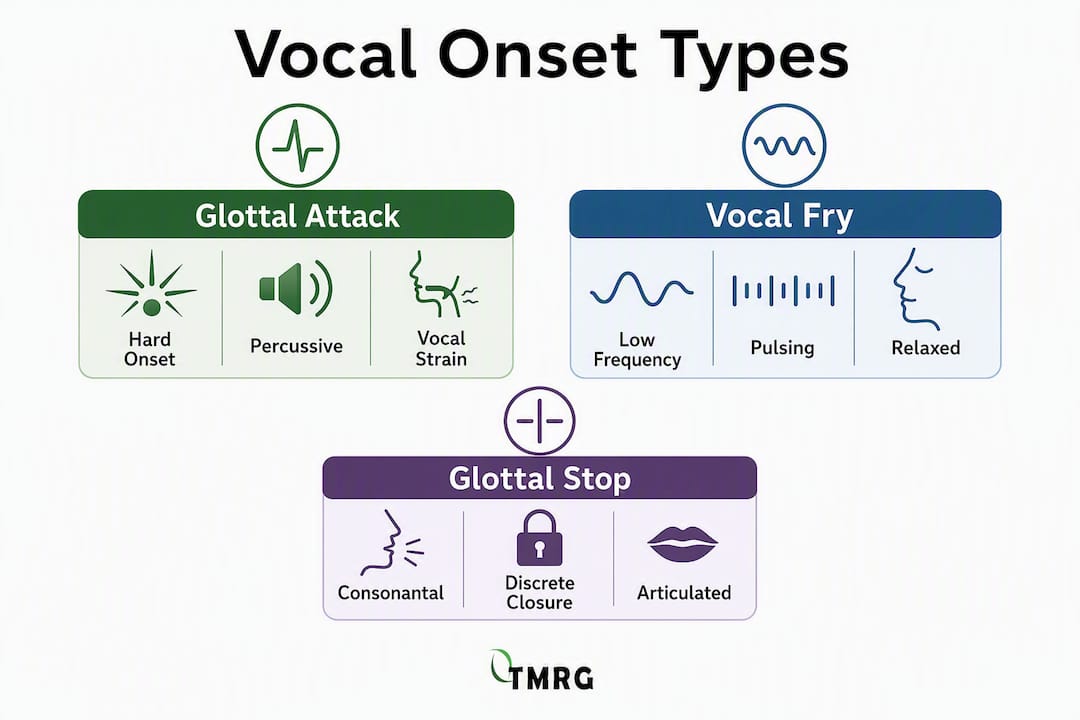
These three terms describe related but distinct phenomena, and confusing them leads to misapplied technique.
| Feature | Glottal Attack | Vocal Fry | Glottal Stop |
|---|---|---|---|
| What it is | An onset type (how phonation starts) | A register (low-frequency creaky phonation) | A consonant (complete closure, then release) |
| Airflow behavior | Blocked then burst at onset | Irregular, slow pulsing | Full stop, then release of air |
| Listener perception | Percussive click at note start | Creaky, crackling low tone | Abrupt silence then sound |
| Typical use | Stylistic emphasis, belting | Low register speech, some pop styles | Phonemic in many languages |
| Risk level | High if habitual and hard | Moderate with overuse | Low in speech; higher if forced |
The glottal stop, known in classical vocal pedagogy as the coup de glotte, is a discrete consonantal closure used intentionally in certain languages and historical singing styles. A glottal attack is specifically about how phonation begins, not a consonant in its own right. Vocal fry sits in a separate register entirely, characterized by slow, irregular fold vibration at very low frequencies rather than an abrupt onset event.
A glottal attack is a hard, percussive vocal onset caused by tight fold closure before airflow, and correcting it through breath support and gentle onset exercises is the most reliable path to vocal health.
| Point | Details |
|---|---|
| Definition | Vocal folds close before airflow starts, producing a percussive onset with negative VAT. |
| Main risks | Repeated hard onsets cause nodules, chronic hoarseness, and range loss over time. |
| Corrective approach | Daily M-hums, straw phonation, lip trills, and soft vowel onsets reduce laryngeal tension. |
| Clinical red flags | Hoarseness beyond two weeks, pain, or sudden range loss require ENT or SLP evaluation. |
| Tmrgsolutions support | TMRG voice therapy kits and recovery products offer structured at-home rehab for singers. |
There is a pattern that shows up repeatedly in vocal health: singers spend months working on repertoire and almost no time examining how their voice starts each phrase. The glottal attack is almost always a downstream consequence of something upstream, usually insufficient breath support or a habit of “placing” the voice with tension rather than airflow. Addressing the onset directly, without fixing the breath, is like treating a symptom while ignoring the cause.
What I find most instructive is that the same collision forces produced by a hard sung onset are also produced by habitual throat clearing, something most singers do dozens of times a day without a second thought. The voice does not distinguish between a slammed onset in a rehearsal room and a forceful throat clear in a coffee shop. Both accumulate. Both cause the same tissue trauma. Singers who clean up their technique at the microphone but continue clearing their throat aggressively often plateau in recovery, and they rarely connect the two behaviors.
The good news is that the voice responds well when you address the root cause early. Breath support work, gentle onset exercises, and reducing abusive non-singing behaviors can produce noticeable improvement within weeks. The singers who recover fastest are not necessarily the most talented; they are the ones who pay attention to what their voice is telling them and act on it before the damage becomes structural.
When hard glottal attacks have already caused strain, soreness, or hoarseness, targeted recovery support can shorten the time your voice needs to bounce back. Tmrgsolutions offers a range of natural, evidence-informed products designed specifically for singers and voice professionals dealing with exactly this kind of vocal fatigue.

For a structured at-home rehabilitation program, the TMRG Voice Therapy Kit combines recovery tools in a single kit designed for singers working through vocal strain. Browse the full range at Tmrgsolutions vocal problems to find the right fit for your situation.
This article is general educational information, not medical advice. For persistent vocal symptoms, consult a qualified ENT or speech-language pathologist.
For persistent hoarseness, pain, or range loss, seek evaluation from a licensed ENT or speech-language pathologist. Early assessment consistently leads to better outcomes.
A glottal attack is when your vocal folds close tightly before you start speaking or singing, causing a sharp, clicking onset instead of a smooth start to the sound.
The word “uh-oh” contains a classic glottal stop between the two syllables; forceful throat clearing and abrupt vowel-initial words spoken under stress produce similar hard glottal onsets.
Persistent hoarseness, a rough or gravelly tone, increased vocal fatigue after short periods of use, and difficulty reaching pitches you previously held easily are the earliest warning signs.
A glottal attack is an onset event, a hard start to phonation, while vocal fry is a low-frequency register characterized by slow, irregular fold vibration throughout a sustained tone, not just at its beginning.
See an ENT or speech-language pathologist if hoarseness lasts more than two weeks, if you experience pain during phonation, or if you notice a sudden unexplained loss of upper range.
