Your Cart is Empty


TL;DR:
- Many actors overlook breath as the physical mechanism that sustains their performances and vocal health. Proper breath control enhances projection, stamina, emotional flexibility, and reduces injury risk across stage and screen. Regular practice of structured breathing exercises builds reliable vocal support, ensuring consistent performance quality under pressure.
Most actors spend years studying emotional truth, physical character work, and script analysis, yet overlook the one physical mechanism that holds every performance together: breath. Your breath is not simply background noise your body manages on autopilot. It is the engine that drives vocal projection, supports your vocal folds (the two small bands of tissue in your larynx that vibrate to produce sound), and determines how long you can sustain a powerful performance before fatigue sets in. This article covers the science, the techniques, and the practical habits that turn breath control from a vague concept into a reliable performance skill.
| Point | Details |
|---|---|
| Core acting skill | Breath control is as fundamental as emotion or movement for stage and screen performance. |
| Science-backed benefits | Structured breath training reduces vocal strain and improves stamina, projection, and clarity. |
| Technique variety | Tailor breath methods for stage versus screen and use stepwise exercises for best results. |
| Practical first steps | Daily breath warmups and focused practice create fast, lasting advantages for actors. |
Many actors believe breath control belongs exclusively to singers. That belief is one of the most limiting misconceptions in theater and film training. Every spoken line you deliver is powered by a column of air moving through your vocal tract. Without controlled, steady airflow, even the most emotionally authentic performance can sound thin, tight, or strained before the end of a long scene.
Here is why breath control belongs at the core of every actor’s training:
“Voice training approaches for actors emphasize reducing vocal tension and improving sustained phonation by developing breathing as part of voice technique.” Research on the Linklater Voice Training Technique confirms improved airflow control during sustained phonation, with direct benefits for long monologues and projection tasks.
A secondary myth worth addressing: some actors assume that emotional states automatically generate the “right” breath pattern for a scene. Emotion and breath influence each other, but relying on emotion alone to manage your breath in performance is unreliable under pressure. Understanding why breath support matters as an independent physical skill gives you a dependable tool regardless of how you are feeling on any given performance night.
Understanding the science lays the groundwork for practical breath training.
Breathing for survival is managed primarily by the brainstem, which regulates the diaphragm (the large dome-shaped muscle beneath your lungs) without any conscious thought. For acting, however, you need to access the volitional (voluntary, intentional) layer of breath control. Research published in Scientific Reports confirms that breathing is largely automatic for survival yet can be voluntarily controlled, and that respiration must synchronize with expiration in conversational speech. This means that when you speak, your nervous system is already coordinating breath with language. Actor training builds on that coordination rather than replacing it.
Here is a simple breakdown of what you are actually working with:
| Breath component | What it does | How actors use it |
|---|---|---|
| Diaphragm | Draws air into the lungs on inhalation | Controlled engagement creates deeper breath capacity |
| Intercostal muscles | Expand and contract the rib cage | Rib reserve breathing extends available air supply |
| Abdominal support | Provides resistance during exhalation | Regulates air pressure beneath the vocal folds |
| Larynx and vocal folds | Convert airflow into sound | Consistent airflow reduces friction and strain |
| Resonance cavities | Amplify and shape tone | Better breath support fills resonators more efficiently |
The key insight here is that mastering air flow and pressure is not about forcing more air. It is about maintaining consistent, measured airflow so your vocal folds vibrate freely without excess tension.
Pro Tip: Most acting breath training aims to coordinate, not override, your natural breathing. If your exercises feel like a fight against your own body, you are working too hard. Back off and focus on ease first.
With these techniques in mind, adapt your practice to specific acting challenges.
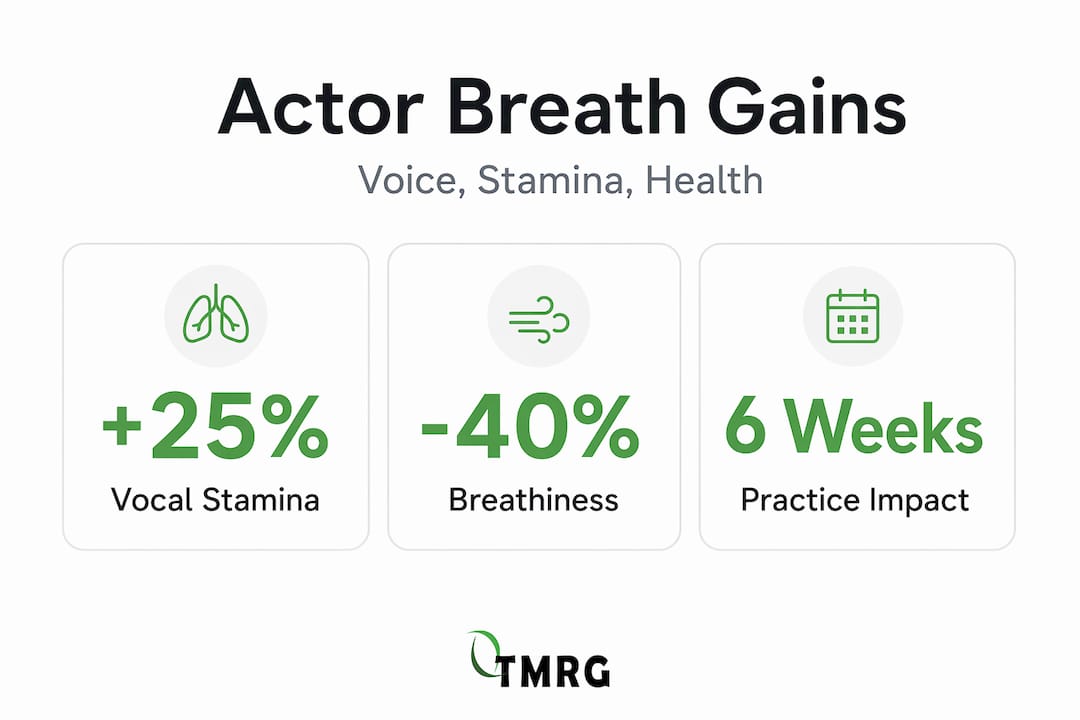
Applied research in voice therapy confirms that structured breathing exercises make a measurable difference. A six-week treatment program for voice actors that included breathing pattern awareness, diaphragmatic breathing, and voice-breath coordination produced a significant decrease in breathiness scores. Breathiness (the audible sound of excess, uncontrolled air escaping through the vocal folds) is one of the most common performance problems actors face, and it responds directly to structured breath training.
Here is how different techniques compare for common acting demands:
| Technique | Best for | Stage or screen? | Skill level |
|---|---|---|---|
| Diaphragmatic breathing | Building foundational air capacity | Both | Beginner |
| Rib reserve breathing | Sustaining long speeches | Stage | Intermediate |
| Slow controlled exhale drills | Reducing breathiness and vocal tension | Both | Beginner |
| Sustained tone on one breath | Building phonation (sound production) stamina | Stage | Intermediate |
| Subtle nasal breath | Naturalistic, camera-ready breathing | Screen | Intermediate |
Three essential breath exercises for actors:
Diaphragm expansion check. Lie on your back with one hand on your abdomen. Inhale slowly through your nose, feeling your hand rise. Exhale slowly through a narrow mouth opening, feeling your hand fall. Repeat 10 times before each rehearsal. This exercise reconnects you to deep, supported breath without tension in the upper chest or shoulders.
Controlled exhale count. Stand tall, inhale for four counts, then exhale on a sustained “sss” sound for eight, twelve, then sixteen counts. Extend the count by two each week. This builds the abdominal endurance that supports long theatrical speeches and helps you understand vocal support tips in a physical, practical way.
Sustained phonation drill. Inhale fully, then sustain a comfortable pitch on “ah” for as long as you can while keeping the tone smooth and even, not forced. Time yourself. A healthy phonation time for adults is roughly 15 to 25 seconds. Work toward the higher end gradually. This directly addresses why actors need vocal exercises that go beyond emotional warm-ups.
Research on conscious breathing benefits also shows that deliberate breath practice supports the nervous system response to stress, which is highly relevant for audition nerves and performance anxiety. A calmer, well-regulated breath pattern signals safety to your body, which reduces the adrenaline-driven tension that makes voices tight and “thin” under pressure.
Pro Tip: Overemphasizing emotional breath, breathing in a specific pattern because your character is frightened or grief-stricken, can undermine your vocal outcomes if the physical mechanics are not already solid. Establish the physical first, then layer emotional intention on top.

For more detail on improving your vocal strength through targeted exercises, explore the progressive training methods that move from breath foundation to full-voice resonance.
Finally, let’s clarify how you can apply all this practically in training and rehearsal.
The performance context you work in shapes which breath skills you prioritize. Stage and screen demand very different things from your voice, and breath technique must follow that difference. Research on voice training for actors confirms that breath technique must be adapted to performance context, whether stage projection or screen intimacy, to support tone and stamina without forcing volume, which can break realism on film and increase strain when misused.
For stage:
For screen:
“Breath support supports tone and stamina without forcing volume, which can break realism for film and can increase risk of strain when misused.” This is one of the most important distinctions a working actor must internalize.
A common pitfall is applying your stage breath habits directly to a film set. Microphones pick up every breath sound, and the forced energy behind a large projected voice reads as unnatural on camera. Conversely, screen actors moving to stage sometimes underbreathe, producing a voice that does not carry to the back row. Understanding breath support for pros includes knowing which tool to pick for which job.
Building lung capacity is a longer-term investment that benefits both stage and screen actors by giving you more breath to work with in either direction.
Having explored practical techniques, let’s examine what the industry gets wrong about breath training.
Consistent daily practice is the only reliable way to make breath control feel automatic during performance. Here is a structured approach to building that habit:
Daily breath warm-up routine (10 to 15 minutes):
Track your progress with these markers:
Combine breath training with broader voice health practices for the best long-term results. Vocal cord relaxation and contraction exercises work directly alongside breath training to reduce tension and improve overall vocal flexibility.
Additional habits that support breath training include:
Actor training methodology confirms that diaphragmatic breath warmups and airflow stability drills, including controlled long exhales and sustained sounds, are established pre-performance tools that support vocal stamina and reduce strain across rehearsal periods.
Here is something worth saying plainly: the theater world has a long tradition of linking breath directly to emotional state. “Breathe into the grief.” “Let the breath carry the anger.” These instructions have real value as metaphors for releasing physical tension and allowing emotional vulnerability. But they are craft tools, not physiological explanations.
The more defensible, research-backed link is through voice outcomes: stamina, airflow regulation, and reduced breathiness. A study tracking voice actors through structured breathing therapy showed measurable, repeatable improvements in vocal quality from focused physical training. Emotion alone did not produce those results. Structured physical practice did.
This matters because actors who rely entirely on emotional breath often find their voice unreliable under the specific conditions that count most: fatigue, illness, nerves, or back-to-back performance nights. A voice built on physical breath training holds up when emotion fluctuates. It gives you a stable floor to stand on.
Think of it this way: emotional breath is the color you paint with. Physical breath control is the canvas. Without the canvas in good condition, the paint has nowhere to hold. Smart actors treat strong breath support as infrastructure, not inspiration. Build the infrastructure first, and your emotional expression will have a far more reliable vehicle to travel through.
The most durable careers we observe are built not on peak emotional performances but on consistent vocal health and adaptability. That consistency starts with breath.
Breath control is your foundation, but keeping your voice healthy through demanding rehearsal schedules, travel, changing climates, and the wear of live performance requires ongoing care.

At TMRG, we have spent more than 25 years developing natural, expert-formulated solutions specifically for voice professionals. Whether you are managing early vocal fatigue or looking to optimize daily vocal health, our voice therapy kit basic offers a practical starting point, while our premium voice therapy kit gives working professionals a complete care system. If you are experiencing persistent hoarseness or other vocal issues, our resource on addressing vocal problems can help you identify what is happening and what steps to take next. Your voice is your instrument. Protect it with the same intention you bring to your craft.
Yes, structured breath training reduces vocal tension and supports endurance, which lowers the risk of strain during long performances. Research on voice training confirms that breathing development directly improves sustained phonation and reduces vocal fatigue.
Automatic breathing keeps you alive, while trained breath control lets actors manage timing, sound, and stamina intentionally during performance. Research confirms that breathing can be voluntarily controlled and synchronized with speech demands when trained.
Yes, stage acting needs strong, projected breath support, while screen acting benefits from subtle, controlled breath for realism and mic sensitivity. Experts confirm that breath technique must adapt to the performance context to avoid strain and maintain authenticity.
Noticeable changes in vocal strength and reduced breathiness can occur in as little as six weeks with consistent, focused practice. A structured program tracking voice actors’ breathiness scores showed significant improvement over that timeframe.
