Your Cart is Empty


TL;DR:
- Laryngeal massage releases deep muscular tension around the voice box, improving vocal function.
- It is most effective when used alongside behavioral voice therapy and technical training.
- Proper evaluation and trained clinicians are essential; self-massage is risky and not recommended.
Resting your voice is the first thing most people suggest when a singer or professional speaker hits a wall with vocal fatigue. It feels logical. But here’s the reality: vocal rest alone often fails to resolve the deep muscular tension that builds up in and around the larynx (the voice box) after months of heavy use. For singers, actors, teachers, and other voice professionals, the muscles surrounding the larynx can tighten chronically, creating a condition that silence simply cannot undo. Laryngeal massage, a manual therapy technique targeting exactly this kind of tension, is gaining serious clinical attention as a targeted, evidence-informed tool for restoring healthy vocal function.
| Point | Details |
|---|---|
| Manual tension relief | Laryngeal massage targets vocal muscle tension, providing direct relief for voice professionals. |
| Evidence-backed technique | Studies show improvement in key vocal measures, but larger research is needed for wider validation. |
| Professional guidance required | Safe and effective outcomes depend on working with trained clinicians rather than self-massage. |
| Integrated vocal care | Massage works best when part of a comprehensive system including breathing, posture, and voice exercises. |
Laryngeal massage is a hands-on, manual technique in which a trained clinician applies controlled pressure and movement to the muscles, cartilages, and soft tissue surrounding the larynx. The goal is straightforward: release accumulated muscular tension that interferes with healthy vocal fold vibration and free, resonant sound production. Unlike a general neck massage, this technique requires precise anatomical knowledge and careful palpation (the process of examining tissue by touch) to target specific muscle groups without causing harm.
Good vocal health therapy starts with understanding what is happening at the tissue level. When voice professionals push through performance schedules without adequate recovery, the extrinsic muscles of the larynx, those that position and stabilize the voice box, become hypertonic (overly contracted). This pulls the larynx out of its natural resting position, often upward, creating what clinicians call a “high larynx” posture. Voicing then becomes effortful and fatigued.
A typical laryngeal massage session involves several progressive steps:
Important note: Laryngeal massage is not a technique for self-application. The proximity to major blood vessels, nerves, and cartilage in the neck means untrained attempts can cause injury. Always work with a certified speech-language pathologist or voice therapist trained in this method.
Research backing this approach continues to grow. An empirical study highlighting positive effects of intensive laryngeal massage therapy (LMT), involving 12 daily sessions, demonstrated measurable improvements in key acoustic parameters in patients with muscle tension dysphonia (MTD), validating what clinicians have observed for decades.
With a foundation laid, it’s time to look at how this technique works and what the evidence says about its effectiveness.
Laryngeal massage targets a condition that sits at the intersection of physical and behavioral vocal issues: muscle tension dysphonia, or MTD. MTD occurs when excessive muscular effort during voicing disrupts normal vocal fold vibration, producing a voice that sounds strained, breathy, or tight. It is one of the most common functional voice disorders among professional voice users, and it responds poorly to voice rest alone because the root cause is a learned muscular pattern, not tissue damage.
The massage works through several interconnected mechanisms. First, it directly reduces the mechanical load on the larynx by releasing hypertonic muscles. Second, it appears to interrupt the pain-tension-strain feedback cycle that keeps chronically overloaded muscles in a state of contraction. Third, by restoring the larynx to a more neutral and lowered position, it allows the vocal folds to approximate (come together) with less effort, producing a fuller, more resonant tone without force.
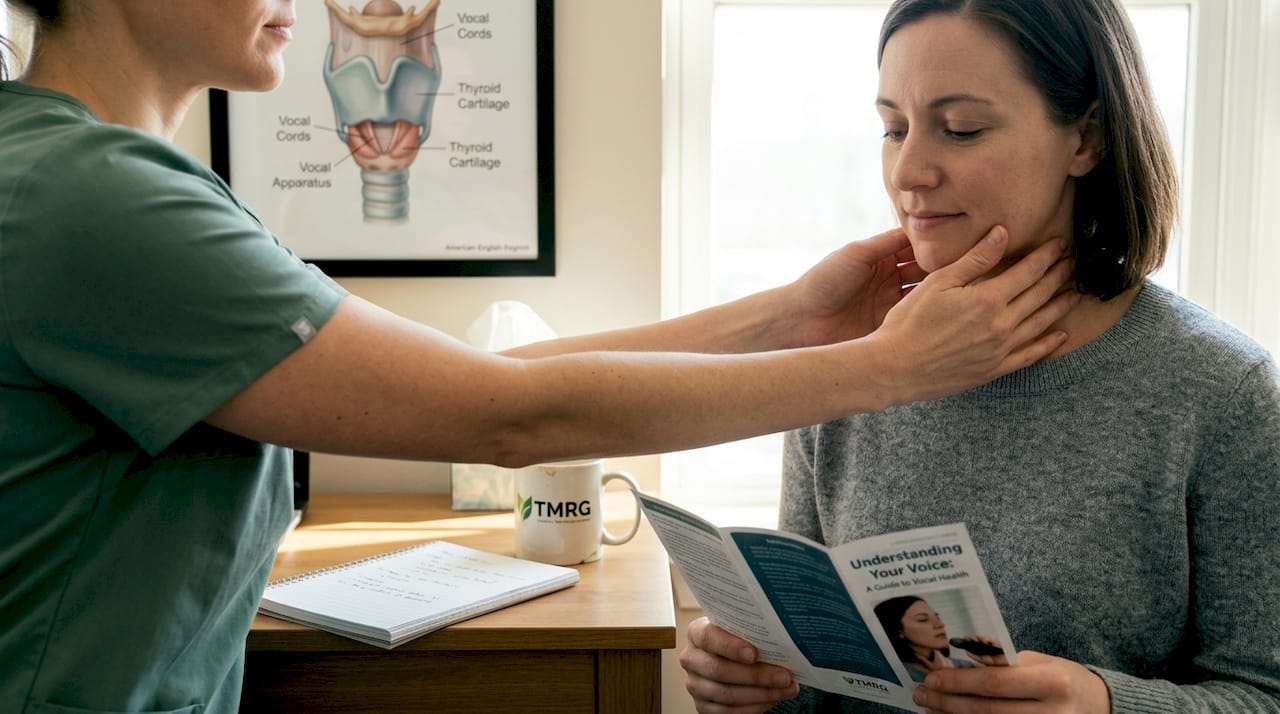
The clinical evidence is promising, though still developing. The same empirical study on LMT reported improvements across multiple acoustic measures after intensive treatment, as outlined below.
| Acoustic measure | What it reflects | Observed change after LMT |
|---|---|---|
| F0 (fundamental frequency) | Pitch stability and range | Improved toward normal range |
| Jitter | Cycle-to-cycle pitch variation | Reduced (indicating steadier tone) |
| Shimmer | Cycle-to-cycle amplitude variation | Reduced (indicating fuller, smoother voice) |
| CPP (cepstral peak prominence) | Overall voice clarity | Increased |
| HNR (harmonics-to-noise ratio) | Signal quality vs. breathiness | Improved |
These are not cosmetic improvements. For a singer, reduced jitter means a more controlled vibrato and better pitch accuracy. For a teacher or lecturer, improved HNR means a voice that carries clearly across a room with less effort.
Understanding the voice therapy benefits of approaches like LMT helps you make smarter decisions about your vocal care. Similarly, knowing the types of voice therapy available ensures you’re not treating laryngeal massage as an isolated fix when a broader plan will serve you better.
Pro Tip: Ask your voice therapist to record acoustic measurements before and after your LMT sessions. Objective data gives you a clear picture of progress and keeps your therapy goal-directed rather than based on subjective feelings alone.
It’s also worth noting that while evidence-based massage therapy for musculoskeletal conditions has a robust body of research behind it, voice-specific laryngeal massage still relies largely on small-scale studies and clinical case reports. Randomized controlled trials (RCTs) are needed to establish stronger benchmarks. This doesn’t diminish its value, but it does mean you should approach it as one component of a complete vocal health strategy.
After reviewing the mechanisms and outcomes, consider who should seek laryngeal massage and where it fits in the bigger picture of vocal health.
The voice professionals who benefit most from laryngeal massage share a common profile: high vocal demand, insufficient recovery time, and a pattern of pushing through fatigue rather than addressing it. This includes touring singers performing night after night, classroom teachers using their voices for six or more hours daily, actors in intensive rehearsal periods, and public speakers with dense conference schedules.
The evidence for laryngeal manual therapies identifies several clear benefits for appropriate candidates:
However, laryngeal massage is not appropriate for every situation. Understanding its limitations protects you from misusing it or delaying necessary medical care.
| Situation | Is LMT appropriate? | Recommended alternative |
|---|---|---|
| Muscle tension dysphonia (MTD) | Yes, strong candidate | LMT combined with voice therapy |
| Vocal nodules or polyps | No, may aggravate tissue | Medical evaluation and possible surgical consult |
| Laryngeal inflammation or infection | No | Medical treatment first |
| Vocal fatigue from overuse | Yes, as part of recovery | LMT plus vocal hygiene practices |
| Structural cartilage abnormalities | No | Specialist referral |
| Chronic hoarseness with unknown cause | Evaluate first | Laryngoscopy before any manual therapy |
If you’ve been treating hoarseness without clear improvement, a full laryngoscopic evaluation (a camera-based examination of the vocal folds) is essential before pursuing LMT. You need to rule out structural issues before applying any manual technique to the larynx.
Self-massage of the laryngeal area is strongly discouraged. The risk of compressing blood vessels, triggering a vagal nerve response, or applying pressure in the wrong direction is real and can result in immediate harm. Pair LMT with vocal support exercises under professional supervision for safe, progressive results. For those curious about general relaxation massage at home, at-home relaxation massage techniques are fine for the shoulders and upper back but should never be adapted for the laryngeal region without clinical training.
Understanding the benefits and limitations, now let’s get practical with how to make laryngeal massage work for you.
The most effective approach is to treat laryngeal massage not as a crisis intervention but as a regular feature of your vocal maintenance routine. The evidence for laryngeal manual therapies supports its role in ongoing prevention, particularly for touring singers and educators who face sustained vocal demand. Think of it the way an athlete thinks about sports massage: not a luxury, but a recovery necessity.
Here is how to build a sustainable integration plan:
Understanding the full scope of natural voice recovery options helps you build a complete plan rather than relying on a single technique. When you’re ready to assess your individual needs, resources to help you choose voice solution strategies tailored to your situation make the process more focused.
Pro Tip: After a laryngeal massage session, avoid loud or high-pitched singing for at least 30 minutes. The muscles need time to integrate the new, relaxed position before being asked to perform again. Think of it as letting the reset fully settle in.
The role of massage in recovery is well-established in sports and physical rehabilitation contexts. Applying that same recovery mindset to your voice means treating your vocal instrument with the same structured care an athlete gives to a major muscle group.
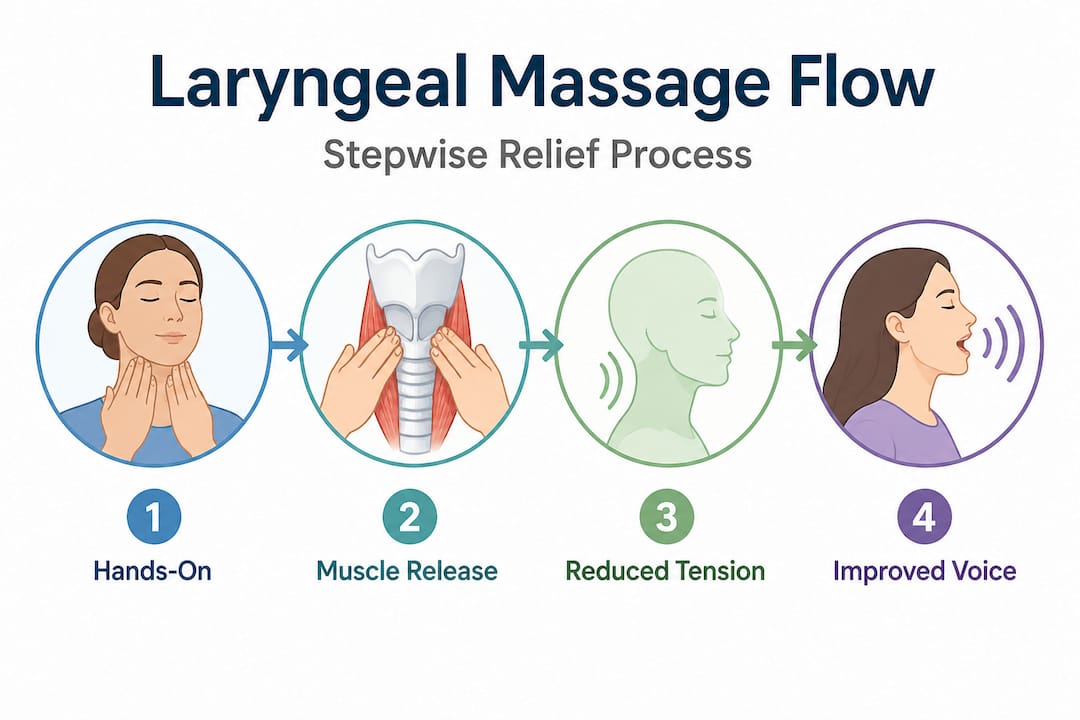
Most articles about laryngeal massage stop at explaining what it is and listing its benefits. That’s useful, but it misses the more important clinical reality.
Rapid relief from a skilled laryngeal massage session is real. Many clients feel a noticeable change in voice quality within a single session. That immediate improvement is part of what makes the technique so compelling, especially for voice professionals desperate for a solution before a performance. But here’s what that quick win can obscure: rapid relief is not the same as lasting correction. If the behavioral patterns, technical habits, or environmental demands that created the tension in the first place remain unchanged, the muscles will return to their hypertonic state within days. You’re back where you started.
Laryngeal massage shines brightest when it’s the starting point for deeper change, not the endpoint. The most clinically successful cases involve massage unlocking the physical capacity for easier voicing, then pairing it immediately with behavioral voice therapy, technical retraining, and habit changes. The massage opens the door. What you do after you walk through that door determines whether the result is temporary or transformational.
Most mainstream resources also miss a subtler point. Many voice professionals develop laryngeal tension not from bad technique alone but from anxiety, performance pressure, and overbracing against vocal failure. The larynx is exquisitely sensitive to psychological state. A voice professional who is constantly bracing against cracking or going flat will habitually elevate and tighten the larynx, regardless of how good their technique is. LMT can address the physical manifestation of that anxiety, but cognitive and behavioral work must accompany it.
The empirical study on LMT confirms that while results are promising, the evidence base remains small and RCTs are still needed. This is not a reason for skepticism but a reason for clinical humility. The technique works best when the clinician and client approach it as part of a broader strategy, not a shortcut. Explore natural recovery for pros to understand what a genuinely complete vocal health plan looks like.
You’ve just taken in a substantial amount of knowledge about laryngeal massage and vocal health. Now it’s time to put that knowledge into action with tools specifically built for voice professionals.

At TMRG Solutions, our 25+ years of experience in vocal health means we’ve designed solutions that work alongside therapeutic approaches like LMT, not instead of them. Whether you’re dealing with vocal fatigue after a tour, working through chronic strain, or simply want to protect your voice before problems develop, we have a kit calibrated to your situation. Start with our voice therapy kit basic for foundational daily vocal care, step up to the voice therapy kit standard for more comprehensive support, or invest in the voice therapy kit premium if you’re a high-demand professional needing full-spectrum vocal wellness. Your voice is your instrument. Give it the care it deserves.
Laryngeal massage is generally safe when performed by a trained clinician, but should be avoided when vocal structural abnormalities are present. Always get a laryngoscopic evaluation before beginning LMT if your voice issues are undiagnosed, as the evidence for structural contraindications is clear.
Many clinicians report rapid relief, often after just one to three sessions, particularly for muscle tension dysphonia. However, the empirical benchmarks from LMT studies urge integration with comprehensive therapy for lasting results.
Self-application is not advised due to the risk of injury to blood vessels, nerves, and cartilage in the neck area. Always work with a certified professional, as guidance from clinical evidence consistently cautions against self-massage.
It can significantly help when muscle tension is the underlying cause, but remains ineffective for structural vocal fold problems such as nodules, polyps, or scarring. The evidence on structural limitations makes accurate diagnosis the essential first step before choosing this treatment path.
