Your Cart is Empty


TL;DR:
- Vocal support involves the deliberate coordination of respiratory muscles to manage subglottic air pressure efficiently, enabling strain-free voice production.
- Proper support enhances voice power, control, and durability, while misconceptions about pushing air or forceful breathing lead to strain and damage.
Most singers and speakers assume that vocal support means breathing harder or pushing more air through the voice. That assumption causes more vocal damage than almost any other misconception in the field. What is vocal support, really? It is the voluntary, coordinated engagement of your respiratory muscles to manage the air pressure beneath your vocal folds, allowing them to vibrate efficiently, without force, and without strain. Get this coordination right, and your voice becomes more powerful, more controlled, and far more resilient. Get it wrong, and fatigue, tension, and injury follow.
| Point | Details |
|---|---|
| Support is not about force | Vocal support means managing air pressure efficiently, not pushing harder or increasing breath volume. |
| Anchoring stabilizes the whole body | Larger muscle groups in the torso and neck brace the vocal mechanism, not just the diaphragm. |
| Optimal pressure is surprisingly low | Phonation threshold pressure typically ranges from just 2 to 5 cm H2O for healthy voice production. |
| SOVT exercises are your best tool | Straw phonation and lip trills train pressure balance and reduce vocal fold strain simultaneously. |
| Stress actively disrupts support | Physical exertion alters pitch, intensity, and speech rate, making conscious support even more critical. |
Vocal support is the voluntary coordination of respiratory muscles to manage subglottic air pressure — the air pressure sitting just below your vocal folds — so that those folds can vibrate with minimal effort and maximal efficiency. Think of it less like pumping fuel and more like regulating water pressure in a hose. Too much pressure and the flow becomes uncontrollable. Too little and nothing comes out.
At the center of this process is a concept called phonation threshold pressure, or PTP. This is the minimum amount of subglottic pressure your body needs to set the vocal folds into vibration. Research shows that PTP typically measures between 2 and 5 cm H2O, which is remarkably low. That figure surprises most people when they first encounter it. The voice does not need brute force. It needs precision.
Here is how the system works in practice:
The key word in all of this is efficiency. Efficient support requires managing airflow by engaging muscles like the external intercostals, pectorals, and lats to expand the chest cavity and delay exhalation. That delay is what gives your voice stability, sustain, and power without tightness.
The biggest myth is that vocal support means pushing air. In reality, pushing air drives subglottic pressure above the PTP threshold, forcing the vocal folds to work against the air stream rather than riding it. The result is a tighter, thinner sound and a faster path to vocal fatigue.
Many voice disorders stem directly from excessive muscle tension and over-pressurization. Professional vocal technique focuses on minimizing effort while maximizing acoustic output, not the other way around.
The second major myth is that support only matters for big, powerful voices. Opera singers, yes. Rock belters, sure. But the Estill Voice Model makes a compelling case that anchoring benefits all voice qualities, including soft and legato singing. The physical stability that anchoring provides allows your smaller laryngeal muscles to do their job without being recruited as backup stabilizers. Without that stability, even a gentle piano phrase can produce unnecessary tension.
A third myth worth addressing: many people believe that more support automatically means more volume. It does not. Resonant Voice Therapy teaches singers and speakers to achieve a forward focus in voice placement, directing vibration toward the lips and front of the face rather than pushing from below. This approach reduces the force with which the vocal folds collide on each vibration cycle. Less collision force means less tissue wear, better tone, and more sustainable output.
Pro Tip: If your throat feels tired after 20 minutes of singing or speaking, you are almost certainly over-pressurizing. Try reducing your breath effort by 20 percent and notice whether your tone actually improves. Most people are shocked that it does.
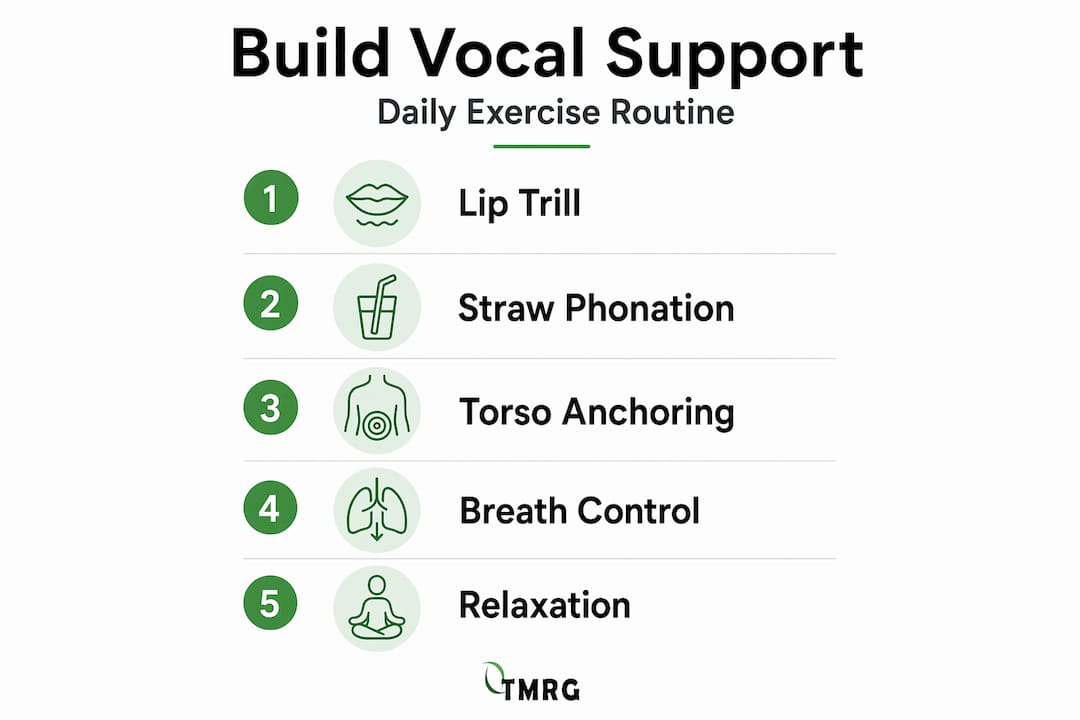
Building vocal support is not about doing more. It is about training the right coordination patterns until they become automatic. The most evidence-backed place to start is with Semi-Occluded Vocal Tract exercises, or SOVT work. These are techniques that partially block the vocal tract at the lips or teeth, which creates a natural backpressure that balances subglottic pressure and reduces strain during phonation.
Here is a daily routine you can start with today:
For detailed vocal cord relaxation exercises that complement this routine, the Tmrgsolutions resource library offers targeted guidance.
Pro Tip: Anchoring during these exercises means bracing your torso gently, as if bracing for a slow punch, without holding your breath. This engages the larger muscle groups that stabilize the vocal mechanism and frees your larynx to work with less effort.
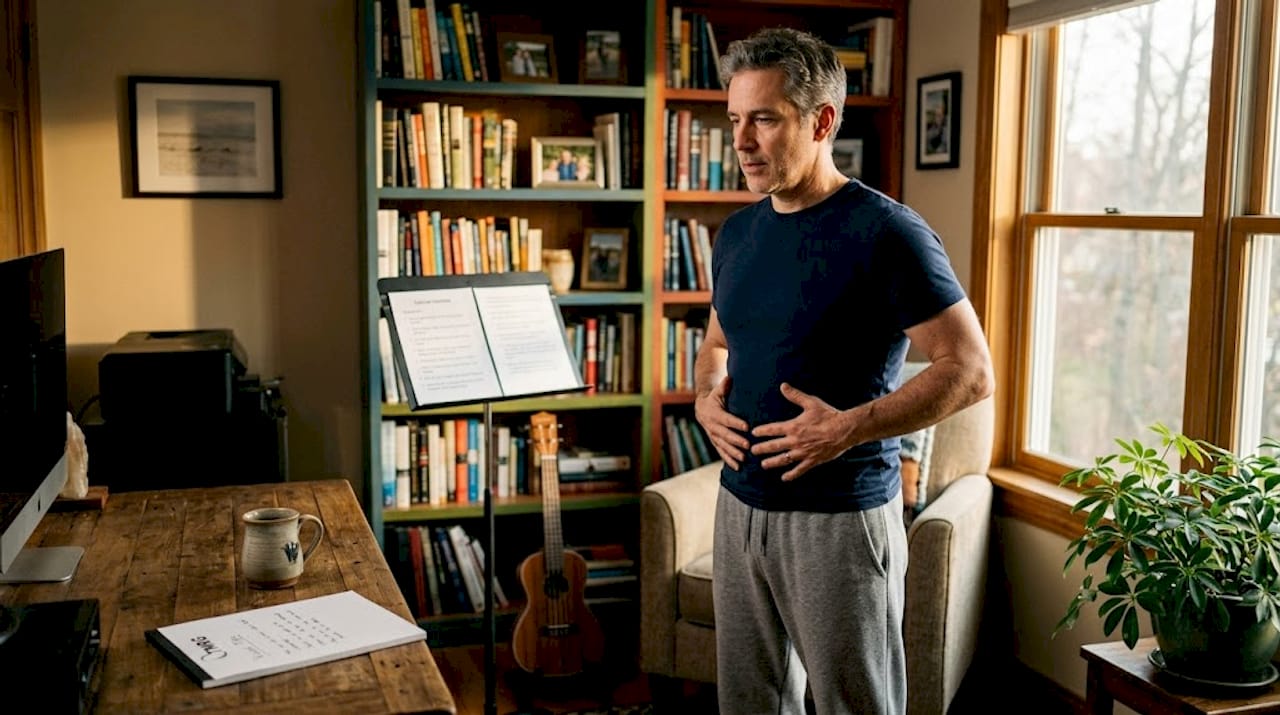
Your body does not prioritize singing when it is under physical stress. Research on the neuroscience of voice demonstrates that physical stress changes pitch, intensity, and speech rate measurably, with pitch and loudness rising, speech rate slowing, and pauses becoming more frequent. This happens because your respiratory system is now competing between breathing for life and breathing for voice.
That competition matters enormously if you perform, teach, or speak professionally. The following table shows what physical stress does to your vocal output and what support can do to counteract it.
| Stress effect | What happens | Support response |
|---|---|---|
| Increased respiratory rate | Less controlled exhalation, unstable pressure | Slow the breath cycle consciously |
| Rising pitch and intensity | Vocal folds under excess tension | Anchor the torso, reduce jaw tension |
| Slowed speech rate | Compensatory breathing pattern | Use pauses strategically, not reactively |
| Increased vocal fatigue | Muscles recruited outside their primary role | Return to forward focus, reduce effort |
The lesson here is that maintaining vocal support under exertion is not automatic. It is a trained response. Singers who rehearse specifically under mild physical fatigue, such as after a brisk walk, develop the neuromuscular memory to maintain support when it counts most. For additional context on managing these dynamics, Tmrgsolutions covers the relationship between stress and vocal performance in depth.
Voice therapy is not just for people with serious vocal disorders. It is one of the most effective tools available for anyone who relies on their voice and wants to use it more efficiently. The importance of vocal support in clinical settings is well established, and the results speak clearly.
Licensed speech-language pathologists who specialize in voice work with a full spectrum of patients, from teachers with chronic hoarseness to professional singers recovering from nodules. Research shows that voice therapy improves outcomes for more than 50 percent of patients with unilateral vocal fold paralysis, often eliminating the need for surgery entirely.
What these therapies have in common is their shared focus on efficiency over force:
The clinical evidence is consistent. Building efficient vocal support techniques produces better acoustic results and longer-lasting vocal health than trying to force a bigger sound. If you are experiencing persistent hoarseness, fatigue after short vocal use, or reduced range, a voice-specialized speech-language pathologist is the right first call.
I have worked with vocal health for over two decades, and the misunderstanding I see most often is not a lack of knowledge. It is a physical habit. People feel that they need to do more to sound better. So they push. They engage the throat. They press air through a tight jaw. And every session reinforces the habit.
What I have learned, both through study and through working with singers and speakers who came to us after years of vocal problems, is that support is not effort in the conventional sense. It is the opposite. When I started treating it as a matter of body stability rather than breath volume, everything changed: more stamina, cleaner tone, and far less fatigue by the end of a long performance day.
The anchoring concept from the Estill model was genuinely transformative for me. Realizing that bracing through the torso and grounding through the feet could free up the larynx entirely shifted how I coached and practiced. The voice does not need to be pushed from below. It needs to be held from around. That distinction sounds subtle. In practice, it is the difference between a voice that lasts and one that does not.
My honest advice: treat vocal support as a coordination skill, not a strength exercise. Be patient with it. The results build gradually, and then they stick.
— Golan

If this article has clarified what vocal support is and why it matters, the next step is putting it into consistent practice. Tmrgsolutions has spent 25+ years developing voice therapy solutions for singers, actors, lecturers, and speakers who need their voice to perform reliably. The voice therapy kit range includes Basic, Standard, and Premium options, each built around evidence-based exercises and expert-guided protocols that complement exactly the kind of support training covered here. Whether you are starting from scratch or recovering from vocal fatigue, there is a kit matched to your level. Explore the full range of vocal health solutions and find the right tools to support your voice for the long term.
Vocal support is the coordinated engagement of your respiratory and stabilizing muscles to manage the air pressure beneath your vocal folds, allowing efficient, strain-free voice production. It is about precision and coordination, not force.
Common signs include vocal fatigue after short periods of use, a tight or pressed throat sensation, reduced pitch range, and a voice that sounds thin or unstable when you try to sing or speak louder.
Semi-Occluded Vocal Tract exercises like straw phonation and lip trills are among the most effective. A daily routine of neck stretches, humming, and sirens performed with intentional torso anchoring builds support coordination over time.
Yes, with consistent and careful practice. SOVT exercises and anchoring techniques can be self-taught using evidence-based resources. However, if you have persistent vocal issues, working with a licensed speech-language pathologist is strongly recommended.
Absolutely. Teachers, actors, public speakers, and anyone who uses their voice professionally benefits from trained vocal support. Physical stress alone can disrupt support patterns, making conscious training relevant for all voice users, not just singers.
