Your Cart is Empty


TL;DR:
- Voice loss in actors results from cumulative inflammation caused by daily vocal stress and environmental irritants. Preventative measures like proper hydration, technique, and vocal rest significantly reduce injury risk and promote recovery. Addressing hidden daily workload and muscle tension is essential for sustaining long-term vocal health.
Voice loss is not a random event for actors. It is the predictable result of compounding physical demands that most performers don’t recognize until serious damage is already done. Understanding why do actors lose voice goes well beyond the obvious answer of “too much talking.” Your vocal folds are small, sensitive structures navigating enormous daily stress from rehearsals, travel, environmental irritants, and emotional intensity. When you understand the mechanics behind that stress, you gain the ability to act before a whisper becomes a crisis.
| Point | Details |
|---|---|
| Voice loss is cumulative | Inflammation builds from daily workload, not just stage time, until it reaches a critical, damaging threshold. |
| Muscle tension is a hidden cause | Excess tension in the jaw, neck, and shoulders directly harms vocal quality and can trigger dysphonia. |
| Whispering worsens recovery | Whispering increases vocal fold strain during injury and should be avoided during recovery periods. |
| Early hoarseness is a warning sign | Hoarseness lasting beyond four weeks requires medical evaluation to rule out structural damage. |
| Prevention outperforms reaction | Consistent warm-ups, hydration, and vocal hygiene protect the voice far more than post-injury treatment. |
Your voice begins with two small folds of mucous membrane stretched across your larynx. When air from your lungs passes through them, they vibrate rapidly to create sound. And rapidly is not a figure of speech. Vocal cords collide hundreds of times per second, and every performance multiplies that impact across thousands of repetitions.
When the tissue lining the vocal folds sustains more collision force than it can recover from between uses, inflammation sets in. That inflammation is the body’s standard repair response. The problem is that actors rarely give that repair process enough time to complete before the next demand arrives.
The most common cause of voice loss in professional performers is functional dysphonia, a condition in which the voice breaks down not because of disease, but because of how the voice is being used. Voice loss is primarily caused by functional dysphonia through vocal misuse and overuse, or by organic causes like infections and trauma.
Phonotrauma refers to the physical injury caused by repeated or forceful vocal fold collision. A loud monologue delivered eight times a week, shouting during emotional scenes, or even aggressive projection without proper breath support all count as phonotraumatic events. Over time, swollen tissue hardens into nodules or develops fluid-filled polyps, both of which fundamentally change how the folds close and vibrate.
Laryngitis, whether viral or bacterial, inflames the mucous lining of the larynx and causes the vocal folds to swell. That swelling prevents them from closing cleanly, which is why your voice sounds rough or drops out completely. Actors often mistake early laryngitis for ordinary voice fatigue and push through it. That decision carries real cost. Untreated vocal injury can progress to hemorrhages and structural damage that sometimes require surgery.
Pro Tip: If your voice sounds thin or feels rough after rest and warm water, treat it as a warning, not an inconvenience. What feels like temporary fatigue may be early-stage inflammation that two days of vocal rest could resolve completely.
Here is what most actors don’t account for: the stage is only one part of your vocal day. Every press interview, soundcheck, meet-and-greet, and late-night conversation in a noisy restaurant adds to what clinicians call your total vocal workload.
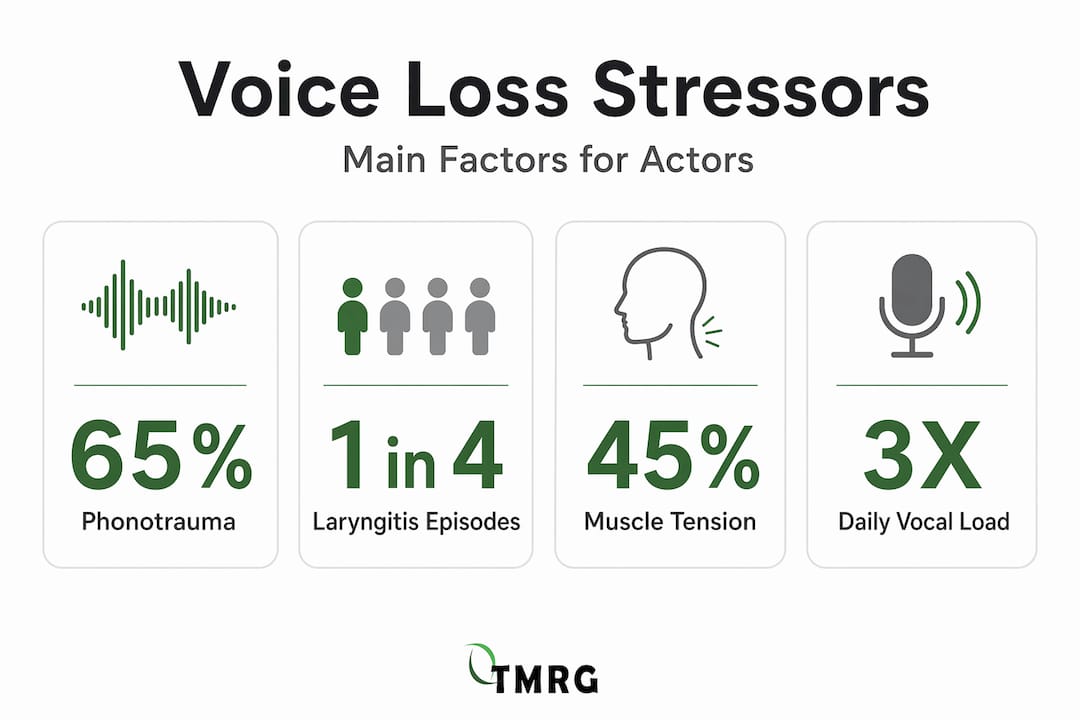
Cumulative vocal workload includes not only stage time but also press, soundchecks, meet-and-greets, and travel, increasing inflammation risk to a critical level. Think of inflammation like water filling a bucket. Each individual stressor might only add a few drops, but when the bucket reaches full, any added drop causes an overflow. That overflow is your voice loss event, and it feels sudden even though it was days or weeks in the making.
Environmental factors accelerate this process faster than most performers realize:
Environmental irritants like stage smoke and dry air increase susceptibility to reaching critical inflammation levels. Recovery days are not optional extras. They are physiological necessities. A single true vocal rest day mid-week can reduce inflammation enough to prevent the cascade that ends a run.
Statistic to note: Pharmaceutical antihistamines used to manage allergy symptoms may dry the vocal folds, worsening the very condition actors are trying to treat. Natural compounds like quercetin offer inflammation management without that drying side effect.
Vocal misuse is not always about volume. Some of the most damaging habits are subtle, and they live in your body rather than in your voice.

Muscle Tension Dysphonia is caused by excess tension in the larynx, jaw, neck, and shoulders, producing voice fatigue and hoarseness in performers. When you carry tension in these areas, your larynx rises and the vocal folds are held at a mechanically disadvantaged position. The result is a thinner, strained sound that requires more effort to produce. More effort means more collision force. More force means more inflammation.
The comparison below shows how healthy vocal technique differs from common patterns of misuse:
| Vocal behavior | Healthy technique | Problematic pattern |
|---|---|---|
| Breath support | Diaphragmatic, consistent airflow | Shallow chest breathing, gasping between lines |
| Larynx position | Relaxed, neutral position | Raised, held high under tension |
| Jaw and neck | Loose, unrestricted movement | Clenched jaw, rigid neck muscles |
| Volume production | Resonance-driven projection | Pushing from the throat to increase volume |
| Vocal pacing | Planned rest between sections | Running at full demand throughout rehearsals |
Physical tension in the jaw and neck muscles profoundly affects vocal quality and control. Releasing this tension is not optional for performers under heavy workloads. It is a clinical requirement.
Actors often develop these patterns while trying to achieve specific vocal effects for a character without receiving proper technical guidance. The desire to sound gravelly, strained, or intense for a role can produce exactly the injury that removes the actor from the role entirely.
Pro Tip: Before any rehearsal or performance, spend three minutes releasing jaw tension by gently massaging the masseter muscles at the sides of your jaw, followed by slow neck rolls. This physical reset can lower your larynx and reduce collision force throughout your entire session.
Prevention is not a passive process. For actors under professional demand, consistent vocal habits and preventative care are far more effective than reactive treatments. Here is a practical framework you can build into your performance schedule:
For ongoing proactive vocal health strategies that complement these steps, Tmrgsolutions has built a resource library specifically for performers navigating high-demand schedules.
When I look back on the actors I have worked with over the years, one pattern stands out more than any other. They all understood that performing was hard on the voice. None of them had genuinely calculated their total daily vocal load.
I have spoken with performers who were meticulous about stage warm-ups and still ending runs early with nodules. When we tracked their full vocal day together, the picture clarified immediately. Three interviews before noon. Lunch with the cast where background noise pushed conversation volume up without anyone noticing. Soundcheck with a monitor mix that was slightly too low, causing them to push to hear themselves. Then a full show. Then a meet-and-greet. Then dinner. That is not a performance schedule. That is a vocal injury schedule disguised as a career.
What I have learned is that the voice does not lie. Thin sound, pressed quality, or a range that starts shrinking are not artistic limitations. They are measurements of cumulative load. The actors who sustain long careers are not necessarily those with the strongest voices. They are the ones who respect the bucket-filling model and take genuine rest before overflow becomes the only teacher.
If you are reading this article, you are already ahead of the performers who wait until they cannot speak. Treat your daily vocal care routine as seriously as your character work. One supports the other.
— Golan
Actors carry an enormous vocal load, and knowledge alone does not protect the folds. Tmrgsolutions has been developing natural vocal health solutions for over 25 years, specifically for performers who cannot afford to lose their voice mid-season.

The Premium Voice Therapy Kit is built for professional voice users including actors, speakers, and singers under sustained high demand. It combines natural herbal formulations, structured recovery protocols, and targeted support tools designed to work alongside professional voice therapy. If you are earlier in your vocal care journey, the Standard Voice Therapy Kit offers a strong entry point with practical resources matched to performing schedules. Both options are grounded in evidence-based vocal health principles and endorsed by vocal coaches and medical professionals who understand what actors actually go through.
Actors lose their voice mid-run because cumulative inflammation from daily rehearsals, travel, press, and environmental irritants reaches a critical threshold. The voice does not fail suddenly. It collapses after days of compounded stress without sufficient recovery.
The most common voice problem in acting is functional dysphonia, caused by vocal misuse or overuse rather than infection. Muscle Tension Dysphonia is also widely reported, driven by excess tension in the larynx, jaw, and neck.
No. Whispering is not a safe alternative to speaking when the voice is injured. It increases muscular effort and tension in the vocal folds, often worsening inflammation rather than allowing recovery.
Hoarseness that persists beyond four weeks or occurs without a clear cause should prompt a medical evaluation. A laryngoscopy can identify nodules, polyps, or hemorrhages before they require surgical intervention.
Natural compounds like quercetin can support inflammation management without the vocal-drying effects associated with pharmaceutical antihistamines. They work best as part of a broader recovery plan that includes vocal rest, hydration, and professional voice therapy.
