Your Cart is Empty


TL;DR:
- Throat pain while singing often results from muscle tension dysphonia caused by poor technique and overuse. Proper rest, technique correction, and vocal care routines help most singers recover quickly and prevent lasting damage. Seek professional help if pain persists beyond two to four weeks or if voice changes occur.
Throat pain while singing is defined as muscular strain or inflammation in the laryngeal region caused by poor vocal technique, overuse, or underlying physical conditions. The clinical term for the most common cause is muscle tension dysphonia (MTD), a condition where the muscles surrounding the vocal folds tighten excessively during phonation. Understanding why does my throat hurt singing is the first step toward protecting your voice and performing without pain. The good news is that most cases respond well to targeted technique corrections, proper rest, and consistent vocal care routines.
Throat pain after singing is primarily a symptom of muscle tension dysphonia caused by muscular strain around the larynx. MTD is especially common among singers, teachers, and anyone who demands sustained voice use from their body. The larynx sits at the top of the airway, and the vocal folds inside it vibrate to produce sound. When the muscles around that structure tighten beyond what healthy phonation requires, you feel it as soreness, fatigue, or a raw burning sensation.
Throat pain during singing is rarely due to lack of talent. It is mostly the result of poor muscular coordination and tension elsewhere in the body that transfers directly to the throat. That distinction matters because it means the problem is correctable. Technique changes, targeted exercises, and proper recovery habits address the root cause rather than just masking the symptom.
Persistent pain beyond 2–4 weeks always merits medical evaluation. Short-term soreness after a long rehearsal is common. Pain that lingers, or that comes with voice changes, points to something that needs professional attention.
The vocal folds are two small bands of tissue that open and close rapidly to produce sound. Healthy singing requires those folds to vibrate freely, supported by a steady column of air from the diaphragm. When that support breaks down, the body compensates.

Improper breath support causes the throat muscles to tighten defensively, creating a “closing throat” sensation and accelerating vocal fatigue. This is a neurological feedback loop. The laryngeal muscles sense insufficient airflow and grip harder to maintain sound production. The result is a voice that feels tight, thin, and strained.
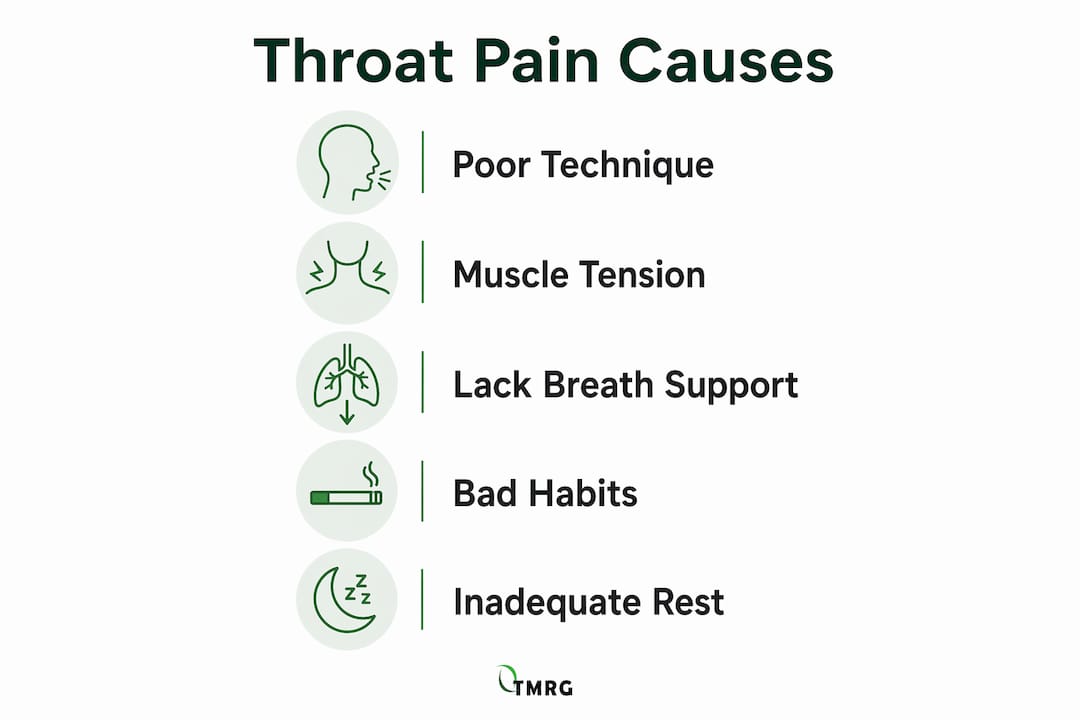
Posture plays a direct role in this cycle. Forward head posture and a collapsed chest restrict the resonating space in the throat and force compensatory muscle constriction around the larynx. Singers who hunch over a microphone or tilt their chin upward to reach high notes are especially vulnerable to this pattern.
Common muscle tension patterns seen in singers include:
Pro Tip: Place two fingers lightly on the sides of your larynx while you sing a sustained note. If you feel the larynx rise sharply or the muscles harden under your fingers, tension is already building. Consciously drop your shoulders and breathe deeper to release it.
Many singers develop throat pain not from one dramatic mistake but from a collection of small daily habits that compound over time. Recognizing these patterns is the fastest way to stop the cycle.
Singing “from the throat” instead of from proper breath support is the most common culprit. When the diaphragm does not drive the airflow, the throat muscles take over as the primary power source. That is a job they were never designed to do, and they fatigue quickly.
Skipping warm-ups and cool-downs leaves the vocal folds unprepared for the mechanical demands of singing. A cold muscle is a tight muscle. Starting a rehearsal at full volume without a gradual warm-up is the vocal equivalent of sprinting without stretching.
Singers pushing to produce power in loud environments cause their vocal folds to slam together, triggering protective muscle tightening that leads directly to pain. Performing over loud bands or in noisy rooms without adequate monitoring forces singers to push harder than their technique can safely support.
Additional habits that worsen throat discomfort in singers:
Pro Tip: If you sing in a loud environment regularly, invest in in-ear monitors. Hearing yourself clearly at a lower volume removes the instinct to push, and that single change can eliminate a significant portion of your throat pain.
Prevention and recovery share the same foundation: releasing tension before it compounds and giving the vocal folds the conditions they need to heal.
A structured pre- and post-session release routine makes a measurable difference. A 3–5 minute routine of laryngeal massage and jaw release lowers vocal fatigue by 50–70% and prevents tension from building across sessions. That is not a minor benefit. It means the voice you bring to Friday’s performance is not already carrying the strain from Monday’s rehearsal.
Follow these steps for a basic release routine:
True vocal rest means silence. Whispering is not restful because it activates vocal fold adduction and muscular tension. If your throat is sore after a performance, 24–48 hours of genuine silence combined with consistent hydration gives the tissue the best chance to recover.
Hydration works from the inside out. Drinking water keeps the mucus layer on the vocal folds thin and slippery, reducing friction during vibration. Avoid alcohol, caffeine, and smoking, all of which dry and irritate the mucosal lining.
| Prevention strategy | Recovery strategy |
|---|---|
| Diaphragmatic breath support | 24–48 hours of true vocal rest |
| Pre-session warm-up (lip trills, siren glides) | Post-session laryngeal massage and jaw release |
| In-ear monitors in loud environments | Consistent water intake throughout the day |
| Correct posture and head alignment | Avoid whispering, alcohol, and caffeine |
| Manage acid reflux and stress proactively | Seek vocal strain evaluation if pain persists |
Most throat discomfort from singing resolves within a few days of rest and good care. Certain signs, however, indicate that the problem has moved beyond self-care territory.
Seek evaluation from an ENT specialist or a speech-language pathologist if you notice any of the following:
Chronic unresolved muscle tension compounds vocal fatigue from session to session. Without release work, residual tightness builds into a progressively strained voice that becomes harder to correct over time. Early intervention prevents that escalation.
An ENT can use laryngoscopy to view the vocal folds directly and rule out lesions, polyps, or nodules. A speech-language pathologist specializing in voice disorders can provide voice therapy targeting the specific tension patterns causing your pain. Acid reflux effects on the vocal cords are also worth investigating if you experience frequent heartburn alongside throat discomfort, since reflux is a common and often overlooked contributor to chronic vocal irritation.
Throat pain when singing is caused by muscle tension dysphonia, poor breath support, and compounding habits that the right technique and recovery routine can fully address.
| Point | Details |
|---|---|
| Root cause is muscle tension | Muscle tension dysphonia from poor technique causes most singing-related throat pain. |
| Breath support is the fix | Diaphragmatic airflow prevents the throat from tightening to compensate for weak breath. |
| True rest means silence | Whispering increases vocal fold tension and slows recovery after strain. |
| Release routines prevent buildup | A 3–5 minute post-session routine stops tension from compounding across rehearsals. |
| Persistent pain needs evaluation | Hoarseness or pain lasting more than 2–4 weeks requires ENT or voice therapy assessment. |
Singers are, as a group, remarkably stubborn about their voices. I have worked with performers who treated throat pain as a badge of effort, something to push through rather than a signal to investigate. That mindset costs them months of recovery time they could have avoided with two days of rest and a technique adjustment.
The pattern I see most often is this: a singer develops mild tension from poor breath support, skips the cool-down because rehearsal ran long, and then wakes up the next morning with a sore throat. They whisper through the day thinking they are being careful. By the weekend, the tension has compounded and the voice is noticeably worse. What started as a one-day fix becomes a two-week problem.
The singers who maintain the healthiest voices are not necessarily the most talented. They are the most consistent. They warm up every time, even for a 20-minute practice. They do their release work after every session. They treat hydration as non-negotiable. And they ask for help early, before a minor issue becomes a structural one.
Integrating vocal wellness practices into your daily routine does not require hours of extra work. Five minutes before and after you sing changes the trajectory of your vocal health over months and years. The voice you protect today is the one that carries you through a long career.
— Golan
Tmrgsolutions has spent 25+ years developing natural remedies and therapy tools specifically for singers, actors, and voice professionals dealing with strain, hoarseness, and throat discomfort.

The TMRG Voice Clarity Trio combines soothing herbal formulations designed to hydrate the vocal folds and ease the inflammation that follows heavy vocal use. For singers dealing with recurring tension and fatigue, the Voice Therapy Kit Standard provides a structured recovery program with tools for muscle relaxation and vocal restoration. Both options are built around the same principle that guides every Tmrgsolutions product: the voice heals best when you give it the right conditions and the right support.
Mild throat fatigue after a long session is normal, but actual pain is a warning sign. Persistent soreness after singing points to muscle tension or vocal strain that needs to be addressed with technique correction and rest.
Most mild strain cases recover within a few days when singers avoid vocal use for 24–48 hours and stay well hydrated. Pain lasting more than 2–4 weeks requires professional evaluation.
Whispering does not rest the voice. It increases vocal fold tension and delays recovery. True vocal rest means avoiding all vocalization, including whispering, for the recommended rest period.
Immediate vocal rest combined with consistent hydration is the most effective nonsurgical remedy for mild throat pain. A post-session natural recovery routine including laryngeal massage and jaw release also accelerates healing.
Yes. Stress and acid reflux both cause and worsen vocal tension. Emotional stress manifests as physical tightening in the neck and jaw, which transfers directly to the laryngeal muscles and increases throat pain during singing.
