Your Cart is Empty


TL;DR:
- Vocal strain presents early warning signs such as hoarseness, fatigue, throat tightness, and pitch instability, which can lead to structural damage if ignored. Recognizing these symptoms promptly and implementing rest, hydration, and proper vocal techniques can prevent chronic voice disorders. High-risk individuals, especially occupational voice users, should seek professional therapy when symptoms persist beyond a few weeks or worsen, to avoid long-term damage.
Vocal strain symptoms are the body’s direct warning signals that the vocal folds are being overworked, irritated, or damaged. Clinically, the condition is often called phonotrauma or vocal overuse syndrome, and it produces recognizable signs including hoarseness, voice fatigue, throat pain, and pitch instability. The Mayo Clinic and Cleveland Clinic both document these symptoms as early indicators of vocal stress that, when ignored, can progress to structural damage. Recognizing these signs early is the single most effective way to prevent chronic voice disorders.
Hoarseness is the most visible and widely recognized sign of vocal strain. Your voice may sound rough, raspy, or breathy because the vocal folds are swollen or not vibrating evenly. This change in voice quality can range from mild roughness in the morning to a near-complete loss of voice by evening.

Voice fatigue is the second major indicator. Vocal strain is cumulative and progressive, with voice quality deteriorating noticeably by the end of a heavy-use day. That end-of-day deterioration is a reliable sign that your vocal load has exceeded your vocal capacity.
Physical sensations in the throat and neck are equally telling:
Pro Tip: If your voice consistently sounds worse at the end of the day than at the start, that pattern alone confirms vocal overuse. Track when symptoms appear relative to your speaking or singing schedule. The timing tells you more than the symptom itself.
Vocal strain and serious voice disorders share overlapping symptoms, which makes early differentiation both difficult and critical. The key distinction lies in duration, progression, and the presence of structural change.
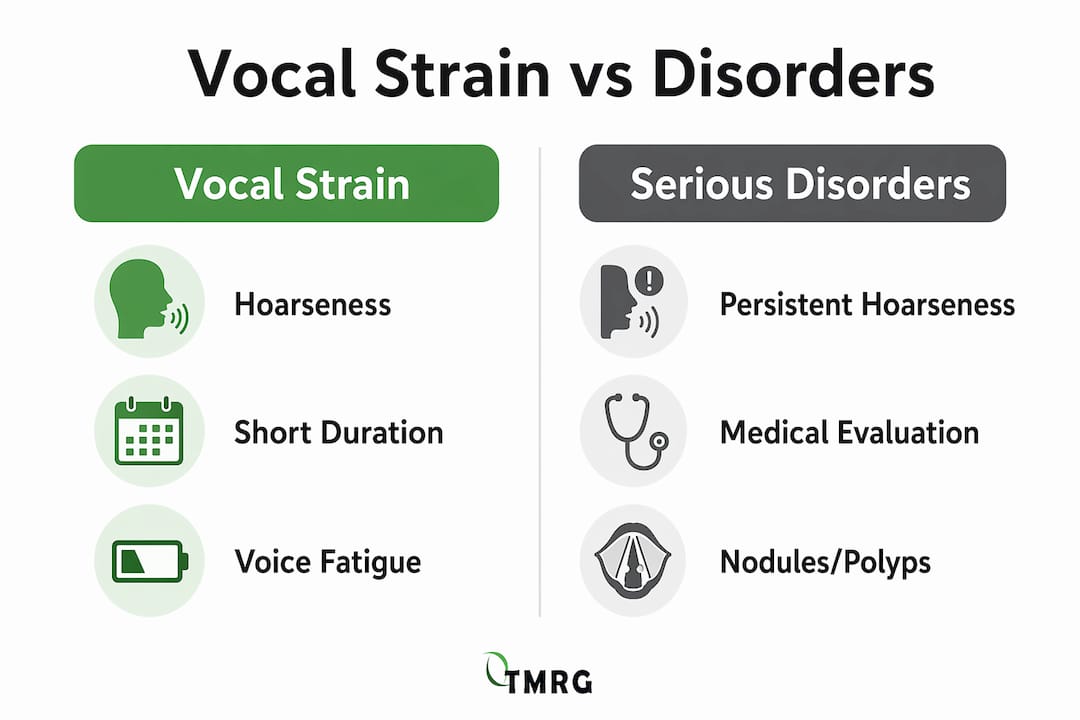
Hoarseness lasting more than 2 to 4 weeks, particularly without a cold or respiratory illness, requires medical evaluation to rule out conditions beyond simple overuse. Most acute laryngitis from vocal strain resolves within three weeks with rest and hydration. Persistence beyond that window signals something more serious.
Benign vocal cord lesions such as nodules and polyps account for 10 to 30% of voice disorders requiring clinical investigation. Vocal nodules, sometimes called singer’s nodes, develop from chronic overuse and produce symptoms nearly identical to acute strain. The difference is that nodule-related hoarseness does not fully resolve with short-term rest.
The table below summarizes the key differences to help you assess your situation:
| Condition | Typical symptoms | Duration | When to see a doctor |
|---|---|---|---|
| Vocal strain (acute) | Hoarseness, fatigue, throat tightness | Days to 3 weeks | If no improvement after 1 week of rest |
| Vocal nodules | Persistent hoarseness, reduced range | Weeks to months | Immediately if rest does not help |
| Vocal polyps | Breathy or rough voice, pitch breaks | Weeks to months | Promptly; polyps rarely self-resolve |
| Muscle Tension Dysphonia | Strained voice, neck tension, fatigue | Variable | When tension persists without structural cause |
| Neurological or malignant | Sudden voice loss, unilateral paralysis | Progressive | Urgent medical evaluation required |
Muscle Tension Dysphonia, or MTD, deserves special attention. It involves abnormal laryngeal muscle coordination rather than structural damage to the vocal folds. Treatment focuses on retraining muscle patterns rather than surgery, and early voice therapy produces strong outcomes. If your hoarseness is accompanied by significant neck tension and no structural lesion is found on examination, MTD is a likely diagnosis.
Neurological causes and malignancy are rare but serious. Sudden complete voice loss, a voice that sounds progressively weaker over weeks, or hoarseness combined with difficulty swallowing all require urgent evaluation. These are not vocal strain symptoms. They are red flags that demand immediate clinical attention. You can read more about persistent hoarseness prevention and when it signals something beyond overuse.
Vocal strain results from a biomechanical mismatch between the demands placed on the vocal folds and their capacity to perform. When the muscles surrounding the larynx work harder than necessary to produce sound, tension builds, blood flow to the tissue decreases, and the folds swell or stiffen.
The behaviors most directly responsible for vocal strain include:
Occupational voice users carry the highest risk. Nearly half of professional voice users report vocal fatigue often or always during work hours, and 27% report neck and shoulder tension directly linked to that fatigue. Teachers, singers, actors, call center workers, and public speakers all fall into this high-risk group. Educators in particular face specific vocal health challenges that require targeted management strategies.
Medical conditions compound the risk significantly. Acid reflux deposits stomach acid on the vocal folds, causing chronic irritation that mimics or worsens strain. Allergies produce postnasal drip that triggers throat clearing. Certain medications, including antihistamines and diuretics, dry out the vocal tract and reduce the protective mucus layer. Smoking causes direct tissue damage and chronic inflammation.
Environmental factors complete the picture. Dry air reduces mucosal hydration, making the folds more vulnerable to friction. High-noise environments force speakers to raise their volume. Chronic stress increases laryngeal muscle tension even before a word is spoken.
Relief from vocal strain symptoms follows a clear progression from immediate rest to long-term behavioral change. The steps below move from acute management to sustainable vocal health practice.
Pro Tip: Stop throat clearing. The globus sensation, that persistent lump-in-the-throat feeling, makes throat clearing feel necessary. But throat clearing repeatedly slams the vocal folds together and prolongs irritation. Replace the habit with a silent swallow or a small sip of water instead.
Vocal strain symptoms are early, reversible warnings. Recognizing them quickly and responding with rest, hydration, and corrected vocal behavior prevents temporary overuse from becoming permanent structural damage.
| Point | Details |
|---|---|
| Recognize symptoms early | Hoarseness, voice fatigue, throat tightness, and pitch changes are the primary indicators of vocal overuse. |
| Duration matters | Hoarseness persisting beyond 2 to 4 weeks requires medical evaluation to rule out nodules, polyps, or MTD. |
| Occupational risk is high | Nearly 48% of professional voice users experience frequent vocal fatigue, making pacing and technique critical. |
| Rest and hydration come first | Immediate voice rest and consistent water intake are the most direct treatments for acute vocal strain. |
| Therapy prevents chronic damage | Early voice therapy for muscle tension and technique errors avoids the need for surgical intervention later. |
The pattern I see most often is this: someone notices their voice getting rough or tired, assumes it will pass, and keeps pushing through. Weeks later, the symptoms are worse, the vocal folds have been under sustained stress, and what could have been resolved in a few days of rest now requires weeks of therapy.
The voice gives you clear signals. Hoarseness after a long day of teaching, a tight throat after a performance, a pitch that keeps breaking on notes you used to hit cleanly. These are not inconveniences. They are your vocal folds telling you the load has exceeded their capacity.
What I find most concerning is the cultural attitude toward voice rest. People apologize for not being able to speak at full volume. They push through presentations with a strained voice because canceling feels unprofessional. In reality, speaking through acute vocal strain is the equivalent of running on a sprained ankle. You are converting a minor injury into a structural one.
The most effective early intervention I have seen is simple: two days of genuine voice rest combined with proper hydration and a review of vocal technique. That combination resolves the majority of acute cases. What it requires is the willingness to recognize the symptoms for what they are and act before the damage compounds.
Education for occupational voice users, teachers, singers, and speakers, makes a measurable difference. When people understand that vocal strain is cumulative and that end-of-day deterioration is a warning rather than a normal state, they change their behavior. That change is where long-term vocal health begins.
— Golan
If your vocal strain symptoms have persisted beyond a few days of rest, or if you are a professional voice user looking to build a stronger vocal maintenance routine, Tmrgsolutions has developed targeted solutions with 25 years of vocal health expertise behind them.

The TMRG Voice Therapy Kit is designed specifically for singers, actors, and speakers managing vocal fatigue and strain. It combines natural herbal formulations, hydration support, and structured rehabilitation tools into a single system you can use at home. For those just beginning their recovery, the basic voice therapy kit offers an accessible starting point. Both options are built to complement professional voice therapy and help you return to full vocal function faster.
The earliest vocal strain symptoms are hoarseness, a rough or breathy voice quality, and a feeling of vocal fatigue by the end of the day. Throat tightness and mild soreness in the laryngeal area often appear alongside these changes.
Most acute vocal strain resolves within one to three weeks with voice rest and proper hydration. Hoarseness that persists beyond four weeks requires medical evaluation to rule out structural causes like vocal nodules or polyps.
Voice fatigue symptoms refer specifically to the progressive weakening of voice quality during or after use, while vocal strain is the broader condition that includes fatigue plus physical discomfort, hoarseness, and pitch changes. Fatigue is one symptom of strain, not a separate condition.
Acid reflux deposits stomach acid on the vocal folds, causing chronic irritation, hoarseness, and throat discomfort that closely mimic vocal overuse symptoms. Treating the reflux is a necessary part of resolving voice symptoms in affected individuals.
See a doctor if hoarseness lasts more than two to four weeks without a clear cause, if you experience sudden voice loss, pain when speaking, or difficulty swallowing. These signs go beyond typical vocal strain and require clinical evaluation.
