Your Cart is Empty


TL;DR:
- Vocal strain results from overuse or misuse of voice muscles, often causing hoarseness and fatigue. Most cases are functional, involving muscle tension without structural damage, and respond well to voice therapy. Prompt medical evaluation is essential if symptoms persist beyond two to three weeks or include severe discomfort or structural signs.
If your voice feels tired, rough, or just “off” after a long day of talking or singing, you are likely dealing with vocal strain. Vocal strain explained simply means that the muscles and tissues involved in producing your voice have been overworked or misused. Understanding this isn’t just reassuring. It’s the first step toward doing something about it. This article covers what vocal strain is, what causes it, how to recognize the symptoms, and what you can do to recover and protect your voice going forward.
| Point | Details |
|---|---|
| Vocal strain is functional | Most cases involve muscle tension and coordination problems, not permanent structural damage. |
| Muscle overuse is the top cause | Prolonged voice use, poor technique, and stress drive the majority of vocal strain cases. |
| Whispering makes it worse | True voice rest means silence and gestures, not whispering, which increases laryngeal tension. |
| Voice therapy works | Speech-language pathology treatment is the most effective path to full recovery and prevention of recurrence. |
| Persistent symptoms need evaluation | Hoarseness or strain lasting beyond 2 to 3 weeks requires medical review by an ENT specialist. |
Before you can understand why your voice hurts, you need a clear picture of what is happening inside your throat when you speak or sing.
Your voice originates in the larynx, commonly called the voice box, which sits at the top of your windpipe (trachea). Inside the larynx are two small bands of muscle tissue called the vocal folds (also known as vocal cords). When you breathe, they stay open. When you speak, the brain signals them to come together, and the air pressure from your lungs causes them to vibrate rapidly, producing sound.
What most people do not realize is that producing a healthy voice requires precise coordination between dozens of muscles, including the muscles that control the larynx, the tongue, the jaw, the neck, and the diaphragm. When that coordination breaks down, either from overuse, fatigue, or poor technique, the surrounding muscles compensate by gripping tighter. The result is what we call vocal strain.
Voice disorders are broadly defined as problems caused by swelling, inflammation, or impaired vocal cord movement that affect sound production. Vocal strain falls into one of two general categories:
Understanding this distinction matters because treatment differs significantly between the two. Functional strain responds well to voice therapy and behavioral changes. Structural issues may require medical intervention alongside therapy.
The most common functional cause of vocal strain is muscle tension dysphonia (MTD). MTD occurs when the muscles surrounding the larynx tighten excessively during voice use, rather than working with efficient, relaxed coordination. Think of it the way a runner develops shin splints from overuse and poor form. The voice muscles are no different. Repetitive misuse causes them to lock into patterns of excessive effort that strain the surrounding tissue and produce a weak, rough, or tired-sounding voice.
MTD involves coordination problems rather than anatomical vocal cord damage, which is actually good news. It means the condition is reversible with the right approach.
Beyond MTD, several other factors trigger vocal strain:
| Cause | Primary mechanism | Who is most at risk |
|---|---|---|
| Muscle tension dysphonia | Excessive laryngeal muscle tension | Singers, teachers, actors |
| Vocal overuse | Physical fatigue of vocal fold tissue | Lecturers, coaches, call center staff |
| Acid reflux (LPR) | Mucosal irritation from stomach acid | Adults with reflux history |
| Infection (laryngitis) | Viral or bacterial inflammation | Anyone during cold and flu season |
| Environmental irritants | Dryness and mucosal damage | Those in dry or smoky environments |
| Psychological stress | Increased neck and laryngeal muscle tension | High-stress occupations |
Pro Tip: If your voice feels strained mainly at the end of the workday or after vocally heavy tasks, this use-dependent pattern strongly suggests a functional cause like MTD rather than a structural problem. Track when symptoms appear to share with your healthcare provider.

Vocal strain symptoms vary in intensity, but most people notice a combination of the following:
A key pattern that distinguishes functional vocal strain from structural vocal problems is how symptoms behave over time. With MTD symptoms, the voice worsens with use and fatigue, then partially recovers with rest. This fluctuating quality is a reliable clinical sign that muscle coordination is the problem.
Structural issues, on the other hand, tend to produce more consistent symptoms that do not fluctuate as much with rest.
Seek medical evaluation promptly if you notice:
Pro Tip: Whispering feels protective but actually tightens the laryngeal muscles more than normal speech. True voice rest means communicating through text, notes, or gestures. Reserve actual speech for necessary moments only.
Voice therapy from a qualified speech-language pathologist is the most effective treatment for vocal strain, particularly for functional conditions like MTD. Therapy is not optional. It is a core treatment that improves long-term voice quality and significantly reduces the chance of recurrence.
A typical therapy program includes breathing retraining, posture correction, resonance exercises, manual laryngeal massage to release muscle tension, and relaxation techniques. Most people see meaningful improvement within four to eight sessions when they apply the techniques consistently between appointments. For singers and voice professionals, resources like vocal exercises for hoarseness can complement formal therapy during the recovery period.
Here is a structured approach to recovering from vocal strain at home, in order of priority:
Pro Tip: Learn more about preventing vocal strain long-term to build habits that protect your voice before problems arise. Prevention is always less work than recovery.
Mild vocal strain from a single day of overuse typically resolves within two to five days of proper rest and hydration. Moderate strain from repeated overuse, or strain compounded by infection or reflux, may take two to four weeks to fully clear with self-care and voice therapy.
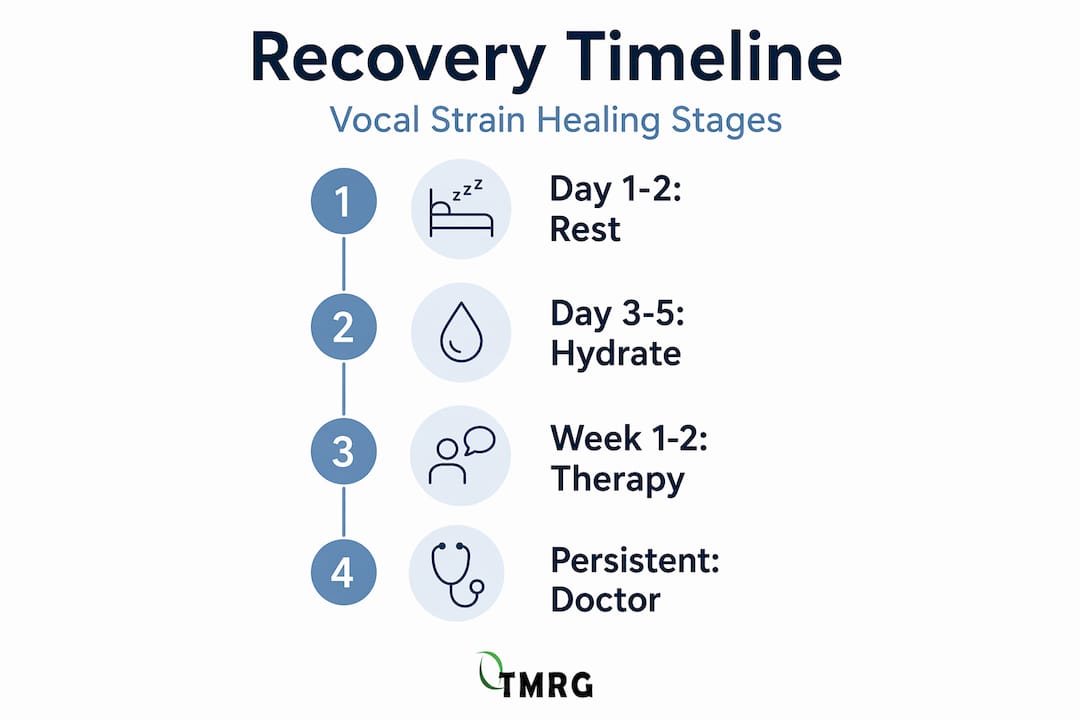
Short-term hoarseness can be monitored at home with confidence, but persistent changes beyond two to three weeks should prompt professional evaluation. Waiting too long risks turning a functional problem into a structural one.
When you do see a doctor, here is what the evaluation process typically involves:
A comprehensive ENT examination including laryngoscopy is necessary for persistent hoarseness to exclude serious underlying causes like vocal nodules or malignancy. Do not let uncertainty stop you from getting checked. Early diagnosis always leads to faster, simpler treatment.
I have worked with hundreds of singers, teachers, and professionals who came to Tmrgsolutions frustrated and confused about their voices. The single most common thing I observe is that people underestimate how much muscle tension drives their problems.
They assume they must have damaged something. They rest for a day, feel a little better, and then push right back into the same patterns that caused the problem in the first place. The cycle repeats, and over time, what started as simple functional strain becomes a deeply ingrained habit pattern that takes much longer to unwind.
Voice therapy has a reputation for being something reserved for serious performers or people with diagnosed nodules. In my experience, that belief is exactly what stops people from getting help early. Therapy is not a last resort. It is precisely the kind of structured retraining that most voices need to break out of a tension cycle and find their natural, easy production again.
I also want to address the whispering myth directly. Nearly every person who comes to me during an acute voice rest period is whispering. They think they are being careful. What they are actually doing is hypercontracting the laryngeal muscles in a way that sustains the problem. Real voice rest is quiet. It takes discipline, but it works.
If your voice is consistently tired, rough, or uncomfortable, take it seriously now. Small, consistent changes in technique, hydration, and rest habits can restore a voice that felt like it was disappearing.
— Golan

At Tmrgsolutions, we have spent over 25 years developing solutions specifically for people dealing with vocal strain, hoarseness, and vocal fatigue. Whether you are a singer, teacher, or someone who simply needs their voice back, our voice therapy kit is designed to complement professional treatment with natural, targeted support. Explore our vocal problems resource page for deeper guidance on specific conditions, or browse our frequently asked questions to find answers tailored to your situation. Your voice deserves consistent care, not just crisis management.
Vocal strain is overuse or misuse of the voice muscles, causing hoarseness, throat discomfort, and vocal fatigue. It most often involves muscle coordination issues rather than structural damage to the vocal folds.
The leading causes of vocal strain include muscle tension dysphonia, vocal overuse, acid reflux, respiratory infections, and psychological stress. Poor vocal technique and dry or irritating environments also contribute significantly.
Mild vocal strain typically resolves in two to five days with proper rest and hydration. More persistent cases may take two to four weeks and benefit from voice therapy with a speech-language pathologist.
No. Whispering increases laryngeal muscle tension more than normal speech in many cases. True voice rest means using text, notes, or gestures instead of speaking.
See an ENT specialist if hoarseness or voice changes persist beyond two to three weeks, or sooner if you experience pain when swallowing, a lump in the throat, or unexplained voice loss. Early evaluation leads to faster, simpler treatment.
