Your Cart is Empty


TL;DR:
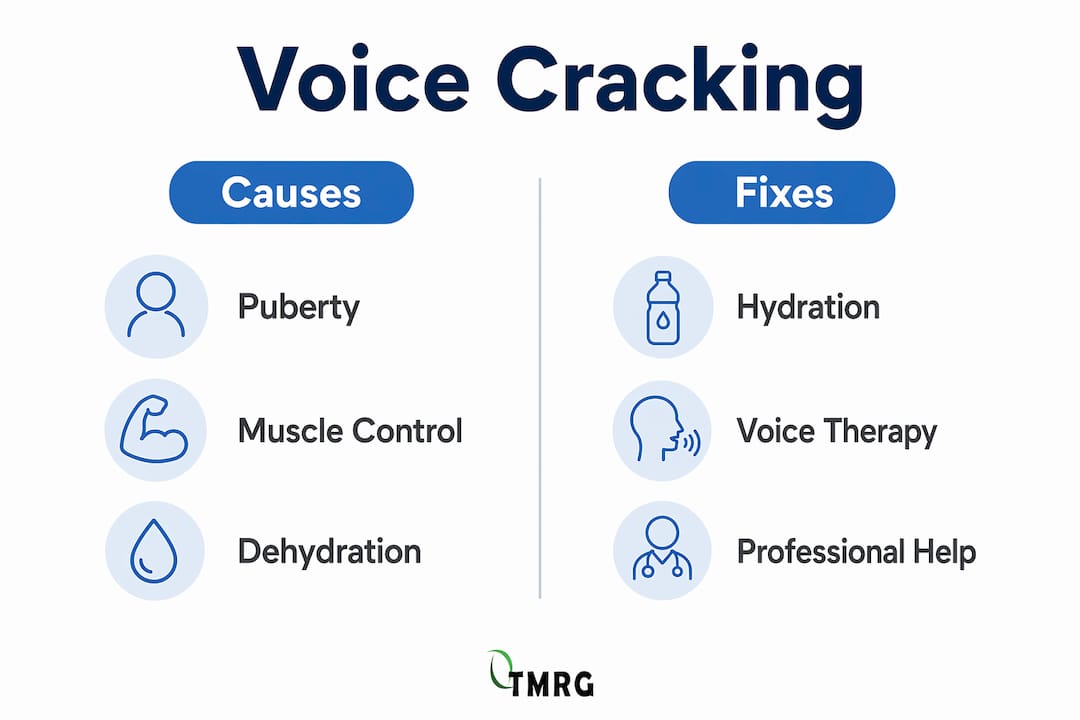
- Voice cracking results from uncoordinated vocal fold muscles during pitch transitions and is common in both adolescents and adults facing tension, dehydration, or poor breath support. For teenagers, rapid vocal fold growth causes temporary instability during puberty, which naturally resolves over time, while adult cracks are mainly due to behavioral factors like dehydration and tension. Consistent hydration, proper breathing, tension release, and targeted exercises help prevent and manage voice cracks effectively.
Voice cracking is the brief loss of smooth vocal fold coordination, causing a sudden flip or break in sound during pitch or register changes. This happens to adolescents going through puberty and to adults dealing with muscle tension, dehydration, or poor breath support. The medical term for this phenomenon is vocal register break, and understanding it is the first step toward managing it. Whether you are a teenager noticing unexpected squeaks or an adult whose voice gives out during presentations, the cause is almost always mechanical and addressable.
A voice crack results from uncoordinated vocal fold muscles during transitions between chest voice and head voice. Your vocal folds are controlled by two main muscle groups: the thyroarytenoid (TA) and the cricothyroid (CT). When these two fail to hand off smoothly during a pitch shift, the folds briefly lose their vibration pattern and the sound breaks. The transition zone between registers is called the passaggio, and it is the most common location for cracks to occur.

Voice cracks are not random. The nervous system maps register transitions, and when that map is blurry or imprecise, cracks happen at predictable notes every time. That predictability is actually useful. It means the problem has a specific cause and a specific fix, rather than being a mystery.
Puberty is the most common trigger for voice cracking in younger people, and the reason is purely structural. During adolescence, the vocal folds grow rapidly in both length and thickness. Boys experience a vocal fold length increase of about 60% during this period. That dramatic growth creates a temporary mismatch between the brain’s existing muscle memory and the new, larger instrument it is trying to control.
Girls’ vocal folds also grow during puberty, but the change is smaller and more gradual. This is why boys tend to experience more noticeable and frequent cracks. The voice is not malfunctioning. It is a system in transition due to uneven vocal fold growth and maturation, and the instability is temporary.
One risk during this period is puberphonia, a condition where a young person unconsciously holds onto a higher, pre-pubertal voice pattern even after the vocal folds have matured. This habit forms when someone feels embarrassed by their cracking voice and tightens the larynx to avoid it. The result is a thin, strained sound that persists well past puberty. Calm, matter-of-fact responses to voice cracks from parents and teachers reduce the chance of this habit forming.
Pro Tip: If you are a parent or teacher, treat a teenager’s voice crack as unremarkable. Laughing at or drawing attention to it increases self-consciousness and can trigger the laryngeal tension that leads to puberphonia.
| Stage | What happens | Typical duration |
|---|---|---|
| Early puberty | Vocal folds begin rapid growth | 6–12 months |
| Mid puberty | Maximum instability and cracking | 6–18 months |
| Late puberty | Muscle memory recalibrates to new size | 6–12 months |
| Post puberty | Voice stabilizes at adult pitch | Ongoing |
Adult voice cracks are mainly behavioral, not hormonal. The most common culprits are poor breath support, muscle tension in the neck and jaw, dehydration, and improper register blending. Unlike adolescents, adults have fully grown vocal folds. When their voice cracks, the cause is almost always a coordination or hydration problem rather than a structural change.
Here are the most frequent causes in adults:
Persistent or frequent voice cracks in adults may signal something more serious. Conditions like laryngitis, vocal fold lesions, or spasmodic dysphonia require evaluation by a specialist. If your voice cracks consistently for more than two weeks without an obvious cause like illness or overuse, schedule an appointment with an ENT or a speech-language pathologist.
Pro Tip: Sip room-temperature water consistently throughout the day rather than drinking large amounts at once. Vocal fold hydration is systemic, meaning the water you drink takes 20–30 minutes to reach the folds. Staying ahead of thirst is the only way to keep them properly lubricated.
Smooth singing and speaking depend on a precise handoff between two muscle systems. The thyroarytenoid (TA) muscle controls chest voice by thickening and shortening the vocal folds. The cricothyroid (CT) muscle controls head voice by stretching and thinning them. The passaggio is the pitch range where these two systems must share control, and it is where most cracks occur.
The nervous system governs this handoff through proprioception, the body’s internal sense of muscle position and movement. When the nervous system has a clear, well-practiced map of the passaggio, the transition is smooth. When the map is imprecise, the TA and CT muscles compete rather than cooperate, and the voice breaks.
Four steps help the nervous system build a clearer register map:
The body tightens surrounding laryngeal muscles in anticipation of difficult vocal tasks, acting like a physiological parking brake that disrupts smooth vocal fold vibration. Recognizing this reflex is the first step to releasing it.
Preventing voice cracks requires attention to hydration, breath mechanics, and physical tension. These are not abstract concepts. Each one has a direct, measurable effect on how your vocal folds behave.
When cracks persist despite these measures, a professional voice assessment is the right next step. A speech-language pathologist can identify specific coordination problems and prescribe targeted exercises. An ENT can rule out structural issues like nodules, polyps, or vocal cord paralysis that require medical treatment.
Pro Tip: Record yourself speaking or singing once a week. Listening back gives you an objective view of where cracks occur and whether your prevention strategies are working. Most people are surprised by how much they improve when they track progress consistently.
Voice cracking is a predictable, mechanical event caused by a breakdown in vocal fold coordination at register transitions, and both adolescents and adults can address it with the right knowledge and consistent practice.
| Point | Details |
|---|---|
| Core mechanism | Voice cracks occur when the TA and CT muscles fail to coordinate during register transitions. |
| Adolescent cause | Boys’ vocal folds grow about 60% during puberty, creating temporary instability that resolves naturally. |
| Adult causes | Poor breath support, dehydration, and muscle tension are the primary drivers of adult voice cracks. |
| Prevention priority | Consistent hydration, diaphragmatic breath support, and daily passaggio exercises reduce cracking significantly. |
| When to seek help | Cracks lasting more than two weeks without a clear cause warrant evaluation by an ENT or speech-language pathologist. |
Most people who come to me about voice cracking carry some version of the same belief: that their voice is broken, weak, or fundamentally unreliable. That belief is almost always wrong, and it is also the thing most likely to make the problem worse.
Here is what I have observed consistently. The moment a person tenses up in anticipation of a crack, they trigger the exact laryngeal tightening that causes one. The crack becomes self-fulfilling. Breaking that cycle requires understanding that a crack is a coordination event, not a failure. Your vocal folds are not betraying you. They are responding to imprecise neurological instructions or insufficient physical support.
The other thing I push back on is the idea that voice cracks in teenagers should be fixed quickly. The voice needs time to recalibrate to a new body. Rushing that process with aggressive technique work or forcing a teenager to avoid certain pitches often creates more tension, not less. Patience and normalization are genuinely therapeutic here.
For adults, the most underrated fix is sleep. Vocal fold coordination depends on fine motor control, and fine motor control degrades with fatigue faster than almost any other skill. A well-rested voice is a more reliable voice. That is not a soft recommendation. It is physiology.
— Golan
Tmrgsolutions has spent over 25 years developing natural vocal health solutions for singers, speakers, actors, and anyone dealing with persistent voice problems. If voice cracking is affecting your performance or daily communication, the right support can make a real difference.

The TMRG Voice Therapy Kit Basic is a practical starting point for people experiencing general voice instability, including cracking and fatigue. For singers and professional voice users, the Standard Voice Therapy Kit addresses register coordination and vocal endurance directly. Both kits combine natural herbal formulations with targeted support for vocal fold hydration and recovery. Browse the full range of vocal problem solutions to find the right fit for your specific situation.
Your voice cracks when the thyroarytenoid and cricothyroid muscles fail to coordinate smoothly during a pitch or register shift. Dehydration, muscle tension, and poor breath support are the most common triggers in adults.
Voice cracking during puberty is completely normal. Boys’ vocal folds grow rapidly, creating temporary instability that resolves as the nervous system recalibrates to the new vocal anatomy.
Adult voice cracks are mainly behavioral: poor breath support, neck and jaw tension, dehydration, and fatigue are the primary causes rather than hormonal changes.
See an ENT or speech-language pathologist if your voice cracks persistently for more than two weeks without a clear cause. Conditions like vocal fold lesions or spasmodic dysphonia require professional diagnosis.
Practice slow scale work through your passaggio, use lip trills to reduce acoustic pressure, and maintain consistent diaphragmatic breath support. Daily short sessions build the neurological muscle map that prevents register breaks.
