Your Cart is Empty


TL;DR:
- Professional voice assessments encompass perceptual, acoustic, aerodynamic, and endoscopic evaluations to diagnose and guide treatment.
- Regular assessments help detect subtle issues like muscle tension dysphonia before they cause injury or significant performance problems.
- Applying assessment results with ongoing routines and resources supports vocal health, longevity, and effective recovery for performers.
Your voice can sound perfectly fine to your own ears while something quietly shifts beneath the surface. Even seasoned singers, actors, and professional speakers miss early signs of vocal strain because the body compensates in ways that feel normal until they aren’t. Professional voice assessments diagnose voice disorders, evaluate vocal function, and guide therapy for vocal professionals. This article breaks down what these assessments involve, which tools clinicians use, why performers need specialized protocols, and how you can apply your results to protect and extend your vocal career.
| Point | Details |
|---|---|
| Comprehensive diagnosis | Voice assessments combine multiple methods for accurate, personalized evaluation. |
| Performer-specific benefits | Specialized protocols reveal subtle issues missed by standard exams in singers and actors. |
| Actionable recovery | Assessment results help guide targeted care routines and therapy for long-term vocal health. |
| Prevention focus | Regular voice assessments detect hidden risks before injuries develop. |
A professional voice assessment is a systematic, evidence-based evaluation of your vocal quality and function carried out by trained clinicians. It goes far beyond a basic throat check. The goal is to capture a complete picture of how your voice works, not just how it looks on a single still image or how it sounds to an untrained ear.
Understanding the importance of professional voice care starts with knowing what these evaluations actually measure. A thorough assessment typically combines four major approaches:
Professional voice assessments combine perceptual, acoustic, aerodynamic, and endoscopic methods to diagnose disorders, evaluate function, and guide therapy.
“A multidimensional assessment is essential. Anatomy alone tells only part of the story. Function, efficiency, and compensatory patterns are equally critical to understanding a performer’s vocal health.” — ASHA Clinical Guidance
Who should seek this level of evaluation? Singers, actors, teachers, public speakers, and anyone with a history of vocal fatigue, recurring hoarseness, or a demanding performance schedule. If your voice is your livelihood, a professional assessment is not optional. It is foundational.
With the foundational role of assessments in mind, let’s look at the specific techniques and why each one matters for your care.
Key methodologies include perceptual evaluation using CAPE-V or GRBAS scales, acoustic analysis, aerodynamic measures, and videolaryngostroboscopy to visualize vocal fold vibration. Each tool contributes something the others cannot.
A typical assessment sequence for a new patient looks like this:
| Methodology | What it measures | Strength | Ideal use case |
|---|---|---|---|
| CAPE-V / GRBAS | Perceived voice quality | Fast, low-cost, clinically validated | Routine screening and therapy tracking |
| AVQI / Jitter / Shimmer | Acoustic signal irregularities | Objective, quantifiable | Tracking progress over time |
| Aerodynamic testing | Airflow, pressure, efficiency | Reveals breath support issues | Hyperfunctional or hypofunctional voice |
| Videolaryngostroboscopy | Mucosal wave and fold closure | Visualizes vibration indirectly | Most clinical diagnoses |
| High-speed videoendoscopy (HSV) | True real-time fold movement | Captures irregular vibrations | Aperiodic or post-surgical voices |
Videolaryngostroboscopy is essential for accurate diagnosis in performers, while high-speed videoendoscopy offers significant advantages when vibration patterns are irregular.
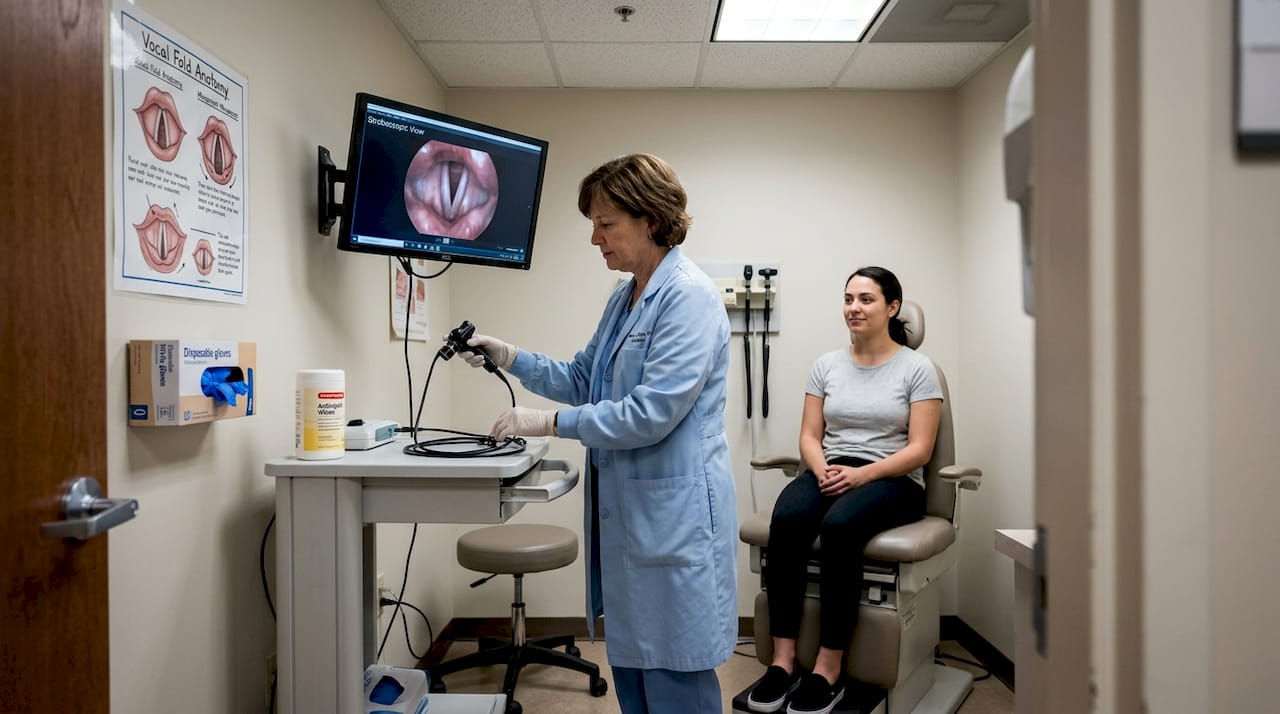
Pro Tip: Request high-speed videoendoscopy specifically if your clinician finds inconsistent stroboscopy results or if you have a history of vocal fold surgery. Standard stroboscopy assumes a regular vibration cycle and can miss subtle asymmetries that HSV captures frame by frame.
When choosing voice solutions after your assessment, knowing which tools were used helps you ask the right questions and interpret recommendations accurately. You can also explore our research approach to understand how evidence guides effective vocal care.
Now, let’s see why one-size-fits-all exams aren’t enough for professionals and what targeted steps offer instead.
A general practitioner’s throat check is designed to rule out serious pathology. It is not designed to detect the subtle compensatory patterns that accumulate in a working performer’s voice over months or years. Singers may have no visible laryngeal changes but nuanced complaints, making dynamic singing assessment essential, while annual exams detect compensations like muscle tension dysphonia before they cause injury.
Muscle tension dysphonia (MTD) is a condition where the muscles surrounding the larynx work too hard to compensate for inefficiency elsewhere. It sounds like effort, not damage. Many performers push through it for years, assuming it is just fatigue.
Red flags that signal a performer needs specialized assessment:
| Sign or symptom | Common assessment finding |
|---|---|
| Vocal fatigue after short use | Reduced airflow efficiency, incomplete fold closure |
| Pitch range narrowing | Mucosal stiffness or early nodule formation |
| Increased projection effort | Elevated subglottal pressure, MTD pattern |
| Register breaks | Phase asymmetry or mucosal wave irregularity |
| Chronic throat clearing | Posterior laryngeal irritation, reflux-related changes |
HSV is more sensitive for phase asymmetry than stroboscopy, which is why specialized centers increasingly use it for performers with subtle complaints.
Pro Tip: Do not rely on how your voice feels or sounds to you as your only measure of health. Objective protocols consistently reveal risk factors in voices that sound healthy to both the performer and an untrained listener. Schedule assessment before problems feel urgent.
Reading about the role of medical professionals in vocal health gives you a clearer picture of who should be on your care team. And if you are concerned about damage, learning about detecting early vocal damage can help you act sooner.
Once you’ve received your assessment, the next step is putting the knowledge to work.
A report full of numbers and clinical terms is only useful if you know what to do with it. Perceptual and objective measures correlate highly, validating combined use, and acoustic tools like AVQI enable tracking therapy progress quantitatively. That means your clinician’s subjective impression and the software data should tell the same story. When they don’t, it signals something worth investigating further.
How to move from assessment to integrated vocal care:
Exploring voice therapy for vocal health helps you understand what structured therapy looks like in practice. You can also review vital voice care strategies and learn about the benefits of voice therapy for performers at every level.
Pro Tip: Save your baseline assessment results as a permanent reference file. After illness, heavy performance periods, or any significant vocal event, a follow-up assessment compared against your baseline gives your care team precise data to guide recovery rather than guesswork.
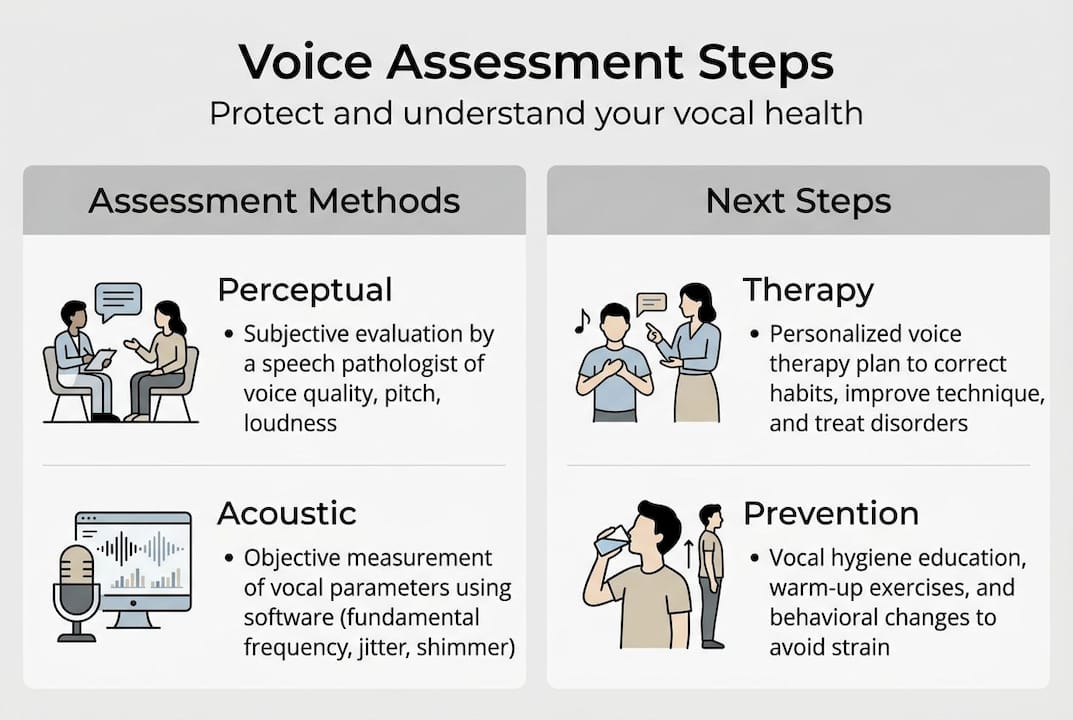
Most performers think of a voice assessment the way they think of a visit to the emergency room. You go when something is clearly wrong. That mindset costs careers.
The most valuable assessment you will ever have is the one you schedule before anything feels broken. Annual exams detect compensations like muscle tension dysphonia before injury, giving you a window to correct patterns that would otherwise silently erode your range, stamina, and tone over years.
Regular assessment means you are not reacting to damage. You are steering away from it. You gain faster intervention, more precise control over your vocal development, and real protection for your career longevity. Think of it as a performance audit, not a medical emergency.
Early assessment is investing in your vocal future. It is not a safety net you reach for after things go wrong. It is the foundation that keeps things from going wrong in the first place.
Building remedies and routines for voice care into your regular schedule, alongside periodic assessments, creates a system that works for you rather than one you scramble to activate in a crisis.
For performers ready to take their next steps, dedicated resources can make all the difference between stalling after an assessment and actually moving forward.

At TMRG Solutions, we have spent 25+ years developing natural, evidence-informed products designed to bridge the gap between what your assessment reveals and what your daily care routine delivers. Whether you are following up on therapy recommendations or building a proactive maintenance plan, the TMRG Voice Therapy Kit Basic and the TMRG Standard Kit for Singers offer targeted support for recovery and ongoing vocal health. You can also visit our resource for vocal problems to find solutions matched to your specific situation.
A professional voice assessment usually includes perceptual, acoustic, aerodynamic, and endoscopic exams to evaluate vocal function and detect issues. These combined methods diagnose disorders and guide therapy planning.
Annual assessments are recommended for early detection, even if you have no symptoms. Regular annual exams catch compensatory patterns like muscle tension dysphonia before they cause lasting injury.
Yes, singers often need dynamic singing tasks and more nuanced protocols since their problems are not always visible in basic exams. Singers may show no visible changes yet have significant functional complaints that only targeted assessment reveals.
Combining both methods gives the most accurate results, as perceptual and acoustic measures strongly correlate. Perceptual and objective measures validate each other, making the combined approach the clinical standard.
