Your Cart is Empty


TL;DR:
- Vocal folds endure significant oxidative stress from high-frequency vibrations and physical demands.
- Consistent intake of dietary antioxidants can reduce cellular damage and support vocal resilience.
- Building antioxidant support into daily routines helps prevent vocal fatigue and enhances recovery.
Most singers know hydration and rest matter. But here is what far fewer realize: the cellular damage happening inside your vocal folds during every rehearsal and performance may quietly build up long before you feel hoarseness or fatigue. Antioxidants are not a wellness trend or a vague dietary bonus. They are a targeted form of cellular protection your vocal tissue actively needs. This article walks you through why singers face elevated oxidative stress, how antioxidants work at the tissue level, which foods deliver the most vocal benefit, and how to build a daily routine around them. Consider this your practical, evidence-based guide to protecting your instrument from the inside out.
| Point | Details |
|---|---|
| Oxidative stress harms vocal folds | Singing produces reactive oxygen species that can damage vocal tissues unless managed. |
| Antioxidants offer vocal protection | Nutrients like vitamins C, E, and compounds in dark honey help neutralize damage and speed recovery. |
| Diet and timing matter | A regular intake of antioxidant-rich foods or supplements is more effective than sporadic use. |
| Natural remedies complement techniques | Integrating food strategies with vocal care practices can improve resilience and performance for singers. |
Your vocal folds are small, but they work incredibly hard. During singing, these folds vibrate at rates ranging from roughly 100 to over 1,000 times per second depending on pitch. That level of mechanical stress is unlike almost anything else the body endures. Vocal folds vibrate hundreds of times per second, generating reactive oxygen species, and antioxidants like vitamins C and E protect cells from the resulting damage.
Reactive oxygen species, or ROS, are unstable molecules produced as a natural byproduct of high metabolic activity and physical stress. Think of them as tiny sparks inside your cells. When their levels rise faster than your body can neutralize them, they begin damaging the cell membranes, proteins, and genetic material in your vocal fold tissue. For casual speakers, this process is mild and usually manageable. For professional singers, the sheer volume of vocal use accelerates it significantly.
This is where antioxidants for vocal recovery become essential, not optional. Antioxidants are molecules that neutralize ROS before they cause lasting cellular harm. They essentially donate electrons to stabilize those unstable sparks, stopping the chain reaction of damage.
Here are some specific reasons singers face higher oxidative stress than most people:
The signs of vocal fatigue include roughness, pitch instability, reduced range, and a voice that tires quickly. These are often the first visible signs that oxidative stress has accumulated past what your body can repair on its own.
“The vocal folds are extraordinary tissue, vibrating relentlessly, yet expected to stay clear and responsive. That demand makes antioxidant protection non-negotiable for anyone who sings regularly.”
Protecting your voice is not just a post-performance concern either. Understanding protecting your speaking voice matters equally, since the same folds handle your everyday communication between gigs.
Pro Tip: Don’t wait until you feel vocal strain to increase antioxidant intake. Consistent daily support builds resilience before oxidative load peaks, so your voice is protected going into a demanding performance, not scrambling to recover after.
Antioxidants are molecules your body uses to counteract oxidative stress. Some are produced internally, like glutathione and superoxide dismutase. Others come from food and supplements, including vitamins C and E, carotenoids, and polyphenols. Each works slightly differently at the cellular level, but the goal is the same: stop ROS from destroying healthy tissue.
Here is what happens to your vocal folds in sequence, with and without adequate antioxidant support:
Researchers have identified specific antioxidants that show particular promise for vocal tissue. Antioxidants like astaxanthin and multi-antioxidant supplements (for example, Twendee X) reduce oxidative buildup and speed wound healing in animal models. Astaxanthin is a red pigment found in salmon and certain algae, and it is considered one of the most potent natural antioxidants identified to date.
| Antioxidant | Source | Primary action for vocal health |
|---|---|---|
| Vitamin C | Citrus, bell peppers, kiwi | Tissue repair, collagen synthesis |
| Vitamin E | Nuts, seeds, avocado | Cell membrane protection |
| Astaxanthin | Salmon, algae, supplements | Potent anti-inflammatory, ROS reduction |
| Polyphenols | Berries, dark honey, tea | Broad antioxidant and anti-inflammatory |
| Glutathione | Spinach, broccoli, garlic | Internal cellular defense |
Think of the diet for a healthy voice as your first line of defense. Food-sourced antioxidants work synergistically, meaning they amplify each other’s effects when consumed together rather than in isolation.
Researchers monitoring detecting singer fatigue have noted that oxidative markers rise sharply after intensive vocal sessions, then decrease more rapidly in subjects with higher antioxidant levels in their system.
“Antioxidants don’t just clean up after damage. When present before stress, they actively reduce how much damage occurs in the first place.”
Food is your most reliable, bioavailable source of antioxidants. And for singers, the priority is choosing foods that deliver polyphenols, vitamins, and anti-inflammatory compounds that specifically benefit mucosal and vocal tissue.
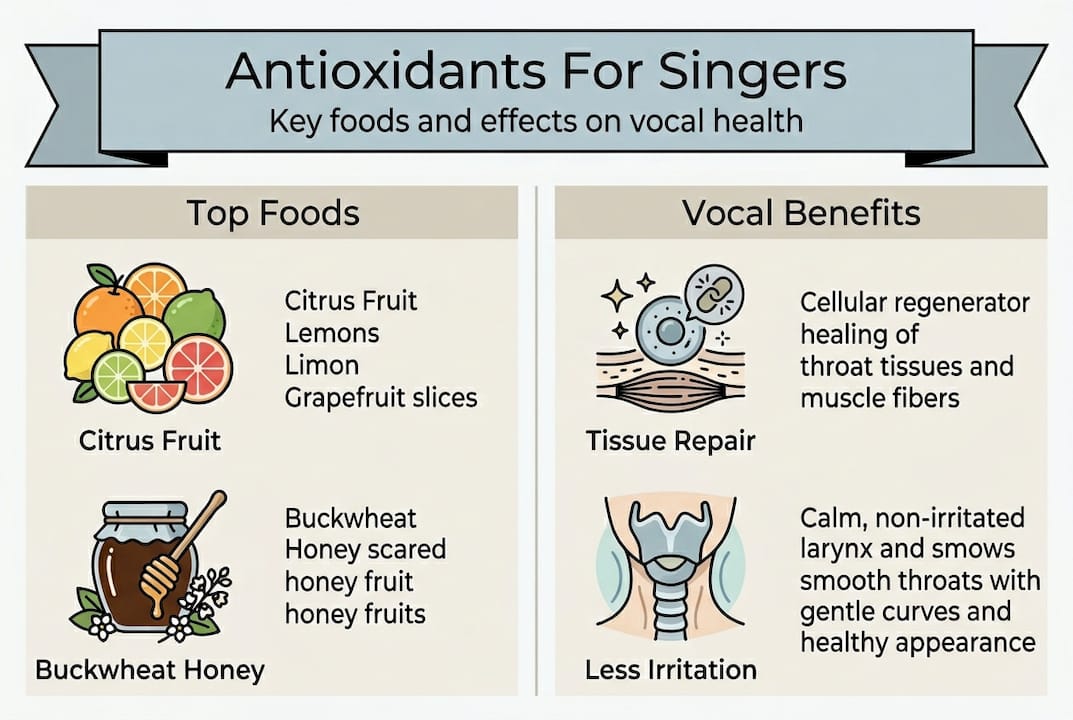
Honey, especially dark varieties like buckwheat, provides antioxidants and polyphenols that reduce inflammation and aid vocal fold healing after irritation. Buckwheat honey has among the highest antioxidant concentrations of any honey variety and has been studied for its role in reducing throat inflammation and coating mucous membranes.

Here is how common antioxidant foods stack up for vocal health:
| Food | Key antioxidants | Vocal health benefit | Ease of use |
|---|---|---|---|
| Buckwheat honey | Polyphenols, flavonoids | Soothes and heals vocal tissue | Very high |
| Wild blueberries | Anthocyanins | Reduces inflammation | High |
| Dark leafy greens | Vitamins C, E, glutathione | Tissue repair, immunity | Moderate |
| Bell peppers (red) | Vitamin C | Collagen support for folds | High |
| Salmon | Astaxanthin, omega-3s | Anti-inflammatory | Moderate |
| Walnuts | Vitamin E, polyphenols | Cell membrane defense | High |
| Green tea | Catechins | Antioxidant and soothing | Very high |
Some practical tips for integrating these foods into your routine as a singer:
For singers working to build full-body vocal resilience, green vegetable proteins offer both antioxidant support and the amino acids your vocal folds need for structural repair. And if you supplement your diet with throat sprays, understanding the options can help. A good throat sprays comparison helps you choose formulas that complement your natural antioxidant strategy rather than replace it.
Pro Tip: Rotate your antioxidant food sources across the week. Different polyphenols work through different pathways, so variety ensures you cover the full spectrum of cellular protection your vocal tissue needs.
Knowing what to eat is only half the equation. The other half is knowing when and how to use antioxidants as part of your daily singing practice. Timing and consistency matter more than any single high-dose intake.
Here is a step-by-step approach to building antioxidant support into your routine:
For deeper support, explore natural vocal remedies that pair well with dietary antioxidants, review vocal recovery strategies for post-performance protocols, and stay consistent with habits outlined in preventing vocal fatigue guides built for professional vocalists.
Pro Tip: Consistency beats intensity. A daily moderate intake of diverse antioxidants does more for your vocal tissue long-term than large, sporadic doses taken only when your voice is already strained.
Here is something we observe frequently in vocal health practice: singers only start thinking seriously about antioxidants after something goes wrong. The voice cracks during a performance. A tour leaves the throat raw and slow to recover. A run of shows produces persistent hoarseness that rests alone can’t fix.
That reactive mindset is completely understandable, but it leaves real performance quality on the table. Antioxidants work best as a preventive layer, one that has to be built steadily over time. No supplement taken the night before a show can compensate for weeks of inadequate dietary support.
Diet alone often isn’t enough either, particularly if your schedule is inconsistent or your food access is limited by travel and touring. A structured approach, combining food, targeted supplementation, and timed intake, is what separates vocalists who maintain a full, resilient voice year-round from those who are constantly managing vocal setbacks.
We also encourage singers to think of antioxidant support as part of a broader vocal maintenance during heavy use strategy. Prevention is not passive. It is a set of active daily choices that protect the instrument you depend on.
Building your antioxidant intake through food is a powerful foundation. But for singers who perform regularly or are recovering from vocal strain, dietary habits alone may not be enough to keep up with demand.
At TMRG Solutions, we have spent over 25 years developing vocal health solutions that work alongside natural strategies like the ones in this article. Our voice therapy kit supports structured vocal recovery, and our voice enhancement drops are formulated to complement the protective work your diet is already doing. If you are ready to give your voice the layered protection it deserves, explore our range and find the right fit for your performance needs.
Vitamins C and E, astaxanthin, and dark honeys provide the strongest antioxidant support for vocal folds. Dark honeys offer polyphenols that additionally soothe and protect vocal tissue from irritation.
Ongoing antioxidant intake helps heal vocal fold irritation quickly, so some reduced irritation can be felt within hours. Lasting resilience, however, requires consistent intake over days and weeks.
Supplements aren’t always needed, but antioxidant supplements like Twendee X can support singers when dietary intake is insufficient or performance demands spike.
Yes. Buckwheat honey reduced cough and aided healing in clinical trials, making it one of the most well-supported natural remedies for singers dealing with vocal irritation.
Antioxidants lower risk and support healing from oxidative stress, but cannot fully prevent injuries caused by overuse or poor vocal technique.
