Your Cart is Empty


TL;DR:
- Your voice is your most vital professional tool, and it requires consistent, protective habits to stay reliable.
- Implementing a daily routine with hydration, gentle exercises, and environmental awareness helps prevent vocal damage and enhances performance longevity.
Your voice is your most essential professional instrument, and it doesn’t get a backup. Whether you’re a singer hitting the stage every weekend, an actor projecting to the back row, or a lecturer holding a room for three hours straight, vocal reliability is not optional. The difference between a voice that holds and one that cracks under pressure almost always comes down to what you do between performances, not just what you do on the day. This guide gives you a research-backed daily routine built specifically for voice professionals who can’t afford to leave their instrument to chance.
| Point | Details |
|---|---|
| Daily care foundation | Consistent hydration, quality sleep, and avoiding dehydrants are key to long-term vocal health. |
| SOVT exercises matter | Routine semi-occluded vocal tract work maintains and protects the professional voice. |
| Know what to avoid | Limit caffeine, alcohol, and environmental irritants to reduce voice strain. |
| Adapt to the situation | During illness or fatigue, switch to gentle SOVT and track your recovery carefully. |
| Focus on prevention | Micro-habits in your daily routine reliably prevent long-term vocal problems better than emergency rest. |
Having set the stage for why your voice needs protection, let’s lay out exactly what you’ll need to build an optimal routine.
The foundation of vocal health isn’t complicated, but it does require consistency. Sleep is where your vocal folds (the two bands of mucous membrane inside your larynx that vibrate to produce sound) actually repair themselves. Prioritize 7-9 hours of sleep, manage stress through practices like yoga or meditation, and avoid dehydrants like caffeine and alcohol that strip moisture from your vocal tract. These aren’t suggestions; they are the bedrock requirements.
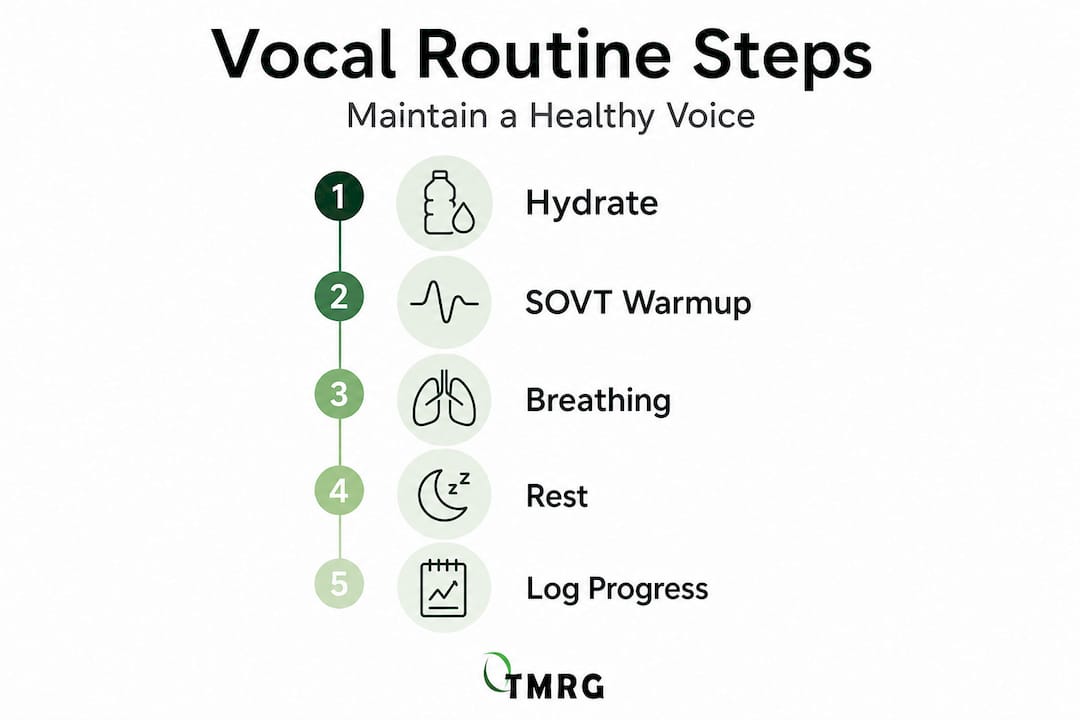
Building daily habits for vocalists starts with gathering the right tools. You don’t need a professional studio. You need intentional, consistent support for your vocal environment.
| Tool | Purpose | Recommended use |
|---|---|---|
| Insulated water bottle (32 oz) | Systemic hydration throughout the day | Sip consistently, not in large gulps |
| Personal steam inhaler or humidifier | Topical mucosal hydration | 10 minutes pre-performance or morning |
| Herbal vocal teas (licorice, slippery elm) | Soothing mucous membranes | 1-2 cups daily, caffeine-free only |
| Voice diary or app | Track patterns, triggers, fatigue | Log daily after voice use |
| Thin drinking straw | SOVT exercises (see below) | Warmup and cool-down sessions |
Beyond tools, pay attention to your environment. Dry office air, centralized heating, and air-conditioned rehearsal spaces all pull moisture away from your airway. Working on improving sleep quality is especially relevant here, since poor sleep increases stress hormones that tighten the muscles around the larynx and reduce mucosal secretions.
Key things to eliminate or reduce right away:
A healthy vocal care routine begins with protecting what you already have. Think of these prerequisites as the maintenance you do before driving a car, not something you skip until something breaks.
Once you gather everything you need, it’s time to weave these fundamentals into your day.
A strong daily routine doesn’t need to be elaborate. It needs to be sequential and realistic. Here is a morning-to-night framework you can adapt to your schedule:
SOVT exercises like straw phonation and lip trills are evidence-based for both daily maintenance and voice therapy, making them the single most valuable tool in your routine. They reduce collisional forces on your vocal folds compared to open-phonation exercises, meaning less wear with the same vocal benefit.
For vocal support exercises that complement this routine, focus on diaphragmatic breathing, which uses your diaphragm (the dome-shaped muscle below your lungs) rather than your chest, giving you airflow control that supports consistent phonation without muscular strain.

Pro Tip: On your busiest days when the full routine feels impossible, prioritize SOVT exercises and hydration above everything else. Five minutes of straw phonation and a full water bottle will protect your voice far better than skipping both and pushing through.
Now that you know what to do, it’s just as crucial to know what NOT to do.
Many voice problems don’t start with a single catastrophic event. They accumulate quietly, habit by habit. Identifying what is working against your voice is just as protective as any exercise.
Substances that dehydrate your vocal folds:
Avoid dehydrants like caffeine and alcohol consistently, not just on performance days. The effect is cumulative. If you are managing dry mouth as a side effect of medication or environmental factors, learning about managing dry mouth naturally can help you maintain systemic hydration more effectively.
Habits that cause direct vocal fold trauma:
Environmental threats include dust, chalk, cigarette smoke, cold dry air, and strong chemical fumes. If your rehearsal or lecture space has poor air quality, advocate for a humidifier or air purifier. These aren’t luxuries for professionals; they are protective tools.
For a complete set of tips to prevent voice loss in high-demand situations, addressing environmental factors is just as important as exercise.
“Sleep is your ultimate vocal repair tool. During deep sleep stages, your body reduces inflammation, replenishes mucosal lining, and repairs microtrauma from daily voice use. No exercise routine can fully compensate for chronic sleep deprivation.”
If you feel that you need to push through fatigue regularly, that is a signal your overall load exceeds your recovery capacity. Adjusting your schedule is part of the routine.
Even with a solid routine, real life throws curveballs. Here’s how to adapt your routine when challenges arise.
Not every day is a normal day. Performance marathons, illness, travel across time zones, and emotionally demanding roles all place different demands on your vocal folds. The key is knowing how to shift your routine without abandoning it.
| Scenario | Primary strategy | What to avoid |
|---|---|---|
| Vocal fatigue after a heavy day | Gentle descending SOVT, hydrate, humidify bedroom | Full vocal rest (silence), loud speaking |
| Upper respiratory illness | Gentle SOVT to reduce inflammation, steam inhalation | Forcing through full warmup, whispering |
| After a long performance or lecture | Cool-down SOVT, complete silence for 30-60 min, extra water | Socializing loudly at post-event gatherings |
| Speaker marathons (multi-day events) | Short SOVT breaks every 45 minutes, morning steam, afternoon rest | Caffeine to push through fatigue |
| Allergies or post-nasal drip | Nasal rinsing, increased hydration, consult a specialist | Antihistamines that dry mucous membranes |
During illness or fatigue, gentle SOVT exercises are preferred over complete silence or continued normal speech, as they minimize the inflammatory mediators that accumulate from vocal fold collision without the full impact load of regular phonation. This is a meaningful clinical distinction, not just a preference.
For practical examples of vocal routines adapted to different professional contexts, including singers managing touring schedules and speakers handling academic conference loads, individual tailoring makes a real difference in outcomes.
If you are working with a diagnosed condition like dysphonia (any disorder affecting voice quality, pitch, or loudness), the voice therapy evidence for dysphonia from the American Academy of Otolaryngology is clear: structured voice therapy improves outcomes before and after surgical intervention, and self-managed routines are most effective when integrated with professional guidance.
Pro Tip: Keep a voice diary where you log how your voice feels each morning and evening on a simple scale of one to ten, note what you ate and drank, how much you slept, and how much you spoke. After two to three weeks, patterns emerge that reveal your personal triggers far more accurately than general advice can.
Finally, you’ll want to track your success. Here’s what results to expect and when to revisit your approach.
Improvement in vocal health is not always dramatic. It often shows up quietly, as fewer mornings with a rough-sounding voice, fewer cracks mid-phrase, and longer periods of comfortable speaking before fatigue sets in. Knowing what to look for keeps you motivated and helps you catch regression early.
Signs your routine is working:
Daily check-in questions to ask yourself:
When to revisit or escalate:
Tracking boosting vocal performance over time requires you to be an honest observer of your own instrument. The voice diary mentioned earlier becomes your most reliable data source for this.
With a sharper routine and ways to measure success, it’s time for a reality check on what truly moves the needle for sustained vocal health.
Here is something we see repeatedly in our 25-plus years of working with voice professionals: the singers and speakers who hold their voices together across long careers are not the ones who take the longest rests. They are the ones who build consistent daily habits that prevent the kind of damage that requires rest in the first place.
Occasional vocal rest is reactive. It is what you do after something goes wrong. Daily micro-habits are preventive. They are what keeps something from going wrong at all. The distinction sounds simple, but it changes everything about how you approach your voice.
The AAO-HNS consensus on voice therapy makes it clear that vocal hygiene integrated with structured therapy produces better outcomes for dysphonia than either approach alone. This means your daily routine isn’t a replacement for professional care when you need it. It is what makes professional care more effective when you do seek it, and what reduces how often you need to seek it.
The most common mistake we see is treating vocal care as episodic rather than continuous. A performer hydrates intensely during show week, then drinks coffee and skips cool-downs in rehearsal weeks, expecting the body to average out. It doesn’t. Vocal fold tissue responds to accumulated conditions, not periodic bursts of good behavior.
Effective vocal health maintenance steps that become non-negotiable habits rather than aspirational goals are what separate professionals who sustain peak vocal performance from those who chase recovery. The investment is small per day. The return compounds over years.
Ready to amplify your results? Here’s how the right tools can help.
Building an effective daily routine is the essential first step, but having the right support products makes it significantly easier to stay consistent and recover faster when your voice needs extra care.

At TMRG Solutions, we’ve spent more than 25 years developing natural vocal health formulas designed for exactly the kind of demands you face. Our TMRG Voice Therapy Kit Basic gives you a complete entry point into structured vocal care, while the TMRG Standard Kit offers a broader range of remedies for singers, actors, and lecturers managing heavier vocal loads. If you’re dealing with a specific issue like hoarseness or loss of voice, explore our full breakdown of common vocal problems to find the most targeted solution for your situation. Your voice deserves daily support, not just crisis care.
A complete routine fits into 25 to 30 minutes spread throughout your day, covering morning hydration, SOVT warmup, midday vocal breaks, and an evening cool-down.
SOVT (semi-occluded vocal tract) exercises like straw phonation and lip trills reduce vocal fold stress and are evidence-based for daily vocal maintenance and therapeutic use.
Both are essential, but consistent hydration gives your vocal folds the systemic moisture they need for repair, especially when combined with adequate sleep.
You don’t need to eliminate caffeine entirely, but limit to 1-2 cups daily and compensate with increased water intake to offset the dehydrating effect.
Prioritize gentle SOVT exercises over total silence or continued normal speech to support healing and minimize inflammatory buildup in the vocal folds.
