Your Cart is Empty


TL;DR:
- Proper throat mucus management begins with addressing the root causes, such as postnasal drip, silent reflux, dehydration, medication effects, and habitual clearing. Hydration, steam inhalation, saltwater gargles, nasal irrigation, and avoiding over-clearing help reduce mucus and protect vocal health. Persistent symptoms beyond two to three weeks require medical evaluation to identify underlying conditions like infections or reflux.
Clearing mucus from your throat means thinning excess secretions and removing them through hydration, saline gargles, steam inhalation, and trigger management. Phlegm, the clinical term for mucus produced in the lower airways and throat, becomes a vocal problem when it coats the vocal folds and disrupts resonance. Singers, speakers, and anyone who relies on their voice knows that a congested throat is not just uncomfortable. It actively degrades vocal clarity, range, and stamina. The good news is that most cases respond well to targeted home care when you address the root cause, not just the symptom.
Understanding why mucus accumulates is the fastest path to lasting relief. Treating the symptom without knowing the source is like mopping the floor while the faucet is still running.
The most common causes of throat mucus buildup include:
Identifying your specific trigger determines which remedy works fastest. A singer dealing with LPR needs a different approach than a teacher whose symptoms spike during allergy season.
Yes, and it is the single most accessible intervention available. Clinical guidelines recommend drinking 2–3 liters of fluids daily to reduce mucus thickness and ease clearing. That translates to roughly 8–10 glasses of water. Well-hydrated mucus flows freely and is far easier to expel than the thick, ropy secretions that form when you are dehydrated.
Follow these steps to build a hydration routine that actually supports vocal health:
Pro Tip: Avoid throat clearing as a reflex. Instead, swallow firmly or take a small sip of water. Swallowing moves mucus down without the mechanical trauma that repetitive clearing inflicts on the vocal folds.
First-line non-medicated interventions are often more effective and safer than over-the-counter cough syrups for mucus management. This means your water bottle and humidifier outperform most pharmacy shelves.

These three home treatments for mucus each target a different stage of the problem. Used together, they produce faster relief than any single method alone.
| Method | How It Works | Best For | Frequency |
|---|---|---|---|
| Saltwater gargle | Draws fluid from swollen tissue, loosens mucus, reduces inflammation | Throat-level phlegm and soreness | 3–4 times daily |
| Nasal irrigation | Flushes allergens and postnasal drip from nasal passages | Mucus originating from sinuses | 1–2 times daily |
| Steam inhalation | Adds moisture and warmth to thin secretions in the airway | Thick, dry mucus; pre-performance prep | 1–2 times daily |
Gargling with 1/2 teaspoon of salt in 8 ounces of warm water multiple times per day soothes inflammation and expels phlegm. Tilt your head back, gargle for 30 seconds, and spit. Do not swallow the solution. Repeat 3–4 times per session for best results. This is one of the oldest throat mucus remedies in existence, and it works because the saline solution creates an osmotic effect that draws excess fluid out of irritated tissue.
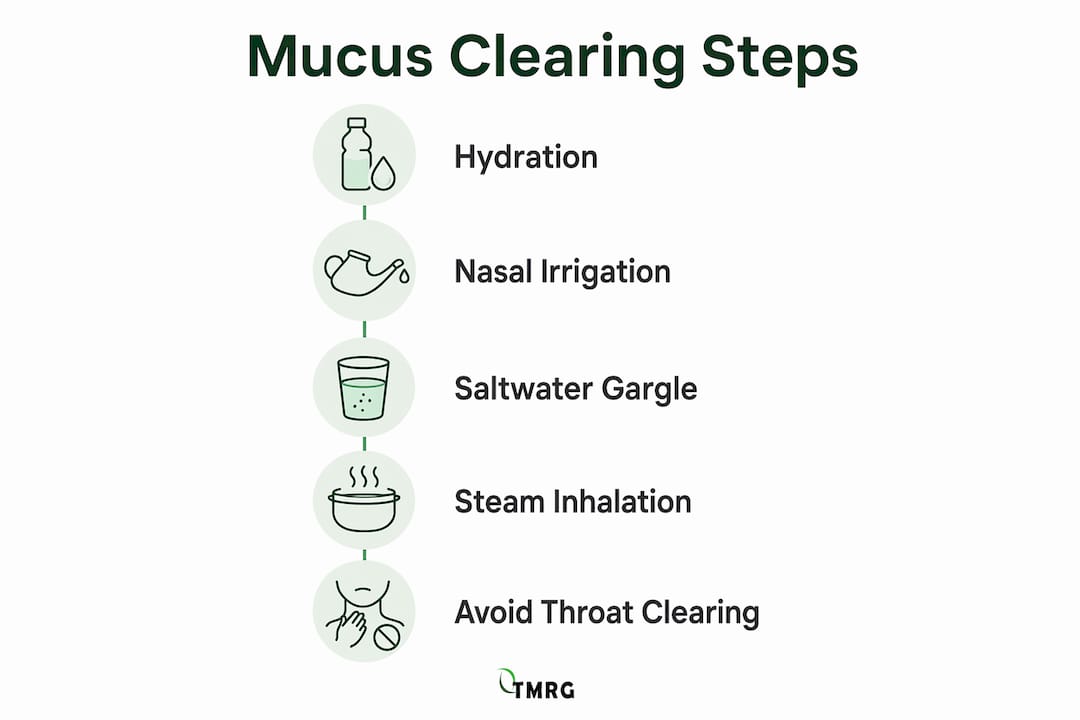
Saline nasal irrigation physically removes postnasal drip and allergens before mucus can deposit in the throat. A Neti pot or squeeze bottle with a saline solution flushes the nasal passages directly. One critical safety note: always use sterile saline, not tap water, in nasal irrigation to prevent infection risks and improve treatment safety. Tap water can carry microorganisms that cause serious sinus infections.
Pro Tip: Perform nasal irrigation before your saltwater gargle, not after. Clearing the nasal passages first reduces the volume of mucus draining into the throat, making the gargle more effective.
Steam inhalation is particularly valuable for voice professionals because it hydrates the vocal folds directly. Add a few drops of eucalyptus oil to the water for additional airway-opening effect. Breathe slowly and deeply through your nose and mouth for 10 minutes. This is a natural mucus relief method that also warms the vocal tract before performance, reducing the risk of strain.
Home care resolves most cases of throat mucus within days to a couple of weeks. However, symptoms lasting longer than 2–3 weeks warrant medical evaluation to exclude chronic conditions. Pushing through persistent symptoms without a diagnosis risks long-term vocal damage.
Watch for these warning signs that indicate you need professional evaluation:
A physician may order a sputum culture to identify bacterial or fungal infection, or use laryngoscopy to examine the vocal folds directly. For cases where home remedies are insufficient, nebulized saline mist helps loosen mucus and assists airway clearance safely. This is a medical-grade version of steam inhalation, delivered through a device that aerosolizes saline directly into the airway.
Respiratory therapists recommend the huff coughing technique to gently clear mucus without vocal strain. To perform it, take a medium breath, hold briefly, then exhale in a short, sharp burst through an open mouth, as if fogging a mirror. This moves mucus upward without the percussive force of a hard cough. For voice professionals dealing with mucus buildup, huff coughing is a far safer daily practice than the habitual throat clearing that most people default to.
Silent reflux, in particular, often goes undiagnosed for months or years. If your mucus symptoms are worst in the morning, worsen after eating, or improve when you avoid acidic foods, LPR is a likely contributor. Dietary changes, including reducing coffee, tomatoes, citrus, and alcohol, often produce noticeable improvement within two weeks. You can find more detail on managing persistent hoarseness and postnasal drip at Tmrgsolutions.
Clearing throat mucus effectively requires addressing the underlying trigger, not just the secretion itself.
| Point | Details |
|---|---|
| Hydration is the foundation | Drink 2–3 liters of water daily to thin mucus and make it easier to expel. |
| Saltwater gargles work fast | Use 1/2 tsp salt in 8 oz warm water, 3–4 times daily, to reduce inflammation and loosen phlegm. |
| Nasal irrigation stops mucus at the source | Flush nasal passages with sterile saline to prevent postnasal drip from reaching the throat. |
| Avoid forceful throat clearing | Huff coughing protects the vocal folds while moving mucus more effectively than hard clearing. |
| Persistent symptoms need medical review | Mucus lasting beyond 2–3 weeks may signal LPR, chronic sinusitis, or infection requiring diagnosis. |
After working with singers, actors, and speakers for over two decades, the pattern I see most often is this: people treat the mucus and ignore the trigger. They gargle religiously, drink their water, and still wake up congested every morning. The reason is almost always silent reflux or a low-grade allergy they have normalized.
The most important shift I have seen in clients is when they stop asking “how do I get rid of this mucus?” and start asking “why does my body keep making it?” That question leads somewhere useful. It leads to dietary changes, to identifying the dusty rehearsal space, to recognizing that the late-night meal before a morning performance is costing them their voice.
I also want to push back on the instinct to reach for over-the-counter decongestants and cough suppressants. Most of them dry out the vocal folds in the process of suppressing mucus. A dry vocal fold is a fragile vocal fold. The non-medicated approaches described in this article, hydration, saline, steam, and huff coughing, work with the body’s natural clearance mechanisms rather than against them.
The vocal folds are delicate structures. They vibrate hundreds of times per second when you speak or sing. Coating them with thick, unmanaged phlegm is like trying to play a violin with rosin caked on the strings. The instrument still works, but not the way it should. Treat the whole system, not just the symptom, and your voice will thank you for it.
— Golan
If home remedies are not delivering the relief you need, Tmrgsolutions has spent 25+ years formulating natural solutions specifically for voice professionals.

The TMRG Loud & Clear Classic Voice Recovery Drops are designed to soothe the throat lining and support mucus clearance without drying out the vocal folds. For daily protection, the TMRG Defense Oils and Saline Throat Spray combines saline with herbal oils to coat and protect the vocal tract. If you want a complete approach, the TMRG Voice Therapy Kit Basic pairs targeted products with guided vocal care to address mucus, hoarseness, and fatigue together. These products work alongside the hydration and gargling routines described above, not as a replacement for them.
Gargling with 1/2 teaspoon of salt dissolved in 8 ounces of warm water 3–4 times daily is the fastest natural method. Combining this with steam inhalation and increased fluid intake produces relief within hours for most people.
Silent reflux (laryngopharyngeal reflux) and postnasal drip from allergies are the two most common causes of throat congestion without illness. Both conditions irritate the throat lining and trigger excess mucus production independent of any infection.
Yes. Warm fluids thin mucus by raising its temperature and increasing hydration of the mucous membranes. Clinical guidance recommends 2–3 liters of fluid daily to reduce mucus thickness and ease clearance.
Forceful throat clearing traumatizes the vocal cords and stimulates more mucus production, creating a cycle that worsens the problem. Respiratory therapists recommend huff coughing or a firm swallow as safer alternatives.
Symptoms persisting beyond 2–3 weeks, mucus that is discolored or blood-tinged, or hoarseness that does not improve with home care all warrant medical evaluation to rule out infection, LPR, or chronic sinusitis.
