Your Cart is Empty


TL;DR:
- Most raspy voices are temporary and improve within one to two weeks with proper care. Key remedies include voice rest, hydration, humidification, and avoiding irritants like smoking and reflux. Persistent hoarseness beyond three weeks requires medical evaluation to rule out serious conditions.
A raspy voice is defined as hoarseness caused by swelling, irritation, or inflammation of the vocal folds, the two bands of tissue inside your larynx that vibrate to produce sound. The medical term for this condition is laryngitis, and it ranges from a mild scratchy quality to a near-complete loss of voice. According to Yale Medicine, most raspy voice episodes are temporary and improve with conservative care within one to two weeks. Knowing how to get rid of a raspy voice starts with understanding what is actually happening inside your throat. The vocal folds cannot vibrate cleanly when they are swollen, which is why your voice sounds rough, thin, or strained. Common triggers include viral infections, vocal overuse, acid reflux, and environmental irritants. The good news is that most cases respond well to hydration, rest, and removing the source of irritation.
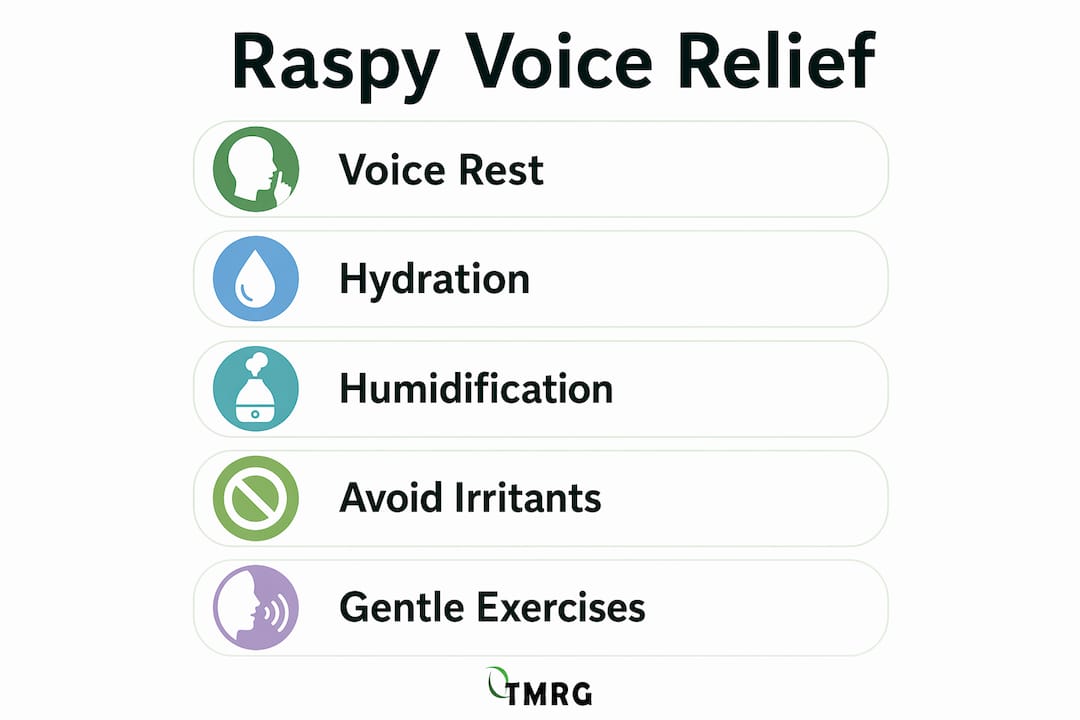
The most effective immediate remedies for a raspy voice are voice rest, hydration, and humidification. These three pillars are consistently recommended by Mayo Clinic, Cleveland Clinic, and Healthline as the foundation of conservative laryngitis care. Applied together, they give your inflamed vocal folds the conditions they need to heal.
Voice rest done right
Voice rest does not mean complete silence, and it definitely does not mean whispering. Whispering strains vocal cords more than normal soft speech because it forces the folds into an unnatural, tense position. Speak softly and briefly when you must communicate, and use tools like speakerphones or text messages to reduce the need for voice use altogether. Healthline notes that amplification devices such as speakerphones let you communicate without adding vocal cord trauma. Think of voice rest as giving your vocal folds a genuine break, not just a quieter workout.
Hydration and what to avoid
Drink water consistently throughout the day. Well-hydrated vocal folds vibrate with less friction, which reduces irritation and speeds recovery. Mayo Clinic specifically advises avoiding alcohol and caffeine because both dehydrate the mucous membranes that coat and protect your vocal folds. Warm herbal teas without caffeine, clear broths, and plain water are your best options. Cold drinks are not harmful, but room-temperature or warm fluids tend to feel more soothing on an irritated throat.
Humidification and steam
Humidified air reduces vocal fold friction and helps clear secretions from the larynx, directly supporting the healing process. A cool-mist humidifier in your bedroom overnight is one of the most underrated remedies for a raspy voice. Steam inhalation, such as leaning over a bowl of hot water with a towel over your head for five to ten minutes, delivers moisture directly to the throat. StatPearls confirms that humidified air supports healing by reducing the dryness that worsens vocal fold inflammation.
Stop clearing your throat
Throat clearing feels instinctive when your voice is rough, but it is one of the most damaging habits during recovery. Repeated throat clearing worsens vocal cord swelling by forcing the folds to slam together repeatedly. Replace the urge to clear with a small sip of water or a gentle, silent swallow. A warm salt-water gargle, using about half a teaspoon of salt in eight ounces of warm water, can soothe surface irritation without the trauma of throat clearing.
Pro Tip: Set a phone reminder to drink four ounces of water every thirty minutes during waking hours. Consistent small sips maintain vocal fold hydration far better than large amounts consumed infrequently.
Recovery speed is directly tied to what you expose your vocal folds to every day. Even the best home treatments lose ground when lifestyle habits keep re-irritating the tissue. Cleveland Clinic emphasizes that there are no overnight fixes for a raspy voice. Consistent lifestyle adjustments are what actually move the needle.
Quit or avoid smoking. Cigarette smoke dries and inflames the laryngeal mucosa directly. Even secondhand smoke prolongs hoarseness by keeping the vocal folds in a state of low-grade irritation. If you smoke, stopping is the single most impactful change you can make for long-term vocal health.
Limit alcohol and caffeine. Both act as diuretics, pulling moisture away from the tissues that protect your vocal folds. During active recovery, replace your morning coffee with warm water and lemon or a caffeine-free herbal tea.
Manage acid reflux. Laryngopharyngeal reflux (LPR) is a major and frequently overlooked cause of persistent hoarseness. Stomach acid that reaches the larynx causes chronic inflammation of the vocal folds. StatPearls confirms that acid reflux contributes to persistent hoarseness and requires diet modification and, in some cases, proton-pump inhibitors prescribed by a clinician. Avoid eating within three hours of lying down, and reduce trigger foods like citrus, tomatoes, and fried items. You can read more about how reflux affects your vocal cords and what to do about it.
Avoid noisy environments. Loud background noise forces you to raise your voice without realizing it, a phenomenon called the Lombard effect. Bars, concerts, and loud offices are particularly damaging during recovery. If you cannot avoid them, wear ear protection to reduce the reflex to speak louder.
Control allergens and air quality. Allergies trigger postnasal drip, which coats the vocal folds in mucus and causes chronic throat clearing. Air pollution and dry indoor air have a similar effect. Use an air purifier with a HEPA filter in your home, and check pollen counts before spending extended time outdoors during allergy season.
Pro Tip: If you work in a loud environment, use a small personal amplifier clipped to your collar. Devices like the Chattervox or similar personal voice amplifiers let you project without straining your recovering vocal folds.
Gentle vocal exercises accelerate recovery by restoring normal vibration patterns to the vocal folds without overloading them. The University of Mississippi Medical Center notes that gentle exercises and laryngeal massage reduce muscle tension and improve voice quality. These techniques are used by speech-language pathologists and voice therapists worldwide.
Lip trills and Lax Vox

Lip trills involve blowing air through loosely closed lips to produce a motorboat-like sound while phonating. This technique, along with the Lax Vox method (humming through a thin tube submerged in water), creates back pressure that gently massages the vocal folds from the inside. Both methods reduce tension in the laryngeal muscles without forcing the folds into hard contact. Start with thirty-second sessions and build gradually as your voice improves.
Diaphragmatic breathing
Shallow chest breathing forces the laryngeal muscles to compensate for inadequate airflow, which increases vocal fold tension. Diaphragmatic breathing, where the belly expands on the inhale and contracts on the exhale, provides steady, supported airflow that takes pressure off the vocal folds. Practice five minutes of diaphragmatic breathing before any extended speaking or singing session. This is a foundational technique in vocal cord rehabilitation and one that pays dividends far beyond a single raspy episode.
Vocal naps and pacing
A vocal nap is a period of complete voice rest lasting fifteen to thirty minutes, taken between periods of speaking. Professional voice users like teachers, singers, and actors use vocal naps to prevent fatigue from accumulating. During recovery, schedule at least two vocal naps per day. Yale Medicine advises that avoiding overuse and loud speaking is the key to preventing recurrent voice problems in professional voice users.
| Technique | Best for | Frequency |
|---|---|---|
| Lip trills | Reducing vocal fold tension | 3 to 5 times daily, 30 seconds each |
| Lax Vox (tube phonation) | Gentle fold massage and resonance | 2 to 3 times daily, 1 minute each |
| Diaphragmatic breathing | Supporting airflow and reducing strain | Before every speaking session |
| Vocal naps | Preventing fatigue accumulation | Twice daily, 15 to 30 minutes each |
| Laryngeal massage | Releasing external muscle tension | Once daily, performed by a therapist |
For a structured program of hoarseness recovery exercises, Tmrgsolutions offers detailed guidance built around these exact techniques.
A raspy voice that lasts beyond two to three weeks is no longer a routine case of laryngitis. Acute laryngitis symptoms typically resolve within that window on their own. When they do not, the cause requires investigation by an otolaryngologist (ENT specialist).
Persistent hoarseness beyond three weeks warrants a laryngoscopy, a procedure where a thin camera is passed into the larynx to visually inspect the vocal folds. StatPearls states that hoarseness beyond 3 weeks requires otolaryngologic evaluation to rule out lesions, nodules, or malignancy. Vocal cord nodules develop from repeated vocal trauma and feel like calluses on the folds. Polyps, cysts, and in rare cases, laryngeal cancer, can also present as persistent hoarseness.
Seek medical attention sooner if you experience any of the following alongside a raspy voice: throat pain that does not improve, difficulty swallowing, a sensation of something stuck in the throat, noisy or labored breathing, or coughing up blood. These symptoms suggest a more serious underlying cause that conservative care cannot address.
The Merck Manual notes that corticosteroids should be reserved for specific cases confirmed by laryngoscopy, not used as a first-line treatment. Self-prescribing or using steroids without a confirmed diagnosis can mask a serious condition and delay appropriate treatment. Early evaluation protects your voice and your overall health.
Restoring a raspy voice requires voice rest, consistent hydration, humidified air, and removal of irritants, with medical evaluation if hoarseness persists beyond three weeks.
| Point | Details |
|---|---|
| Voice rest over whispering | Speak softly and briefly; whispering strains vocal folds more than normal soft speech. |
| Hydration is non-negotiable | Drink water consistently and avoid caffeine and alcohol, which dehydrate vocal fold tissue. |
| Humidification accelerates healing | A cool-mist humidifier or steam inhalation reduces vocal fold friction and clears secretions. |
| Lifestyle habits drive recovery speed | Smoking, acid reflux, and noisy environments all prolong hoarseness and must be addressed. |
| See a doctor after three weeks | Persistent hoarseness requires laryngoscopy to rule out nodules, lesions, or malignancy. |
Most people reach for silence the moment their voice goes rough. Complete silence feels protective, but it is rarely necessary and sometimes counterproductive. What your vocal folds actually need is reduced demand, not zero activity. Gentle, low-effort phonation through lip trills or humming keeps the folds pliable and prevents the kind of stiffness that makes recovery slower.
The other mistake I see constantly is underestimating hydration. People drink a glass of water and consider the job done. Vocal fold tissue requires sustained systemic hydration, meaning you need to drink consistently throughout the day, every day, not just when your throat feels dry. By the time you feel thirsty, your vocal folds are already working at a disadvantage.
I also want to address the acid reflux connection directly, because it is the most commonly missed cause of recurring hoarseness. Many people treat each raspy episode as a fresh infection when the real culprit is stomach acid silently bathing the larynx overnight. If your hoarseness keeps coming back without an obvious trigger like illness or a loud event, reflux deserves serious attention before anything else.
Finally, recovery is not linear. Your voice will have good days and bad days during healing. A bad day does not mean you have set yourself back. It means your vocal folds are still working through inflammation. Pace yourself, keep the lifestyle changes consistent, and trust the process.
— Golan
Recovering from a raspy voice takes more than rest and water. Sometimes you need structured guidance and targeted tools to get your voice back to full strength.

Tmrgsolutions has spent over 25 years developing natural vocal health solutions for singers, speakers, actors, and anyone dealing with persistent hoarseness. The TMRG Voice Therapy Kit Basic gives you a guided recovery program built around the same principles covered in this article: gentle exercises, hydration support, and step-by-step vocal rehabilitation. For professional voice users who need a more thorough program, the Standard Voice Therapy Kit includes additional tools and exercises designed for singers and speakers returning to full performance. Visit Tmrgsolutions to find the right kit for your recovery stage and get your voice back on track.
A sudden raspy voice is most commonly caused by acute laryngitis from a viral infection, vocal overuse, or exposure to an irritant like smoke or dry air. The vocal folds become swollen and cannot vibrate cleanly, producing the characteristic rough or hoarse sound.
Acute laryngitis typically resolves within two to three weeks with proper rest and care. Hoarseness lasting longer than three weeks requires medical evaluation to identify an underlying cause.
Whispering does not help and actually makes recovery slower. Healthline and Cleveland Clinic both confirm that whispering strains the vocal folds more than normal soft speech, so speak quietly and briefly instead.
Yes. Laryngopharyngeal reflux (LPR) is a direct cause of chronic hoarseness because stomach acid irritates the laryngeal tissue. Managing reflux through diet changes and, when necessary, medication is a required step for anyone with recurring voice problems.
The fastest combination of natural remedies for a raspy voice is voice rest, consistent water intake, warm salt-water gargles, and overnight humidification. These four steps together reduce vocal fold swelling faster than any single remedy applied alone.
