Your Cart is Empty


Many singers assume their speaking and singing voices work the same way, but this misconception can limit vocal potential and increase injury risk. The truth is, speech and singing engage your vocal mechanism in fundamentally different ways, from breath control to vocal fold vibration patterns. Understanding these distinctions isn’t just academic curiosity; it’s essential knowledge that can transform your vocal health, extend your performance longevity, and unlock new levels of artistry. Whether you’re a professional vocalist or an enthusiastic amateur, recognizing how these two vocal modes differ will reshape your approach to training and daily voice use.
| Point | Details |
|---|---|
| Vocal registers differ | Speech uses flexible adjustments while singing requires sustained pitch control across registers |
| Breath patterns vary | Speaking involves intermittent air bursts; singing demands steady, controlled airflow |
| Coordination changes | The muscles and vocal fold vibration patterns differ significantly between speech and singing |
| Health implications | Proper technique for each mode prevents strain and supports long-term vocal wellness |
| Training matters | Separate warm-ups and exercises for speaking and singing optimize performance in both |
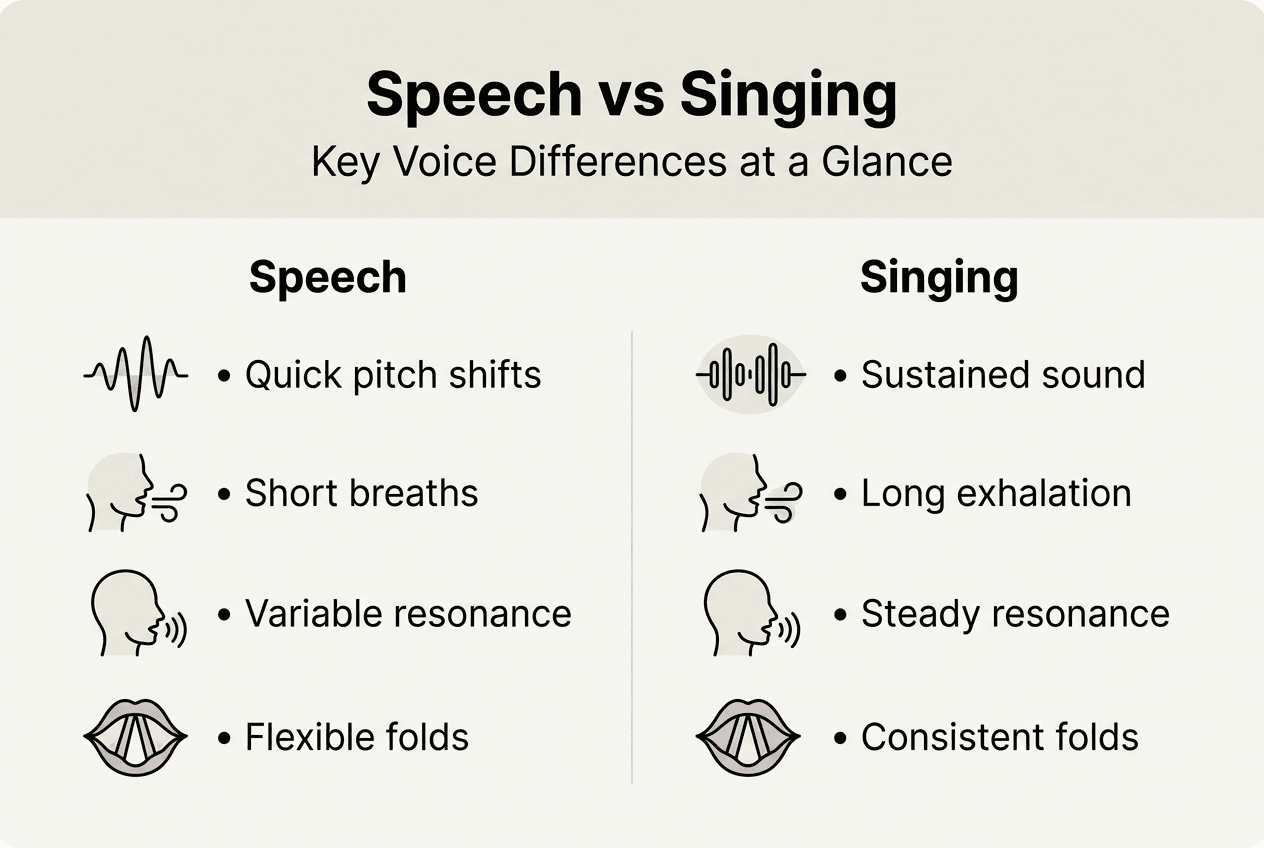
Your voice production starts with a deceptively simple process: air from your lungs passes through your vocal folds, causing them to vibrate and create sound. Yet this basic mechanism operates very differently depending on whether you’re chatting with friends or performing a challenging aria. Speech production uses flexible vocal fold adjustments distinct from those in singing, involving rapid changes in pitch and articulation that happen almost unconsciously as you communicate.
When you speak, your vocal folds make quick, varied movements. You shift pitch constantly to add meaning and emotion, moving from word to word with minimal sustained tone. Your articulation muscles work overtime, shaping consonants and vowels in rapid succession. The tempo varies wildly based on what you’re saying and how you feel about it. This flexibility serves communication perfectly but doesn’t demand the precise control singing requires.
Singing transforms these same structures into instruments of sustained musical expression. Your vocal folds must maintain steady vibration at specific pitches for extended periods. Resonance becomes crucial as you shape vowels to maximize tone quality while projecting over accompaniment. The coordination involves conscious control of muscles that work automatically during speech. You’re not just making sound; you’re crafting it with deliberate attention to pitch accuracy, timbre, and dynamic control.
The physiological differences extend throughout your vocal system:
These distinctions mean that excellent speakers aren’t automatically skilled singers, and vice versa. Each mode requires its own vocal technique training and awareness. Recognizing these differences helps you approach each vocal task with appropriate strategies, reducing the risk of applying speech habits to singing or forcing singing techniques into everyday conversation.
Your vocal folds behave like different instruments depending on the task at hand. During speech, they make quick adjustments with variable tension and closure patterns. The vibration isn’t sustained; instead, it starts and stops with each syllable, allowing for the rapid articulation speech demands. This intermittent pattern means your vocal folds can rest briefly between words, reducing continuous strain.
Singing flips this script entirely. Your vocal folds must maintain consistent vibration throughout phrases that can last many seconds. The closure pattern becomes more precise and balanced to produce clear, resonant tone. Breath support techniques crucially differ for singing and speech, impacting vocal endurance and quality in ways that directly affect your performance capacity and vocal health.
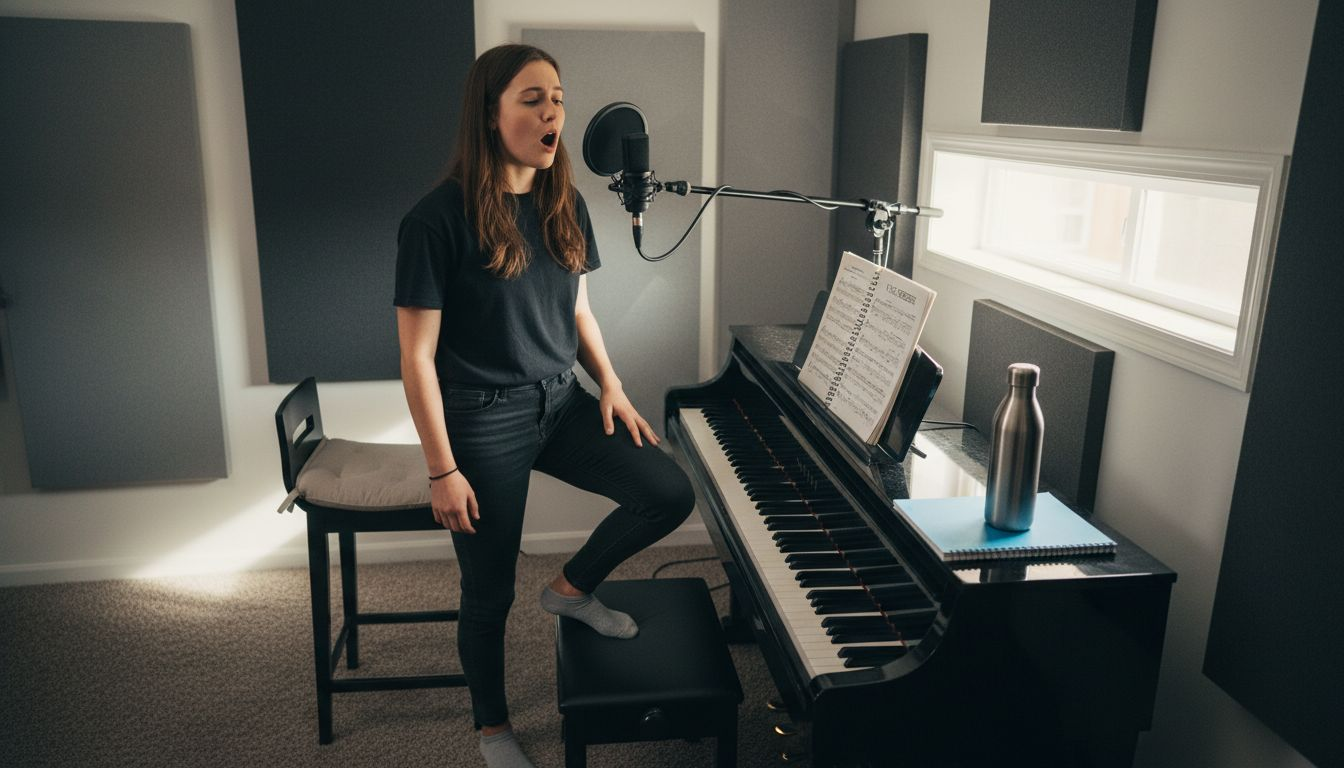
The breath management differences are striking. When you speak, you take quick, shallow breaths between phrases, using just enough air to power your words. The breath pressure varies constantly as you emphasize different syllables and adjust volume naturally. This works fine for conversation but would sabotage sustained singing. Singers need deep, controlled breathing that provides steady airflow throughout long phrases, maintaining consistent subglottic pressure to support even tone production.
| Vocal Parameter | Speech | Singing |
|---|---|---|
| Typical airflow rate | 100-200 mL/second (variable) | 80-150 mL/second (steady) |
| Subglottic pressure | 5-10 cm H2O (fluctuating) | 7-15 cm H2O (controlled) |
| Breath cycle duration | 2-4 seconds per phrase | 8-20+ seconds per phrase |
| Vocal fold closure | Incomplete to complete (varied) | Consistent balanced closure |
This data reveals why singers often feel breathless when they first train properly. You’re learning to manage air differently than your body’s speech habits have programmed. The steady pressure and extended phrases demand diaphragmatic control and intercostal muscle coordination that casual breathing never develops. Improper coordination can lead to vocal strain and hoarseness in both speech and singing, making proper technique essential for vocal longevity.
Pro Tip: Practice sustaining a single comfortable pitch on a vowel sound for increasing durations, focusing on steady breath release without pushing or tension. This builds the breath control singing demands while protecting your vocal folds from strain.
The resonance differences matter too. Speech resonance shifts constantly as you form different sounds, with your vocal tract changing shape rapidly. Singing requires you to maintain optimal resonance spaces while navigating pitch changes, often keeping vowels pure and consistent to maximize tone quality. This demands awareness of your soft palate, tongue position, and pharyngeal space in ways that speech never requires. Understanding these distinctions helps you develop appropriate breath support in singing while maintaining healthy speech patterns, and alerts you to vocal strain prevention tips that apply to both vocal modes.
Knowing the differences between speech and singing voices means nothing unless you apply this knowledge to your daily practice and vocal care. The distinctions we’ve explored translate into specific training strategies that can dramatically improve your vocal function and reduce injury risk. Here’s how to structure your approach:
Separate your warm-ups for speaking and singing activities. Speech warm-ups should include gentle humming, lip trills, and articulation exercises that prepare your vocal mechanism for the rapid changes speech demands. Singing warm-ups need scales, sustained tones, and exercises that build breath control and register coordination.
Develop breath awareness specific to each vocal mode. Practice conversational breathing patterns separately from singing breath support. Notice how your body naturally breathes during speech, then consciously engage deeper breathing for singing practice. This dual awareness prevents you from forcing singing breath patterns into everyday conversation or bringing shallow speech breathing into performance.
Schedule voice rest strategically based on your vocal demands. If you’ve been teaching or speaking extensively, your vocal folds need recovery time before intensive singing practice. Conversely, after a demanding performance, give your voice gentle speech-level activity rather than silence, which can actually stiffen your vocal mechanism.
Cross-train your vocal registers intentionally. Work on smooth transitions between chest and head voice in singing exercises, then notice how these registers blend naturally in your speech. This awareness helps you avoid forcing chest voice too high in singing or losing connection to your full vocal range in speaking.
Monitor vocal fatigue signals differently for each mode. Singing fatigue often manifests as difficulty sustaining pitch or reaching high notes. Speech fatigue shows up as hoarseness, vocal fry, or the need to clear your throat frequently. Recognizing these distinct warning signs lets you adjust your vocal use before minor fatigue becomes serious damage.
Pro Tip: Record yourself speaking and singing the same text, then listen critically to identify where your vocal quality differs. This reveals habits you might transfer inappropriately between modes.
The importance of specialized training can’t be overstated. Specialized voice therapy and training tailored to singing and speaking needs can enhance vocal resilience and performance in ways that generic vocal exercises never achieve. Working with professionals who understand these distinctions ensures you’re building skills appropriately for each vocal mode rather than reinforcing problematic patterns.
Your daily vocal hygiene should account for both speech and singing demands. Stay hydrated throughout the day, not just before performances. Avoid vocal abuse in speech like yelling or speaking over noise, which can undermine your singing voice even if you never strain while performing. Consider the cumulative vocal load from all sources: teaching, phone calls, rehearsals, and performances all draw from the same vocal resources.
Exploring voice therapy benefits and vocal strength improvement tips gives you tools to address specific challenges in either vocal mode. These resources help you identify whether a vocal problem stems from speech habits, singing technique, or the interaction between them. Many singers discover that addressing problematic speech patterns dramatically improves their singing voice, revealing how interconnected these systems truly are.
The biggest myth surrounding speech and singing voices is that they’re essentially the same thing with minor differences in musical training. This oversimplification causes countless vocal problems as singers apply speech habits to singing or try to speak with singing technique. The reality involves both clear distinctions and fascinating overlaps that sophisticated vocalists learn to navigate skillfully.
| Aspect | Speech Characteristics | Singing Characteristics | Overlap Zone |
|---|---|---|---|
| Pitch control | Flexible, unconscious variation | Precise, sustained pitches | Speech-like singing styles, recitative |
| Breath pattern | Short bursts, natural rhythm | Extended, controlled support | Patter songs, rap-singing hybrids |
| Articulation | Rapid, varied, communication-focused | Sustained vowels, musical phrasing | Sung speech, sprechgesang |
| Vocal intensity | Conversational to projected speech | Soft to powerful singing dynamics | Theatrical speaking, sung dialogue |
This comparison reveals that the boundaries aren’t always absolute. Musical theater performers constantly navigate the spectrum between speech and singing, using techniques that blend elements of both. Understanding where these modes overlap and where they diverge helps you make conscious choices rather than accidentally mixing them inappropriately.
Some vocal styles intentionally blur these boundaries. Sprechgesang, a German term meaning “speech-song,” sits precisely between speaking and singing. Performers use approximate pitches and speech-like rhythms while maintaining some musical structure. Talk-singing in contemporary music employs similar hybrid techniques. Blurring the boundaries between speech and singing can confuse vocal coordination, potentially leading to misuse if you don’t understand what you’re doing.
The pitfalls of mixing speech and singing improperly include:
Advanced vocalists develop the flexibility to move along the speech-singing continuum deliberately. They can employ speech-like qualities in singing for expressive effect without losing vocal support. They can project their speaking voice using principles borrowed from singing without sounding artificial. This sophisticated control comes from understanding the distinctions deeply enough to blend them artistically rather than confusing them accidentally.
The neurological control differs too. Speech is largely automatic, controlled by brain regions that handle language and communication. Singing engages additional areas involved in musical processing, pitch discrimination, and conscious motor control. When you sing lyrics, both systems activate simultaneously, requiring integration that doesn’t happen in pure speech or instrumental music. This neural complexity explains why some people who stutter when speaking can sing the same words fluently.
Exploring singing therapy techniques helps you understand how therapeutic approaches address these different neural pathways and physical coordinations. Whether you’re recovering from vocal injury or optimizing healthy function, recognizing that speech and singing engage your voice differently ensures your rehabilitation or training targets the right mechanisms.
Now that you understand how speech and singing voices differ, you’re ready to optimize both with targeted support. TMRG Solutions offers comprehensive voice therapy kits designed specifically for singers and vocal professionals who demand peak performance and long-term vocal health. Our 25+ years of expertise in vocal wellness means you’re getting proven solutions, not generic remedies.

Whether you’re addressing existing vocal challenges or preventing future problems, our therapy kits provide natural, effective support. The basic voice therapy kit introduces essential vocal care tools perfect for emerging singers. The standard voice therapy kit expands your options with additional remedies for moderate vocal demands. Professional performers benefit from our premium voice therapy kit, which delivers comprehensive support for intensive vocal use. Each kit addresses the unique challenges both speech and singing place on your voice, helping you maintain optimal function across all your vocal activities.
Speech uses flexible, rapid pitch changes with intermittent vocal fold vibration, while singing requires controlled, sustained pitches with consistent resonance. The breath support, muscle coordination, and vocal fold closure patterns differ significantly between these two modes. These distinctions affect both technique and long-term vocal health, making it essential to train each appropriately.
Yes, poor speaking habits like tension, strain, or inadequate breath support can cause vocal fatigue that directly impacts your singing ability. Your vocal mechanism doesn’t distinguish between speech and singing damage; misuse in either mode compromises both. Comprehensive voice training should address speaking and singing techniques together to protect your entire vocal range and function.
Speech typically uses shorter, shallower breaths between phrases, while singing demands deep, sustained airflow with controlled diaphragmatic support. Practice exercises that emphasize steady breath release for singing, maintaining consistent subglottic pressure throughout long phrases. For speech, focus on natural breathing patterns that support projection without tension. Understanding breath support in singing helps you develop appropriate techniques for each vocal mode.
Yes, specialized voice therapy programs and kits address the unique demands of both speaking and singing, enhancing vocal strength, endurance, and health across all uses. Customized approaches can target individual challenges whether they stem from speech habits, singing technique, or the interaction between them. Exploring voice therapy benefits reveals how professional support can transform your vocal function and prevent long-term damage in both speech and singing contexts.
