Your Cart is Empty


TL;DR:
- Effective throat exercises for singers focus on vocal fold efficiency and use semi-occluded techniques rather than forcing or stretching the throat.
- Injuries like post-nasal drip and reflux require medical attention, as exercises cannot address underlying medical issues affecting the throat.
Most singers reach for the wrong solution when their voice feels tight or strained. They push harder, stretch the neck, or force a few aggressive vocal runs hoping something loosens up. The truth is, effective throat exercises for singers have nothing to do with forcing or stretching your throat. They work by training your vocal folds to vibrate more efficiently, using less effort to produce more sound. This guide walks you through the science-backed methods that actually protect your voice, paired with natural care strategies that keep your instrument performing at its best.
| Point | Details |
|---|---|
| Throat exercises are efficiency drills | Effective throat exercises focus on vocal fold efficiency using gentle semi-occluded techniques, not forcing the throat. |
| Medical evaluation is crucial | Persistent throat clearing over 2–3 weeks often signals underlying issues needing professional diagnosis and treatment. |
| Hydration supports vocal health | Layered hydration strategies including steam and nebulizing before voice use ease voicing and protect vocal folds. |
| Safe exercises include lip trills and straw phonation | These exercises reduce vocal strain by creating beneficial back-pressure and improving breath support. |
| Avoid overuse and strain | Overdoing humidification or pushing through pain risks vocal injury; rest and expert care are essential. |
Building on the introduction, let’s clarify what effective throat exercises really entail and why they differ from common misconceptions.
Most people picture “throat exercises” as something physical, like tilting the head, stretching the neck, or gargling aggressively. But vocal science points in a completely different direction. Throat exercises for singers are best approached as vocal-function and vocal-fold efficiency drills, not as stretching or forcing the neck and throat. This distinction matters enormously for your long-term vocal health.
The category of exercises that vocal specialists favor most is called semi-occluded vocal tract (SOVT) exercises. “Semi-occluded” simply means your vocal tract, the airway from your vocal folds up through your mouth, is partially closed at the lips or tongue. This partial closure creates a gentle back-pressure inside your throat that helps your vocal folds vibrate with less muscular effort.
Here is what makes SOVT exercises particularly valuable for singers:
You can find boost vocal health tips and detailed guidance on vocal cords relaxation exercises to complement the SOVT approach described here.
Now that we know what throat exercises are, it’s important to understand when irritation signals a deeper issue requiring medical attention.
Throat exercises can sharpen your vocal function, but they cannot treat everything that makes a singer’s throat uncomfortable. Chronic throat clearing is one of the most misunderstood symptoms in the voice world. Many singers assume it means they need more warm-ups. Often, it signals something medical entirely.
Two of the most common underlying causes are post-nasal drip and laryngopharyngeal reflux (LPR). Post-nasal drip sends excess mucus down the back of the throat, triggering the urge to clear. LPR is a form of acid reflux where stomach acid travels all the way up to the level of the larynx, inflaming the throat tissue without necessarily causing heartburn. Both conditions create sensations that no amount of lip trills or straw phonation will resolve.
Here is what you need to watch for:
Throat clearing lasting over 2 weeks is a clear signal to see a clinician, especially because post-nasal drip and LPR need targeted treatment that goes well beyond vocal exercise. For singers, getting this evaluation early protects your voice far better than continuing to push through with exercises that cannot address the root cause.
Understanding the medical role in vocal health is an essential part of smart, sustainable voice care.
With medical caution in mind, let’s explore effective throat exercises you can safely add to your vocal routine.
These five exercises form the foundation of evidence-informed vocal training. They cover warm-up, range building, muscle coordination, and relaxation. Done consistently, they make a measurable difference in how your voice feels and performs.
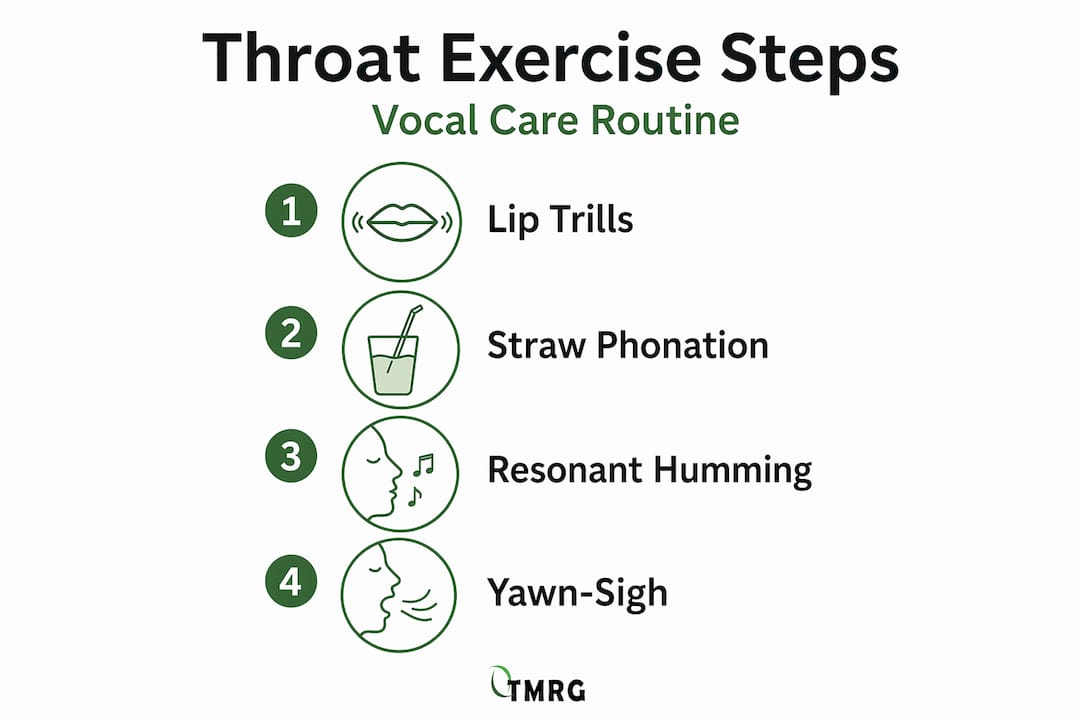
Lip trills. Press your lips together lightly and push a steady, relaxed breath through them so they vibrate. Add pitch, starting in your mid-range and gently sliding up and down. Lip trills and straw phonation improve vocal quality by building back-pressure that reduces strain, making them a foundational warm-up. Do this for 60 to 90 seconds to start.
Straw phonation. Place a regular drinking straw between your lips. Hum or sing a sustained note through the straw. The narrowed opening increases back-pressure in your vocal tract, which reduces laryngeal tension and stabilizes vocal fold vibration. Move through your range in small intervals. Start with five minutes.
Sirens. Slide your voice smoothly from your lowest comfortable pitch to your highest, and back again, like the sound of an ambulance siren. This is one of the best breathing techniques for singers because it connects chest voice and head voice across a seamless arc. Avoid pushing at either end of your range. The goal is smooth, unbroken transitions.
Yawn-sigh. Inhale slowly as if beginning a full yawn. Let your throat open wide during the inhale. Then exhale with a gentle, breathy sigh on a descending pitch. This throat relaxation technique releases tension in the extrinsic muscles of the larynx, the muscles most prone to tightening under performance pressure.
Resonant humming. Close your lips gently and hum at a comfortable pitch. Notice where you feel vibration. Aim for a sensation of buzzing in your lips, nose bridge, or cheekbones. This is forward resonance, which places less load on the vocal folds while still producing a rich, “full” tone. Practice moving this feeling across different pitches.
Here are a few practical tips to get the most from these exercises:
Pro Tip: Record yourself doing straw phonation on a single sustained note once a week. Over a month, you will hear your tone becoming more consistent and your effort clearly decreasing. It is a simple way to track real vocal progress.
Find additional guidance on vocal support exercises and specific methods for improving vocal strength to build on these foundations.
In addition to exercises, keeping your vocal folds hydrated naturally supports your voice’s ease and longevity.

Vocal folds rely on a thin layer of mucus to vibrate smoothly. When that surface dries out, friction increases, and the tissue has to work much harder to produce sound. Dehydration is one of the most overlooked contributors to vocal fatigue, and it affects singers at every level.
The most effective approach is layered humidification, which means addressing moisture at multiple levels simultaneously.
| Hydration method | How it works | Best timing |
|---|---|---|
| Systemic water intake | Hydrates tissue from the inside out | Throughout the day, consistently |
| Room humidifier | Raises ambient moisture in your space | While sleeping or during practice |
| Personal steam inhalation | Direct warm vapor to the laryngeal area | 5 to 10 minutes before heavy voice use |
| Nebulized saline | Delivers fine saline mist to vocal fold surface | 5 to 10 minutes before performance |
Layered humidification and short steam sessions of 5 to 10 minutes before heavy voice use are clinically recommended to reduce vocal fold surface drying and ease phonation. The key word is “before.” Waiting until your voice is already fatigued and then steaming is far less effective than building hydration into your pre-performance preparation.
Here are the most practical hydration habits to build into your routine:
Pro Tip: Saline nebulization is not well known outside of clinical settings, but it is worth exploring. A small portable nebulizer with isotonic saline can deliver moisture directly to the laryngeal surface in a way that drinking water cannot, since water you swallow bypasses the vocal folds entirely.
Learn more about building a vocal health basis and reviewing vocal health maintenance strategies that pair well with a consistent hydration practice.
Let’s round out your practice with expert tips to avoid common mistakes and keep your voice safe.
The most frustrating thing about throat tension is how often singers misdiagnose it. Tightness in the throat during singing is rarely a structural problem. Throat tension complaints often reflect coordination issues rather than true physical tightness, which is why low-load phonation exercises like humming and SOVT methods relieve tension so quickly. You are not loosening a muscle; you are retraining a pattern.
Key pitfalls to avoid in your practice:
Important: Sudden hoarseness or pain after vocal overuse requires ENT evaluation before you continue singing. Pushing through with exercises when a vocal hemorrhage or structural injury is present can cause serious, lasting damage. When in doubt, stop and get checked.
Build long-term vocal resilience through consistent vocal hygiene habits and daily practices from daily vocal health habits tailored to working vocalists.
Here is the perspective that took us years of working with singers to fully articulate: the harder a vocalist tries to “work” their throat, the less power they actually produce. This runs directly against the instinct most singers have, especially when a note feels out of reach or the voice feels tired.
The cultural mythology around singing is built on effort. Big voice equals hard work. But the vocal folds are small, delicate structures. They do not generate power the way a bicep does. What they do extraordinarily well, when supported correctly, is respond to airflow and vocal tract shaping. The real power in a voice comes from the breath column managed by the diaphragm and the resonance chambers shaped by your pharynx, palate, and lips. The vocal folds are more like a valve than a muscle.
This is why semi-occluded exercises work so well: they remove the temptation to force. When you are singing through a straw or doing lip trills, you physically cannot push. The back-pressure does the balancing work for you, and your nervous system learns what efficient phonation actually feels like. That muscle memory then transfers into open-vowel singing.
Singers who shift from a “push and stretch” mindset to an efficiency-first approach consistently report three changes: their voice tires less, their upper range opens without forcing, and their tone becomes more consistent across the week, not just on good days. That consistency is the real goal. Great technique is not about what you sound like at your best; it is about your floor, the level you perform at even when conditions are not perfect.
Focus your training on vocal support tips that build breath management, and incorporate vocal strength tips that reinforce coordination over force.
Implementing a consistent throat exercise routine is a meaningful step forward. But singers who see the most sustained improvement pair that routine with products designed specifically to support vocal fold health between sessions.

TMRG’s voice therapy standard kit and voice therapy premium kit are built to complement the exercises and hydration strategies covered in this guide. From natural herbal formulations that soothe irritated tissue to targeted tools that support vocal fold recovery, each kit is developed with over 25 years of vocal health expertise. If you are just starting out, the basic voice therapy kit is a practical entry point. Explore the full range and find the option that fits where you are in your vocal journey right now.
Safe throat exercises for singers include lip trills, straw phonation, sirens, yawn-sighs, and resonant humming, all of which support efficient vocal fold vibration without adding strain. Lip trills and straw phonation specifically reduce vocal strain by generating beneficial back-pressure in the vocal tract.
If throat clearing persists for more than two to three weeks, or is accompanied by pain or hoarseness, a clinical evaluation is strongly recommended. Throat clearing lasting over 2 to 3 weeks may indicate post-nasal drip, LPR, or another condition requiring targeted treatment.
Proper hydration, including consistent water intake and surface humidification through steam or nebulized saline, helps vocal folds vibrate with less friction and reduces voice fatigue. Layered humidification with 5 to 10 minute sessions before heavy voice use is clinically supported for reducing vocal fold dryness.
Throat exercises alone cannot resolve vocal issues caused by laryngopharyngeal reflux. Post-nasal drip and LPR require targeted medical management, including dietary changes and medication, alongside any voice care routine.
Avoid forcing or pushing the throat, using excessive humidification without adequate rest, and continuing to sing through sudden hoarseness or pain. Sudden hoarseness and pain after vocal overuse require ENT evaluation before training resumes, as pushing through a potential injury can cause lasting damage.
