Your Cart is Empty


TL;DR:
- Voice strengthening devices use resistance or electrotherapy to improve vocal power and stamina. They are safest when used with proper technique, gradual progression, and professional guidance. Consistent practice with these tools builds voice strength effectively over time.
A voice strengthening exercises device is a specialized tool designed to build vocal power, improve breath support, and reduce strain through targeted resistance training. These devices fall into two main clinical categories: semi-occluded vocal tract (SOVT) tools and electrotherapy units. Voice science and speech-language pathology both recognize device-assisted training as a safe, structured method for singers, actors, lecturers, and anyone recovering from vocal fatigue. Tmrgsolutions has supported vocal health professionals and performers for over 25 years, and the guidance here reflects that depth of experience.
SOVT exercises are widely recognized as the gold standard for safe voice strengthening across singing and speaking professions. The term “semi-occluded” means the vocal tract is partially closed at the lips or teeth, which creates back-pressure inside the throat. That back-pressure gently pushes the vocal folds apart and pulls them together in a more efficient pattern, reducing the effort needed to produce sound.

The mechanics work like this: when you phonate through a narrow straw or a vocal trainer, the resistance slows the airflow leaving your mouth. Your vocal folds respond by vibrating with less collision force. Less collision force means less tissue trauma over time, which is why SOVT devices are used in both performance training and voice rehabilitation.
Breathing trainers add a second layer of benefit. Voice-strengthening devices that provide controlled resistance during inhalation and exhalation improve respiratory efficiency and reduce throat tension. A stronger, more controlled breath stream gives the vocal folds a steadier foundation to work from. Think of it as building the engine before tuning the exhaust.
Electrotherapy devices work through a different mechanism entirely. Clinical units like vocaSTIM stimulate the nerve and muscular systems that control swallowing and phonation. These are not home-use gadgets. They require specialist training and careful parameter adjustment to deliver safe, effective results.
Pro Tip: When you first use an SOVT device, focus on keeping your throat relaxed. The resistance should feel like a gentle push, not a squeeze. If your neck muscles tighten, reduce the resistance level.
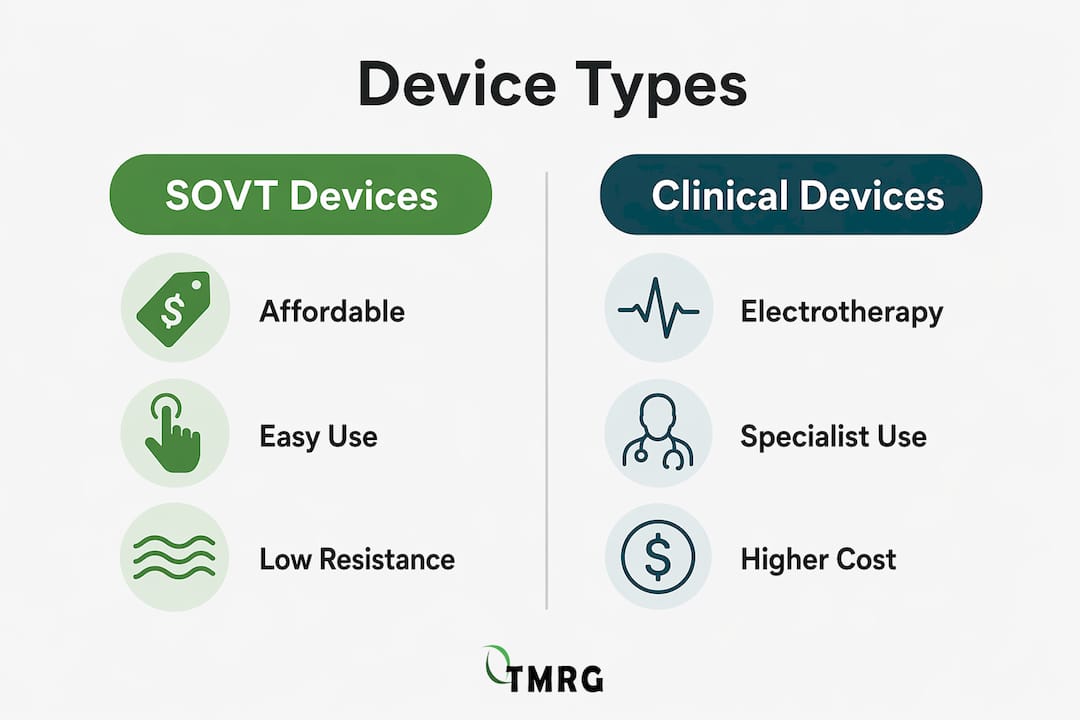
Device categories differ by mechanism, use case, and the level of supervision required. The table below maps the main types to their primary functions and typical cost ranges.
| Device type | Primary function | Typical use setting | Approximate cost |
|---|---|---|---|
| SOVT straw or vocal trainer | Back-pressure, vocal fold efficiency | Home practice, warm-up | Under $30 |
| Resistance breathing trainer | Breath support, diaphragm strength | Home or clinical | $20–$50 |
| Handheld voice amplifier | Projection support, reduced strain | Stage, classroom | $30–$80 |
| Clinical electrotherapy unit | Neuromuscular rehabilitation | Clinic, specialist only | Professional pricing |
SOVT devices are the most accessible entry point. A simple narrow straw costs almost nothing, and purpose-built vocal trainers add adjustable resistance levels for progressive training. Both are appropriate for daily home practice without supervision.
Resistance breathing trainers sit in the $20–$50 range and are widely available. They build the diaphragmatic strength that underpins all vocal power. Singers and lecturers who struggle with breath running out mid-phrase benefit most from this category.
Clinical electrotherapy units like vocaSTIM are intended for neurological vocal rehabilitation under specialist supervision. They are not casual voice training gadgets. If you are recovering from a neurological event that has affected your voice, an ENT or speech-language pathologist (SLP) will determine whether this category is appropriate for you.
The Tmrgsolutions breathing mask device bridges the gap between home-use resistance trainers and clinical-grade equipment. It is designed to improve respiratory efficiency, which is the foundation of vocal power, without requiring specialist oversight.
Structured routines produce results. Standard warm-up sessions run approximately 3 minutes and include lip trills, humming, and scales to prepare the vocal mechanism before any demanding work. Skipping this step with a device in hand is the most common mistake beginners make.
The following sequence works well for daily device-assisted practice:
Consistency matters more than session length. Daily 15-minute sessions outperform occasional hour-long efforts. Vocal strengthening compounds over weeks of targeted practice, not days.
Pro Tip: Stand or sit with your spine long and your chin level. Dropping your chin compresses the larynx and cancels out the benefit of the device. Good posture is not optional. It is part of the exercise.
You can find additional vocal support exercises that pair well with device routines, including straw phonation techniques with clear guidance on breath placement.
Devices are training tools, not instant cures. Overexerting with a device risks vocal fatigue or injury just as surely as overexerting without one. The resistance creates a training stimulus. Too much stimulus too soon damages the tissue you are trying to strengthen.
Follow these precautions every time you train:
Persistent hoarseness, pain, or voice loss that does not resolve with rest signals the need for professional evaluation. No device replaces an ENT or SLP assessment when symptoms persist. A professional voice assessment can identify structural issues that no amount of device training will fix on its own.
Professional training plans that combine device use with personalized voice therapy produce the strongest results over weeks of consistent work. That combination is the standard of care in clinical voice rehabilitation, and it applies equally to performers training at home.
Device-assisted voice training builds vocal power safely when you pair the right tool with consistent, posture-aware practice and know when to seek professional guidance.
| Point | Details |
|---|---|
| SOVT devices are the safest starting point | Back-pressure reduces vocal fold strain and suits daily home practice without supervision. |
| Breathing trainers cost $20–$50 | Resistance breathing builds diaphragm strength, the foundation of all vocal projection. |
| Sustained holds build stamina | Hold notes for 15–20 seconds per set to train vocal fold endurance over time. |
| Pain is always a stop signal | Pushing through vocal pain with a device causes injury, not strength gains. |
| Devices work best alongside professional care | Combining device routines with SLP or vocal coach guidance maximizes long-term results. |
The biggest mistake I see is treating a voice device like a shortcut. Someone buys an SOVT trainer, uses it for three days at full resistance, and then wonders why their voice feels worse. The device did not fail them. They skipped the foundational principle: the resistance is a stimulus, and stimuli need to be graduated.
What actually works is boring by comparison. You start at the lowest resistance your device offers. You hold notes for 15 seconds, not 30. You do this every day for two weeks before you increase anything. The voice responds to consistency the way a muscle responds to progressive overload. Slow, steady, and deliberate.
The second mistake is projecting sound outward instead of building inward support. The key to vocal stamina is drawing sound inward to build laryngeal resistance, not pushing it out toward the audience. When you use a device and focus on that internal engagement, you feel the difference immediately. The sound becomes fuller without getting louder. That is the sensation you are training toward.
My honest recommendation: pair any device routine with at least occasional sessions with a qualified vocal coach or SLP. Devices give you the stimulus. A trained ear gives you the feedback. You need both to build a voice that lasts.
— Golan
Devices build strength. Recovery products protect the tissue you are working so hard to develop. Tmrgsolutions combines both sides of vocal care in one place, with over 25 years of expertise behind every formulation.

The TMRG Voice Therapy Kit Basic pairs well with daily device routines, giving your vocal cords the herbal support they need between sessions. For singers and performers with heavier demands, the TMRG Voice Synergy Oil supports recovery after intensive resistance training. The TMRG Loud & Clear Classic Voice Recovery Drops soothe vocal folds after sustained note work and help maintain the moisture that efficient vibration depends on. Browse the full range at Tmrgsolutions to find the combination that fits your training level.
A voice strengthening exercises device is a tool that uses resistance or electrotherapy to improve vocal fold efficiency, breath support, and vocal stamina. SOVT trainers and resistance breathing devices are the most common categories for home use.
Vocal strengthening builds over weeks of consistent daily practice, not days. Short daily sessions of 15 minutes produce better results than infrequent longer sessions.
SOVT devices are safe for most beginners when used at low resistance with proper posture and breath alignment. Start with simple straw phonation and increase resistance gradually over two weeks.
Persistent hoarseness, pain during phonation, or voice loss that does not resolve with rest requires ENT or SLP evaluation before continuing device training.
Yes, and combining device exercises with personalized voice therapy produces stronger results than either approach alone. A coach provides the feedback that a device cannot.
