Your Cart is Empty


Singers often develop nodule-related concerns when high vocal load, strain, poor recovery, mucus, or technique issues repeat over time. Prevention starts with reducing unnecessary pressure, noticing early hoarseness, and getting professional guidance before minor symptoms become recurring problems.
TMRG products can significantly improve day-to-day voice comfort, clarity, mucus balance, and recovery routines for singers managing heavy practice or performance schedules. They do not diagnose, treat, or cure vocal nodules, and persistent symptoms should be evaluated by an ENT, laryngologist, SLP, or qualified voice professional.
Related TMRG support: Vocal Nodules Support Products, Vocal Load Support, and Hoarseness Voice Support.
TL;DR:
- Vocal nodules are benign growths caused by repetitive mechanical stress on the vocal folds.
- Singers develop nodules due to phonotrauma from overuse, force, illness, poor hydration, and tension.
- Most nodules improve with voice therapy, early diagnosis, and proper vocal care, avoiding surgery.
Vocal nodules are far more common among singers than most people realize, and they don’t discriminate based on talent or training level. Voice disorders affect ~42% of professional voice users, with nodules accounting for nearly a quarter of those cases. The popular myth is that nodules only happen to singers who use “bad technique.” In reality, even well-trained, experienced performers develop them under the right conditions. This guide covers what nodules are, why singers are particularly vulnerable, how to recognize them early, and what genuinely works to treat and prevent them.
| Point | Details |
|---|---|
| Nodules are common | Nearly a quarter of professional singers develop vocal nodules during their careers. |
| Prevention is possible | Proper vocal care and awareness of early symptoms can help singers avoid nodules. |
| Voice therapy is first-line | Most nodules respond best to structured voice therapy rather than surgery. |
| Recognize early signs | Hoarseness and vocal fatigue are early warnings signaling potential nodules. |
| Natural strategies assist recovery | Complementary remedies can support healing when used alongside proven therapies. |
Think of vocal nodules as the voice’s version of a callus. When your hands are subjected to repeated friction, skin thickens and hardens as a protective response. Your vocal folds do something similar. Nodules are benign (non-cancerous) growths that form on the surface of the vocal folds as a result of chronic mechanical stress. They feel and sound much worse than a callus, though, because even small changes to the vocal fold surface can significantly disrupt how your voice sounds and how long it lasts.
Nodules develop bilaterally at the midpoint of the membranous vocal folds, specifically at the junction of the anterior and middle thirds. This is not a random location. It is precisely where the two vocal folds collide with the greatest force during phonation (sound production). Every time you speak or sing, your vocal folds vibrate together hundreds of times per second. At that midpoint, the mechanical stress is highest, which is exactly where the tissue responds by thickening.
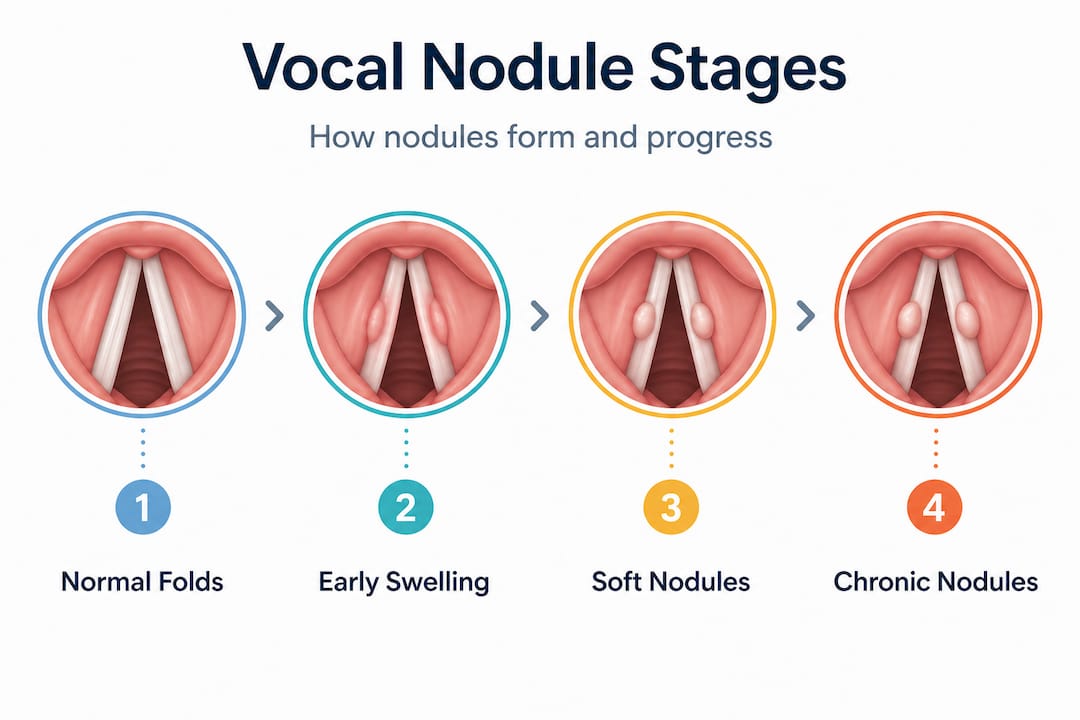
Early nodules are soft, swollen, and somewhat pliable. At this stage, they are often called “soft nodules” or “acute nodules,” and they are highly responsive to voice therapy and behavioral changes. If the stress continues without intervention, they mature into firm, fibrous growths called “hard nodules.” Hard nodules do not respond as quickly to therapy alone and may eventually require medical consultation.
Here is a quick reference to help you visualize how nodules present across different stages:
| Stage | Appearance | Voice impact | Typical response to therapy |
|---|---|---|---|
| Early (soft) | Small, fluid-filled swellings | Mild hoarseness, fatigue | High, resolves quickly |
| Intermediate | Firmer, more defined | Reduced range, breathiness | Moderate, requires consistency |
| Chronic (hard) | Dense, fibrous tissue | Significant voice loss, pain | Slower, may need medical support |
Clinical note: Nodules are almost always bilateral, meaning they form as a matched pair on both folds. This is an important clinical clue that differentiates them from polyps or cysts, which typically appear on only one fold.
If you want a deeper look at vocal nodules basics, including how they are clinically diagnosed, we cover this in detail on our site.
Singers are among the highest-risk groups for vocal nodules, and the reason is biological, not just behavioral. The core mechanism is phonotrauma, which refers to repetitive mechanical trauma from chronic vocal fold collision during voice overuse or misuse. Every time your vocal folds vibrate together, there is an impact. Under normal conditions, the tissue handles it. Under sustained high-demand conditions, such as long rehearsals, loud performance environments, or singing while sick, that tissue begins to break down.
Several specific factors drive nodule formation in singers:
These key causes of nodules explain why even technically skilled performers are not immune. It is often not a failure of technique, but a failure of recovery and pacing.
Voice disorders affect 42% of professional voice users, with females aged 20 to 50 showing particularly high prevalence. This gender pattern is partly anatomical. Female vocal folds are shorter and vibrate at higher frequencies, which means more collisions per second and, therefore, more cumulative stress over the same performance period.
The nodule risk in singers is compounded by professional pressures: touring schedules, performance demands, limited downtime, and the financial cost of canceling shows. These realities push singers to perform when they should rest, creating the exact conditions nodules need to develop.
Pro Tip: If you notice that your voice takes longer than usual to “warm up” in the morning, or that your upper range feels thin and unreliable after a performance, do not dismiss these signs as normal tiredness. Early nodule formation often presents exactly this way, weeks before any hoarseness becomes obvious.
Nodules do not appear overnight. They develop gradually, and so do their symptoms. The challenge for singers is that early symptoms closely mimic ordinary vocal fatigue, which makes it easy to attribute them to a demanding schedule rather than structural change.
The most common symptoms, roughly in order of appearance, include:
It is worth knowing how nodules differ from other vocal fold lesions, because the distinction affects treatment. The effects of nodules on professional performance are significant, but they differ from the effects of other growths:
| Lesion type | Location | Typical cause | Voice quality | Treatment path |
|---|---|---|---|---|
| Nodules | Bilateral, midpoint of folds | Chronic overuse/phonotrauma | Breathy, rough, reduced range | Voice therapy first |
| Polyps | Usually unilateral | Single traumatic event or smoking | Sudden hoarseness, variable | Often surgical |
| Cysts | Unilateral, deeper tissue | Congenital or blocked duct | Strained, effortful | Usually surgical |
| Edema | Diffuse swelling | Smoking, reflux, chronic misuse | Low-pitched, rough | Behavioral and medical |
Important: Never self-diagnose a vocal lesion. These conditions can look and sound similar to an untrained ear, and accurate diagnosis requires laryngoscopy (visual examination using a camera) by a qualified ENT or laryngologist. If your voice changes persist for more than two weeks, seek professional assessment.
The prevalence of voice disorders among singers is a serious professional concern. A hoarse or unreliable voice does not just affect performance quality; it can affect bookings, contracts, and career longevity. This is why early identification and proactive management matter so much. The singers who navigate this challenge best are those who recognize the warning signs before nodules become chronic. Seeking professional voice assessments early gives you the clearest picture of what is happening and the most options for recovery.
Good news: most nodules do not require surgery. The treatment landscape has shifted considerably in the past two decades, with voice therapy now firmly established as the first-line intervention. Understanding the full progression of treatment options helps you make informed decisions with your healthcare team.
Here is how evidence-based treatment typically unfolds:
Natural and supportive remedies play a meaningful role alongside clinical treatment. Herbal throat sprays that soothe mucosal membranes, steam inhalation, anti-inflammatory dietary adjustments, and careful hydration protocols all reduce the inflammation and tissue vulnerability that allow nodules to persist. These approaches do not replace voice therapy, but they support healing and improve day-to-day comfort during recovery.
Pro Tip: During voice therapy, keep a simple daily voice log. Rate your voice quality, fatigue level, and any pain or discomfort on a scale of one to ten each day. This data is invaluable for your SLP, and it helps you recognize the gradual improvements that are easy to miss in the moment.
The vocal health steps that matter most for prevention are the same ones that support recovery: consistent hydration, adequate sleep, managing reflux, and building structured vocal rest into every week, not just during illness.

Here is something most articles will not say plainly: waiting and hoping rarely resolves nodules. The “take some time off and see what happens” approach might reduce symptoms temporarily, but without addressing the underlying vocal habits that caused the damage, nodules return the moment you resume normal demand. We have seen this cycle repeat with countless performers over more than 25 years in vocal health.
The second truth is that fear of diagnosis keeps too many singers from getting assessed. There is a real professional anxiety around the word “nodules.” Singers worry that a diagnosis will mean surgery, career disruption, or permanent limitation. In reality, the opposite is true. Early diagnosis gives you the most options and the best outcomes. The singers who struggle most are those who wait until symptoms are advanced before seeking help.
Sustainable voice care is not about singing less. It is about singing smarter. That means building vocal rest into your weekly routine, not just your sick days. It means warming up systematically and cooling down after performance. It means treating your voice like the muscle-based instrument it is, with training, recovery, and nutrition all taken seriously. Exploring voice care strategies that fit your specific performance schedule is one of the highest-value steps any singer can take.
The third truth is that nodules are a signal, not a sentence. They are your vocal folds telling you that something in your current approach to voice use needs to change. Listening to that signal early and responding with genuine care almost always leads to full recovery and a stronger, more resilient voice.
Knowledge is your first tool, but it works best when paired with the right support. At TMRG, our 25+ years of experience in vocal health have helped us develop targeted solutions for singers at every stage, from early prevention to active recovery.

Whether you are just starting to notice signs of vocal strain or you are managing diagnosed nodules alongside voice therapy, our kits are designed to complement evidence-based treatment. The basic voice therapy kit is ideal for singers addressing early-stage issues or building preventive habits. For those in active recovery, the standard voice therapy kit provides a fuller range of natural remedies and guidance. Performers with demanding schedules or chronic conditions benefit most from the premium voice therapy kit, which includes our most comprehensive support. Your voice is your career, and it deserves proactive, consistent care.
Vocal nodules can become chronic and significantly harder to treat if consistently ignored, but most cases resolve with proper, consistent voice therapy. Voice therapy resolves 90%+ of nodule cases when applied correctly.
Early symptoms typically include increased vocal fatigue, mild hoarseness, and a noticeable reduction in upper range, often appearing weeks before more obvious voice changes. These signs occur because nodules form where vibration stress is highest, disrupting fold closure from the very beginning.
Nodules are especially prevalent in females aged 20 to 50 who use their voices professionally, due to higher vocal fold vibration rates and greater cumulative mechanical stress over time.
Surgery is rarely necessary. Most nodules resolve with voice therapy, and surgery is only considered when consistent, well-supervised therapy has not produced adequate results after several months.
Natural remedies support mucosal health, reduce inflammation, and improve comfort during recovery, but they work best as a complement to structured voice therapy, which research confirms outperforms steroid injections as the primary treatment approach for nodules.
