Your Cart is Empty


Apple cider vinegar can feel soothing on a raw throat, but it does not repair the vocal folds and won’t cure laryngitis. Its acidity can even backfire, irritating tissue that’s already inflamed and wearing away tooth enamel with repeated use. If your voice is hoarse or gone, your time is better spent on hydration, humidified air, and voice rest, which have real clinical backing behind them.
TL;DR:
- Gargling with apple cider vinegar only offers brief throat comfort and does not improve or heal damaged vocal cords.
- Consuming acidic beverages can cause immediate vocal roughness and strain, with no proven benefits for recovery from laryngitis.
- Repeated use of undiluted or concentrated ACV risks enamel erosion, worsened reflux, and increased vocal fatigue.
- The most effective recovery strategies involve hydration, humidified air, voice rest, and avoiding irritants like smoke and alcohol.
- Seek professional care if hoarseness persists beyond three weeks or if symptoms like breathing difficulty or blood cough occur.
Gargling with apple cider vinegar can make a scratchy throat feel better for a few minutes. That sensation is coming from the mucosa lining your mouth and throat, not from the vocal folds themselves, which sit lower in the larynx and never actually make contact with anything you swallow or gargle. Clinicians at UT Southwestern point out that ACV and similar remedies may soothe the throat, but they do not wash or heal the folds. The relief is symptomatic, not curative, which is an important distinction if you’re hoping ACV will speed up recovery from laryngitis.
The research on acidic beverages and vocal quality tells an even more pointed story. A 2021 thesis out of Florida International University measured vocal quality before and after participants drank an acidic beverage, and found immediate, measurable changes in jitter, shimmer, and noise-to-harmonics ratio, the acoustic markers of vocal roughness. Female participants showed the sharpest shifts, and while some of that change eased within an hour, the beverage clearly did not act like a tonic.
That lines up with what broader clinical summaries report. Medical News Today’s review notes that human clinical evidence for ACV curing a sore throat or laryngitis is limited at best.
The acoustic reality: the FIU research found significant shifts in vocal quality measures immediately after acidic beverage consumption, a signal that acid exposure can stress the voice rather than restore it, even short term.
Undiluted or frequent ACV use carries three distinct risks, and singers, teachers, and anyone who talks for a living should weigh all three before reaching for the bottle.
Dental erosion tops the list. The American Dental Association warns that repeated exposure to low-pH drinks wears down enamel over time, and vinegar sits well into acidic territory. Reflux is the second concern. Acidic intake can aggravate laryngopharyngeal reflux, which is already one of the most common hidden causes of hoarseness. Third, as covered above, acidic exposure can produce immediate, measurable vocal strain rather than relief.
Watch for burning in the throat, a voice that sounds worse than before you started, or new heartburn. Any of those is a signal to stop.
Pro Tip: If your throat burns during or right after gargling ACV, that’s your cue to stop immediately, not push through it. Pain is not part of a working remedy.
If you’re going to try it anyway, dilution and technique matter more than the vinegar itself. Straight vinegar against inflamed tissue is a bad trade, and the FIU thesis findings on acid exposure are reason enough to keep concentrations low.
| Step | What to do | Why it matters |
|---|---|---|
| Dilute | 1 to 2 tbsp ACV per 8 to 12 oz water | Reduces acid exposure to tissue and teeth |
| Gargle and spit | Never swallow the mixture | Limits reflux and vocal strain risk |
| Rinse and wait | Water rinse, then wait an hour to brush | Protects enamel already softened by acid |
The measures that have real support behind them are less exciting than a vinegar remedy, but they work with your body instead of against it. AAO-HNS guidance treats hydration, humidified air, and voice rest as the primary tools for acute laryngitis, and most acute cases are viral and self-limited, meaning they resolve on their own once the tissue has time and the right conditions to heal.
For a fuller rundown of remedies that pair well with these basics, see these vocal remedy examples and natural recovery steps for performers.
Hoarseness lasting longer than three weeks, or a voice that’s completely gone for more than a few days, warrants a professional look. Move faster, within days, if you notice trouble breathing or swallowing, or if you cough up blood.
Some companies have spent years focused on vocal health, building products around the principle this article keeps circling back to: soothing the throat and supporting the folds are related, but not the same job.
Most of what gets repeated about apple cider vinegar and sore throats treats the mouth and the larynx as one system. They are not. The throat lining can register comfort within seconds of a warm gargle, while the vocal folds, two small bands of tissue vibrating hundreds of times a second when you speak, need something entirely different to recover: reduced friction and time. That gap between how a remedy feels and what it actually does is where most home-remedy advice quietly falls apart.
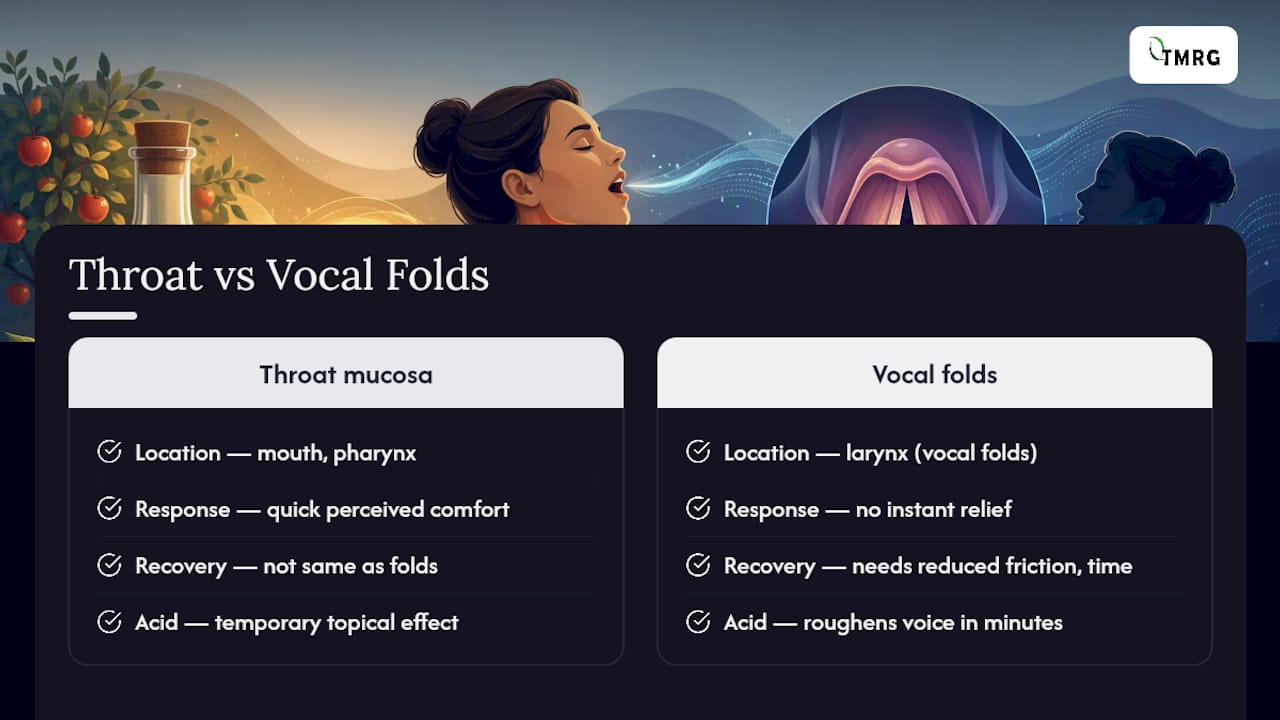
The bigger failure in typical advice isn’t recommending ACV. It’s what that advice skips: dilution ratios, dental precautions, and the acoustic research showing acid can measurably roughen the voice within minutes of drinking it. If you’re going to experiment with a home remedy, the FIU findings on acidic beverages are worth taking seriously before you reach for the bottle.
Prioritize hydration, humidified air, and rest first. Those cost nothing and carry no downside. If you want a supportive product on top of that foundation, choose one built around soothing and protecting tissue rather than one relying on acid to do the work.
— Golan
Sometimes you need something in reach before a show, a lecture, or a long call, and plain water alone doesn’t cut it. TMRG built its lineup around that exact gap between “drink more water” and “get through the next two hours.”
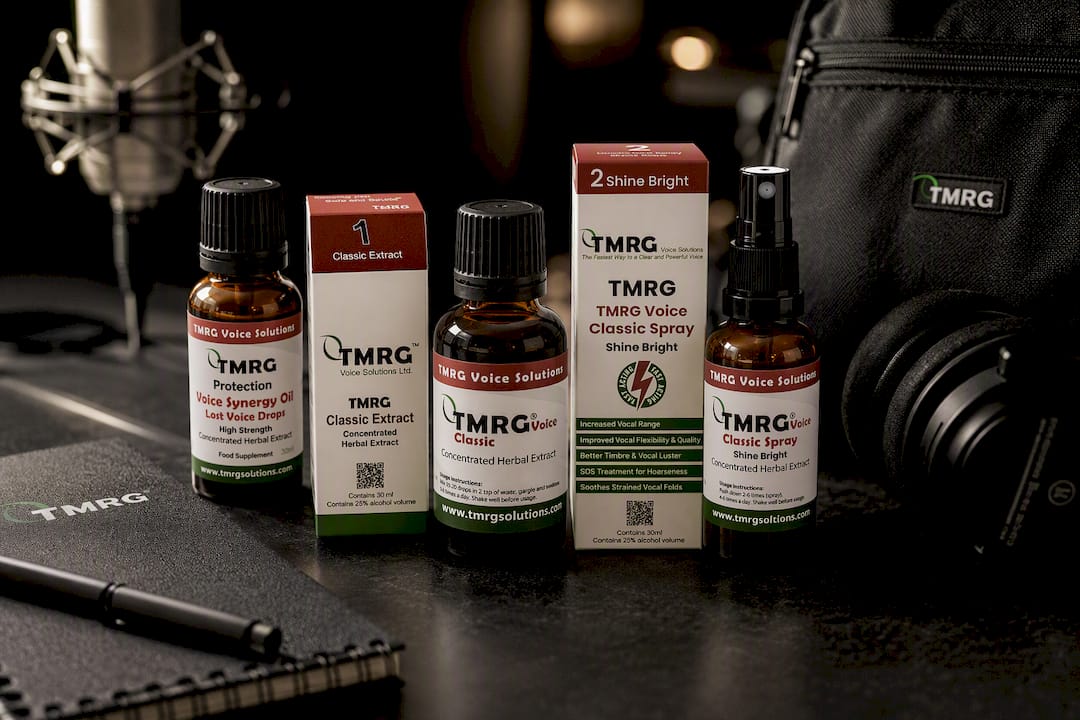
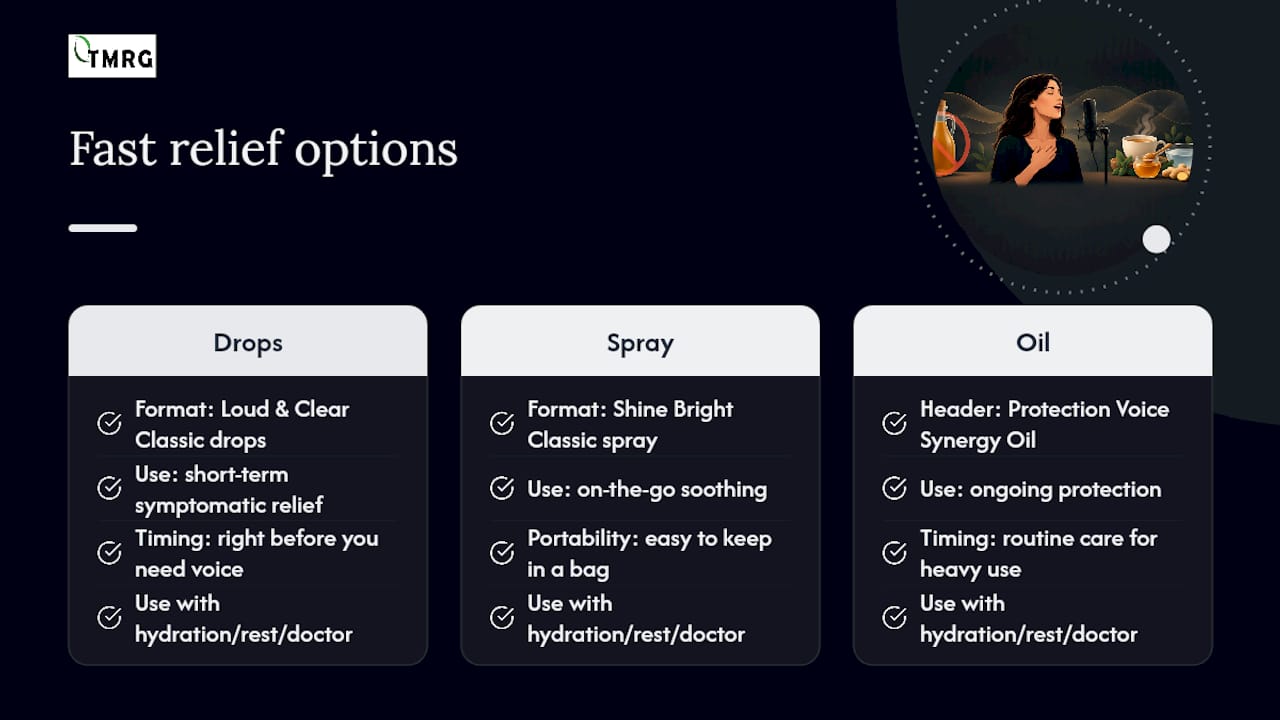
TMRG Loud & Clear Classic Voice Recovery Drops are formulated for short-term symptomatic relief, useful right before you need your voice at its best. TMRG Shine Bright Classic Voice Recovery Spray offers the same kind of on-the-go soothing in a quick spray format, easy to keep in a bag between sets or sessions. For ongoing protection rather than a quick fix, TMRG Protection Voice Synergy Oil is built for routine care if you use your voice heavily day after day.
Use any of these alongside hydration, rest, and a doctor’s guidance, not instead of them. Stop use and check with a clinician if hoarseness worsens or new symptoms appear. Browse the TMRG Voice Therapy Kits collection to find a bundle that matches how hard you work your voice.
This article is general information, not a substitute for advice from a qualified doctor. Consult a qualified healthcare professional about your own circumstances before acting on anything here.
Most acute laryngitis is viral and self-limited, meaning it resolves on its own once the tissue has time and the right conditions to heal, according to clinical reviews. Home remedies like apple cider vinegar can soothe the throat but don’t speed up healing of the vocal folds themselves.
Plain water, sipped steadily through the day, is the most reliable choice for keeping vocal fold tissue hydrated. Warm, non-acidic drinks can feel comforting, but ENT guidance makes clear that no drink actually reaches or heals the folds. For more specific options, see this breakdown of the best drinks for hoarseness.
Hoarseness without pain often points to vocal fold swelling, strain, or reflux rather than an infection. Acid reflux in particular can irritate the folds silently, with no burning sensation at all, which is why persistent hoarseness deserves a look even when it doesn’t feel sore.
Lemon water carries the same acidity concerns as apple cider vinegar. It may feel refreshing, but there’s no strong clinical evidence it treats laryngitis, and its acid content can irritate an already inflamed throat. Plain water and humidified air remain the better-supported choices for actual recovery.
