Your Cart is Empty


TL;DR:
- Essential oils help soothe symptoms but cannot cure laryngitis or replace medical treatment.
- Proper use involves dilution, steam inhalation, and avoiding ingestion to ensure safety.
- Combining oils with rest, hydration, and medical care optimizes vocal recovery.
Many vocal professionals reach for essential oils at the first sign of a hoarse voice, only to discover that the information available ranges from genuinely helpful to dangerously misleading. Laryngitis can sideline a singer mid-tour or silence a voice coach for days, so the stakes are real. This guide cuts through the noise, separating evidence-supported applications from overblown claims, and gives you a clear, practical framework for using essential oils safely as part of your vocal recovery plan.
| Point | Details |
|---|---|
| Not a magic bullet | Essential oils can relieve laryngitis symptoms, but they are not stand-alone cures for vocal professionals. |
| Safe use is crucial | Always dilute essential oils and avoid ingestion or strong application, especially before performances. |
| Combine with core care | Maximize benefits by pairing essential oils with rest, hydration, and proven recovery strategies. |
| Seek help appropriately | Chronic or unresponsive laryngitis requires timely medical evaluation to prevent long-term damage. |
With the importance of vocal health established, it’s vital to understand what laryngitis means in practical terms for those who depend on their voices.
Laryngitis is inflammation of the larynx, the structure housing your vocal folds. When those folds swell or dry out, their ability to vibrate cleanly is compromised. Your voice becomes “thin,” raspy, or disappears altogether. For a singer or voice coach, that is not just uncomfortable. It is a direct threat to your livelihood.
The most common causes include:
Acute laryngitis lasts fewer than three weeks and typically resolves with supportive care. Chronic laryngitis persists beyond three weeks and signals something that requires professional investigation. As Verywell Health notes, acute laryngitis responds best to supportive care, while chronic forms demand specialist treatment because missed warning signs can lead to serious vocal injury.
Warning: If your hoarseness lasts more than two weeks, or if you experience significant pain, difficulty swallowing, or fever, stop self-treating and see an ENT specialist. Persistent symptoms can indicate nodules, polyps, or even more serious pathology.
For vocal professionals specifically, the risk is compounded by pressure to perform. Many singers push through early warning signs and convert a mild inflammation into a weeks-long recovery. That pattern is one of the most preventable causes of chronic vocal damage we see.
Pro Tip: Start using a vocal remedy for hoarseness at the very first sign of roughness in your voice, not after the problem has taken hold. Early intervention consistently produces faster recovery.
Understanding laryngitis sets up the question: which essential oils actually help, and why are they recommended?
The five most frequently cited essential oils for laryngitis relief are eucalyptus, tea tree, peppermint, thyme, and lavender. Each one carries a distinct set of active compounds that interact with inflamed tissue, mucus membranes, and the nervous system in different ways.
| Essential oil | Key active compound | Primary mechanism | Evidence level |
|---|---|---|---|
| Eucalyptus | 1,8-cineole | Anti-inflammatory, mucolytic | Moderate (respiratory studies) |
| Tea tree | Terpinen-4-ol | Antimicrobial, antifungal | Moderate (topical research) |
| Peppermint | Menthol | Cooling, mild analgesic | Low to moderate |
| Thyme | Thymol | Antimicrobial, antioxidant | Moderate (in vitro) |
| Lavender | Linalool | Anti-anxiety, mild anti-inflammatory | Low (indirect benefit) |
Here is what the evidence actually says. Research confirms that certain essential oils improve rhinosinusitis symptoms in systematic review, and this is the closest quality data available for upper respiratory applications. However, controlled trials focused specifically on laryngitis remain scarce. That gap matters enormously if you are making treatment decisions for a performance career.
Eucalyptus oil deserves special attention. Its primary compound, 1,8-cineole, works as a mucolytic, breaking up thick mucus that accumulates during laryngeal inflammation. It also demonstrates measurable anti-inflammatory action in respiratory tissue. Peppermint oil creates a cooling sensation through menthol, which can reduce the “scratchy” feeling in your throat without treating the underlying inflammation directly. Think of it as turning down the discomfort dial rather than fixing the circuit.
Thymol, found in thyme oil, has demonstrated strong antimicrobial properties in laboratory studies, which is relevant when laryngitis has a bacterial component. However, lab results do not always translate directly to clinical benefit, which is why Health Guide Net’s essential oil analysis for laryngitis correctly points out that while these oils are praised for relevant effects, controlled clinical trials are still limited.
Now for the myths worth addressing directly:
If you want to enhance your voice with essential oils effectively, start with an accurate picture of what these compounds can realistically do. They reduce discomfort, support the body’s own repair processes, and create an environment more conducive to healing. That is genuinely valuable. It is also not magic, and treating it as such leads to delayed care and preventable damage.
For those interested in the broader landscape of botanical approaches, herbal medicine for vocal self-healing offers additional context on how plant-based compounds can support the body’s natural recovery pathways.
Having explored which oils are effective and why, let’s focus on safe, practical application, especially for those with performances at stake.
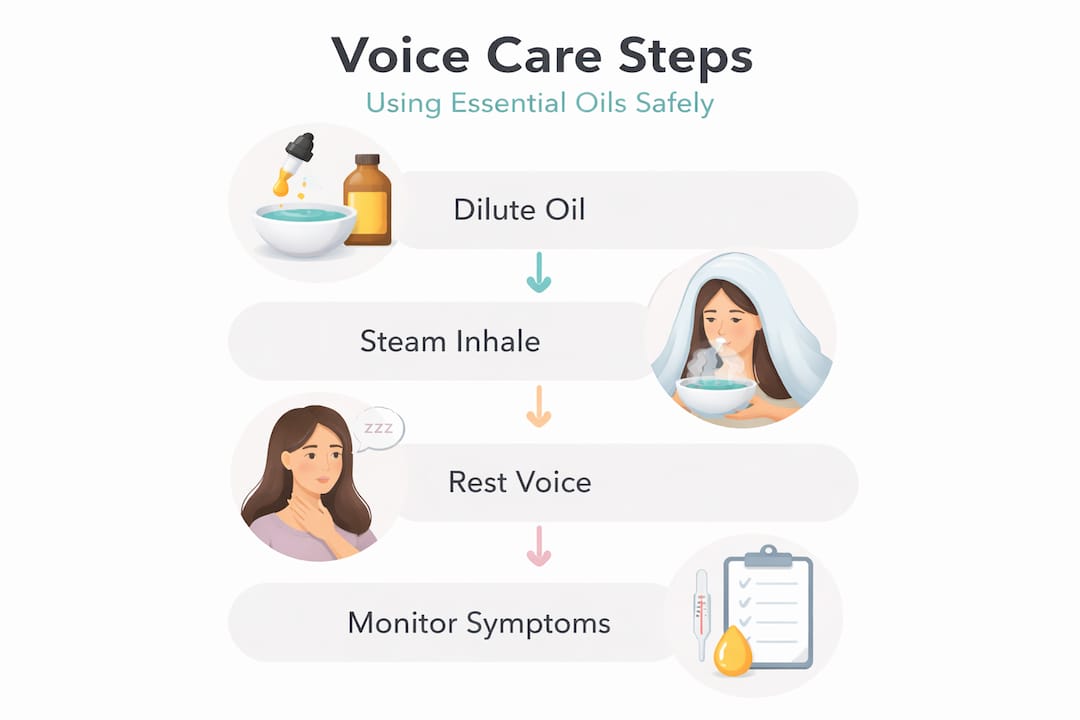
Safety is not optional when your voice is your profession. The following step-by-step approach reflects the guidance aligned with vocal coach recommendations on dilution and allergy testing before any performance use.
Pro Tip: Avoid any strong essential oil use in the 12 hours before a performance. Eucalyptus and menthol in particular can temporarily affect mucus viscosity and sensation in ways that alter your vocal output unpredictably. Save steam sessions for after the show.
Certain groups should exercise extra caution. Children under two years old should not be exposed to eucalyptus or peppermint oil in any form, as these can cause respiratory distress. Pregnant vocalists should consult a physician before using any essential oil therapeutically. Those with asthma or chronic respiratory conditions should introduce new oils gradually and monitor for any airway reactivity.
If your symptoms do not improve within three to five days of supportive care, including essential oil use, step back and reassess. Review the guidance on herbal solutions for vocal care to see whether additional botanical support is appropriate, and consider whether the role of medical professionals in vocal health is being underutilized in your recovery plan.
After safe use is established, vocal professionals should know how essential oils fit within a complete approach to recovery.
Essential oils are one tool in a well-stocked recovery toolkit. Relying on them alone, while neglecting the fundamental pillars of vocal healing, is one of the most common mistakes we see from professionals who underestimate the complexity of laryngeal recovery.
The foundational elements of recovery are:
The table below illustrates how essential oils complement, rather than replace, these core strategies:
| Recovery strategy | Primary benefit | Essential oil role |
|---|---|---|
| Vocal rest | Reduces mechanical trauma | None; rest must come first |
| Hydration (64oz+/day) | Restores mucosal lining | Steam inhalation adds moisture locally |
| Humidification | Reduces dryness | Diffusion can accompany humidifier use |
| Medical treatment | Addresses infection or pathology | Oils are adjunct only |
| Stress reduction | Lowers cortisol, reduces tension | Lavender diffusion has supporting evidence |
As Lelior’s aromatherapy guidance for singers correctly states, essential oils should complement, not substitute for, vocal rest, hydration, and proper medical oversight. That framing is exactly right. Think of essential oils as the finishing layer of a recovery approach, not the foundation.
Exploring proven vocal recovery strategies and strategies for voice health will give you a fuller picture of how to structure your recovery systematically rather than reactively.
With the bigger picture in focus, here is an on-the-ground perspective you won’t find in generic guides.
After 25 years working with singers, actors, and voice professionals, we have noticed a consistent pattern. When essential oils appear to “work miracles” for someone’s voice, it is almost never the oil alone. It is the oil used within a framework of rest, hydration, and intentional vocal care. The oil gets the credit. The system did the work.
Conventional wisdom in natural wellness circles tends to overstate what essential oils can do for vocal health. Social media amplifies this, with viral posts showing singers “cured” by a single steam session. What those posts rarely show is the 48 hours of silence, two liters of water daily, and the complete halt to vocal training that accompanied the steam session.
The honest assessment is this: essential oils contribute meaningfully to comfort, mild anti-inflammatory support, mucus management, and psychological readiness to perform. That psychological dimension is often overlooked. Lavender’s anxiolytic effects, for example, genuinely reduce pre-performance stress that tightens the throat and constricts airflow. That matters. But it is a supporting role.
Research from the journal Antibiotics confirms that essential oils best serve as complementary aids in acute scenarios, and are most effective when combined with rest and hydration. Solo use rarely produces the outcomes professionals need on a tight performance schedule.
No single remedy fits every voice or every case of laryngitis. A touring soprano dealing with dry air and schedule stress needs a different approach than a voice coach recovering from a cold. Tailoring your recovery strategy to your specific situation, rather than following a generic protocol, consistently produces better results. That is where tools like TMRG herbal essences for vocal problems come in, offering targeted formulations developed with vocal professionals in mind.
When you understand the evidence and want to move beyond piecing together a recovery plan on your own, structured support makes a measurable difference.

At TMRG Solutions, our 25+ years of vocal health expertise is built into every product we offer. The TMRG Voice Therapy Kit Basic gives you a professionally assembled starting point for voice recovery, combining herbal formulations and expert guidance in a single kit. For more acute or persistent cases, the Herbal Vocal Recovery Kit provides a more intensive set of natural tools designed for professionals who cannot afford prolonged downtime. If you are still assessing your situation, our vocal problem solutions page is the right place to start identifying the right approach for your specific needs.
Eucalyptus, lavender, and chamomile are widely considered safe when properly diluted and used in steam inhalation or diffusion; eucalyptus, tea tree, thyme, peppermint, and chamomile are also specifically recommended for laryngitis symptom relief.
Singers should use diluted oils for steam inhalation or diffusion, avoid ingestion or direct throat application, and do an allergy spot test first; combining oils with vocal rest and hydration is essential for effective recovery.
Side effects are generally mild and may include rare allergic skin reactions or airway irritation; users should avoid ingestion, test for allergic reactions, and refrain from use on children under two or during pregnancy without medical advice.
If symptoms persist for more than two weeks, worsen significantly, or include pain and fever, medical evaluation is essential; symptoms lasting over two weeks require professional assessment to rule out nodules, polyps, or infection.
Essential oils support symptom relief but are not a cure for laryngitis; essential oils work best as supportive tools alongside rest and hydration, and chronic cases always require proper medical management.
