Your Cart is Empty


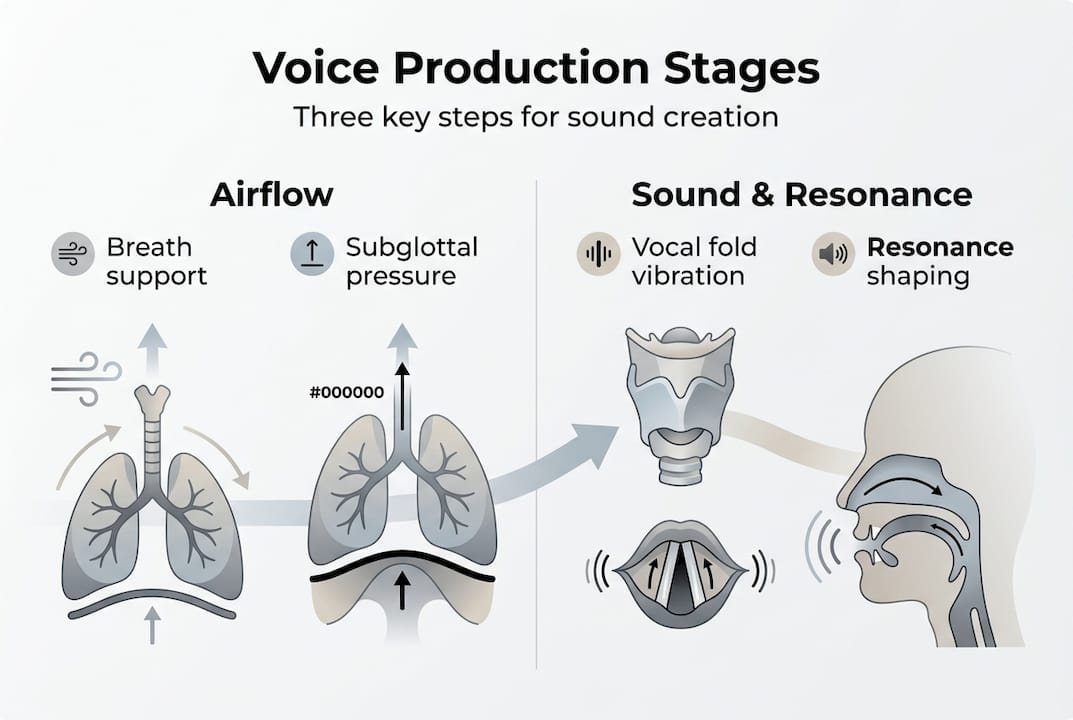
Your voice is the result of a precisely coordinated three-stage process that begins deep in your lungs and ends at your lips. Most singers and actors use their voices daily without fully understanding the intricate mechanics behind pitch, tone, and resonance. This lack of knowledge can lead to inefficient technique, vocal strain, and preventable injuries that sideline careers. By grasping how respiration, phonation, and resonance work together, you gain the insight needed to refine your performance, protect your instrument, and troubleshoot problems before they become serious. This guide breaks down the science of voice production into practical knowledge you can apply immediately.
| Point | Details |
|---|---|
| Breath support | Engage the diaphragm and maintain controlled exhalation to steady airflow and reduce vocal fatigue. |
| Free vocal vibration | Allow the vocal folds to vibrate with relaxed tension to avoid strain and injury. |
| Shape resonance for timbre | Fine tune tongue position, jaw opening, and soft palate height to sculpt the vocal tract and emphasize desired frequencies. |
| Hydration and warmups | Stay hydrated and perform gentle warmups to keep vocal tissues pliable and reduce strain. |
Voice production involves lung air compression creating subglottal pressure, vocal fold vibration transforming airflow into sound, and vocal tract filtering shaping timbre. Each stage plays a distinct role, and understanding them helps you diagnose weaknesses in your technique.
Respiration is the foundation. Your lungs compress air, building pressure below the vocal folds. This subglottal pressure must be steady and controlled. Shallow breathing or poor posture limits airflow, forcing your vocal folds to work harder and increasing fatigue. Singers who master breath support can sustain phrases longer and maintain consistent tone quality.
Phonation happens when air pressure forces your vocal folds to vibrate. These paired muscle-tissue structures in your larynx open and close rapidly, chopping the airstream into pulses that become sound waves. The speed of vibration determines pitch. Tension, thickness, and length of the folds all influence the resulting tone.

Resonance is the final shaping stage. The raw sound from your vocal folds travels through your throat, mouth, and nasal passages. These spaces act as filters, amplifying certain frequencies and dampening others. By adjusting tongue position, jaw opening, and soft palate height, you sculpt your unique vocal timbre. This is why two singers hitting the same note sound different.
Pro Tip: Focus on consistent breath support during essential vocal practice to reduce unnecessary vocal fold strain and improve endurance.
Core elements of each stage:
Steps to optimize voice production:
Your vocal folds are the primary sound source. Phonation involves adduction, subglottal pressure buildup, vibration cycles with open and closing phases, and resonance in the vocal tract. When you change pitch, you alter fold length, tension, or mass. Longer, thinner folds vibrate slower and produce lower pitches. Shorter, tighter folds vibrate faster for higher notes.
Vocal registers describe different vibratory patterns. Chest voice uses thicker, fuller fold contact and feels resonant in your chest. Head voice involves thinner fold edges and lighter contact, resonating in your skull. Mixed voice blends both patterns for smooth transitions. Falsetto uses minimal fold contact for a breathy, high tone. Vocal fry involves slow, irregular vibrations at the lowest end of your range.
Vibration characteristics vary by technique: normal chest voice shows glottal area index 0.379 to 0.437, vibration rate 3500 to 4500 Hz, and amplitude 5 to 11, while growling introduces more impurities. These differences matter because they affect vocal health. Techniques requiring extreme fold tension or irregular vibration increase injury risk if overused without proper conditioning.
Pro Tip: Develop habits for better performance by gradually expanding your register range rather than forcing unfamiliar vocal fold configurations.
| Vocal Register | Fold Contact | Typical Pitch Range | Common Use |
|---|---|---|---|
| Chest voice | Full, thick | Low to mid | Power, projection |
| Head voice | Thin, light | Mid to high | Clarity, agility |
| Mixed voice | Balanced | Mid range | Smooth transitions |
| Falsetto | Minimal | High | Breathy effects |
| Vocal fry | Irregular | Very low | Stylistic texture |
Key factors affecting pitch and tone:
Resonance transforms the raw buzz from your vocal folds into a rich, recognizable voice. Singers tune vocal tract resonances R1 and R2 to harmonics, with sopranos aligning R1 to fundamental frequency in high range and R2 to twice the fundamental, achieving precision within 20 Hz. This tuning varies by voice type, with sopranos using different strategies than baritones.
Your vocal tract acts like an adjustable filter. By changing its shape, you emphasize certain overtones and suppress others. This is how you create different vowel sounds and stylistic colors. Classical singers often aim for a balanced resonance across registers, while contemporary singers may emphasize brighter or darker tones depending on genre.
Resonance tuning enhances both clarity and power. When a vocal tract resonance aligns with a harmonic of your fundamental pitch, that harmonic gets amplified. This is called formant tuning. Skilled singers adjust their tongue, jaw, and larynx position to keep favorable resonances aligned as they move through their range. The result is a voice that projects effortlessly and maintains consistent timbre.
Resonance tuning techniques:
| Voice Type | R1 Strategy | R2 Strategy | Precision |
|---|---|---|---|
| Soprano | Align to f0 high range | Align to 2f0 | ±20 Hz |
| Mezzo | Moderate f0 alignment | Flexible 2f0 | ±25 Hz |
| Tenor | Lower f0 focus | Adjusted 2f0 | ±20 Hz |
| Baritone | Minimal R1 shift | Stable R2 | ±30 Hz |
| Bass | Fixed low R1 | Conservative R2 | ±30 Hz |
Mastering resonance takes time and focused listening. Recording yourself and comparing your tone to professional models helps you identify which adjustments produce the sound you want. Working with a voice teacher accelerates this process, as they can hear subtleties you might miss. Integrating resonance work into your vocal wellness routine ensures consistent progress.
Vocal health is non-negotiable for professional voice users. Assemble a multidisciplinary team including a voice teacher, laryngologist, and therapist, obtain baseline laryngoscopy, and perform warm-ups like lip trills, sirens, and scales to increase fold flexibility and prevent strain. Hydration and rest are equally critical.
Warm-up exercises prepare your vocal folds for demanding use. Inspiratory warm-up improves maximum phonation time significantly, boosting high pitch duration by 32 percent. Lip trills encourage gentle fold vibration without excessive tension. Sirens glide smoothly through your range, promoting flexibility. Scales build coordination and stamina. Aim for 10 to 15 minutes of warm-up before rehearsals or performances.
Hydration keeps your vocal fold mucosa supple. Dry folds are prone to irritation and injury. Drink water consistently throughout the day rather than chugging right before you sing. Avoid excessive caffeine and alcohol, which dehydrate tissues. Humidifiers help in dry climates or heated indoor environments.
Rest is when your vocal folds heal. Overuse without recovery leads to chronic inflammation, nodules, or polyps. Schedule vocal rest days, especially after intense performances. If you feel persistent hoarseness, pain, or vocal fatigue, consult a voice specialist immediately. Early intervention prevents long-term damage.
Pro Tip: Integrate daily warm-ups and hydration into your voice care routine to build resilience and catch problems early.
Essential vocal health practices:
“Baseline laryngoscopy and a multidisciplinary care team are foundational for any serious voice professional. Prevention is always easier than treatment.”
Understanding how your voice works is the first step. Applying that knowledge with the right support makes all the difference. Professional voice users need specialized resources to maintain peak performance and recover quickly when issues arise.
TMRG Solutions offers targeted kits designed specifically for singers, actors, and voice professionals. The premium voice therapy kit combines natural herbal formulations with professional-grade tools to address hoarseness, strain, and fatigue. For those seeking essential support, the voice therapy standard kit provides effective solutions at an accessible price point. If you need rapid recovery, the herbal vocal recovery kit delivers potent natural remedies backed by 25 years of vocal health expertise.

These kits complement your daily vocal care routine by providing evidence-based remedies when you need them most. Whether you are preparing for a demanding performance season or recovering from vocal fatigue, having professional-grade tools at hand empowers you to take control of your vocal health.
Warm-ups typically last 10 to 15 minutes to increase vocal fold flexibility and prevent strain. Consistency matters more than duration, so make warm-ups a non-negotiable part of your daily voice care routine. Longer sessions may be needed before particularly demanding performances.
Hydration keeps vocal folds supple and reduces the risk of strain. Proper fluid intake supports overall vocal endurance by maintaining the mucosa that protects your folds during vibration. Drink water consistently throughout the day and avoid dehydrating substances like excessive caffeine. For more guidance, explore vocal health tips.
Registers like chest, head, mixed, and falsetto influence pitch and tone quality. Balanced use prevents vocal fatigue and enhances stylistic versatility by allowing smooth transitions across your range. Understanding how each register engages your vocal folds differently helps you choose the right technique for each musical phrase. Strengthen all registers through essential performance habits.
Consult a specialist if you experience persistent hoarseness, pain, or vocal strain lasting more than two weeks. Early assessment helps prevent long-term damage that could sideline your career. Baseline laryngoscopy and regular check-ups are recommended for all professional voice users. Learn more about the importance of medical professionals in vocal health.
