Your Cart is Empty


Vocal inhalation masks, more precisely called semi-occluded vocal tract exercise (SOVTE) masks, reliably reduce perceived phonatory effort and produce measurable short-term improvements in acoustic and aerodynamic function when used correctly. Peer-reviewed trials, including randomized controlled studies, confirm these effects across multiple acoustic markers. For working singers, that translates to a more efficient warm-up, faster recovery between sessions, and a lower injury risk over a long career.
Three immediate benefits you can expect from a single session:
A semi-occluded ventilation mask RCT reported significant self-assessed decreases in phonatory effort alongside objective reductions in air pressure-related variables, confirming that the comfort singers feel is not placebo.
Vocal inhalation masks reduce perceived phonatory effort and improve short-term acoustic measures when used as active phonation tools within a structured warm-up, not as passive inhalation devices.
| Point | Details |
|---|---|
| Immediate acoustic gains | Jitter, shimmer, PNIF, and POIF improve significantly after a single bubble-mask session. |
| IWU combination effect | Adding inspiratory muscle warm-up boosts maximum phonation time by 21% and cuts perceived exertion. |
| Articulatory advantage | Masks placed outside the mouth allow continuous singing, improving transfer to real repertoire. |
| Safety and clearance | Hoarseness over three weeks, throat pain, or recent surgery requires ENT/SLP evaluation before mask use. |
| Tmrgsolutions recovery support | TMRG drops, sprays, and therapy kits complement mask protocols for post-session recovery and maintenance. |
Benefits fall into three distinct time horizons, and understanding which is which helps you set realistic expectations.
Immediate (single session): A randomized trial using the VocalFeel® bubble-mask device found significant improvements in jitter, shimmer, PNIF, and POIF compared with a control condition after one warm-up session. These acoustic and aerodynamic gains appear within minutes and make the mask a practical pre-show tool.
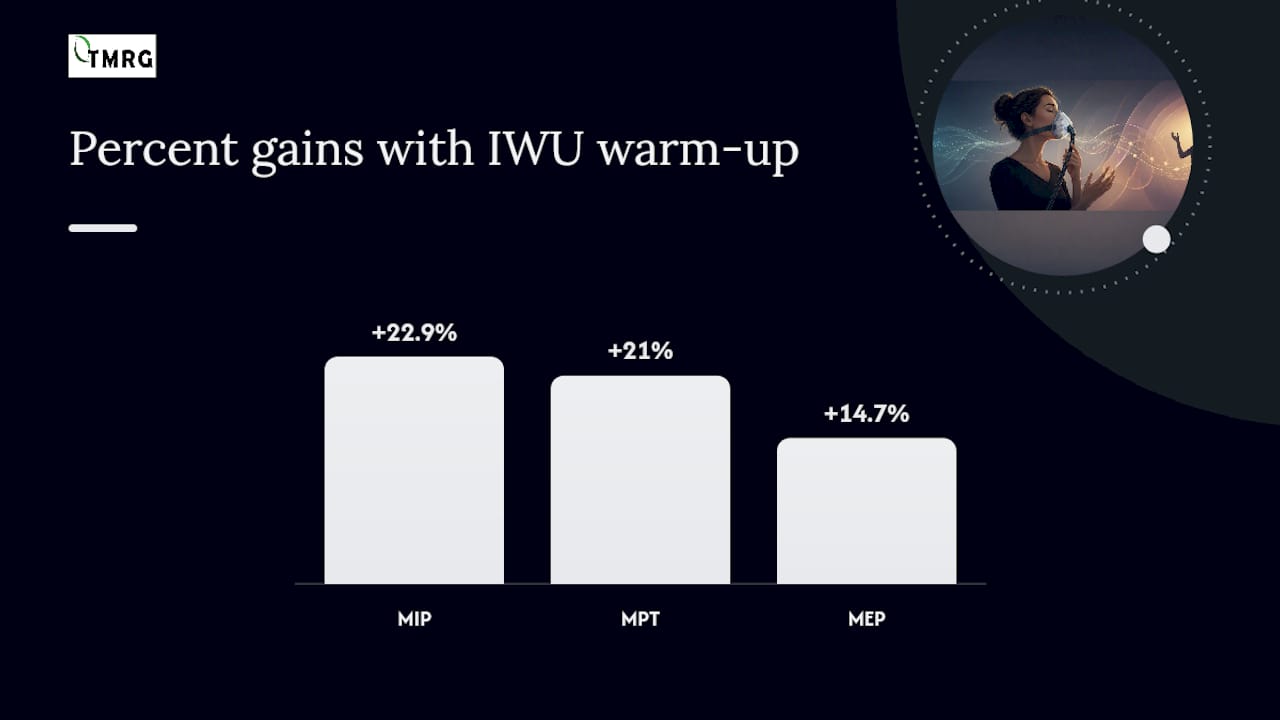
Short-term (days to weeks): When mask-based SOVTEs are combined with inspiratory muscle warm-up (IWU), singers gain more than acoustic polish. A controlled study reported that IWU acutely improved maximum phonation time by 21%, MIP by 22.9%, and MEP by 14.7%, while reducing perceived exertion on the Borg scale by 11.6%. Pairing the two approaches targets both respiratory power and vocal economy in a single session.
Cumulative (consistent use): Repeated mask work as part of a physiologic protocol builds vocal economy over time, reducing fatigue risk for touring singers and studio professionals. Evidence strength here is moderate; most published trials focus on acute effects, so longer-term gains are plausible but require more follow-up research.
By use case:
The core mechanism is supraglottal pressure loading. When you sing or speak into a mask that partially restricts airflow, pressure builds above the vocal folds. That increased supraglottal pressure reduces the transglottal pressure difference, which lowers the phonation threshold pressure (the minimum air pressure needed to set the folds vibrating). The result: your folds vibrate more efficiently with less muscular effort.
Acoustic researchers measure this efficiency through CPP (cepstral peak prominence), a signal-processing measure that correlates strongly with perceived voice quality. Higher CPP means a cleaner, more periodic voice signal. Jitter and shimmer measure cycle-to-cycle frequency and amplitude variation; lower values indicate more stable vibration. Both improve after mask-based SOVTE sessions.
What separates masks from intra-oral SOVTEs like straw phonation or lip trills is where the occlusion sits. With a straw, your mouth is occupied and articulation stops. A mask places the semi-occlusion outside the oral cavity, so you can continue singing full phrases, consonants, and vowels throughout the exercise. A water resistance ventilation mask study in musical theater students found this design allowed continuous singing and articulation, which may increase transfer to actual performance tasks compared with intra-oral methods.
Picture the airflow path: breath travels from the lungs, through the vocal folds, through the oral and nasal cavities, and then meets resistance at the mask interface. In water-resistance designs, the mask tube dips into water, creating bubble resistance. In steam or humidifier masks, warm moisture is added to the inhaled air. Both alter the supraglottal pressure gradient, though through slightly different mechanisms.
Study types range from small randomized pre/post designs to RCT-style protocols. Sample sizes are modest across the field, typically 20–50 participants, which is worth keeping in mind when weighing effect sizes.
| Outcome Measure | Finding | Study Type |
|---|---|---|
| Jitter (%), Shimmer (%) | Significant improvement vs. control after bubble-mask SOVTE | Randomized trial |
| PNIF / POIF (aerodynamic) | Significant improvement after single bubble-mask session | Randomized trial |
| Phonatory effort (self-assessed) | Significant reduction after semi-occluded ventilation mask protocol | RCT-style protocol |
| CPP / CSID | Consistent modest improvement across pitch and occlusion conditions | Small randomized pre/post |
| MIP / MEP / MPT | MIP +22.9%, MEP +14.7%, MPT +21% with IWU added to warm-up | Controlled study |
A variably occluded face mask (VOFM) study found consistent reductions in perceived vocal effort and modest CPP improvements across multiple pitch and occlusion conditions, adding confidence that the effect is not device-specific.
Limitations to know: Most trials measure effects immediately after a single session. Effect sizes vary across studies, and longer-term follow-up data are sparse. Small sample sizes limit generalizability, particularly across voice types and professional experience levels. Treat acute benefits as well-supported; treat cumulative gains as promising but not yet conclusively proven.
Practical implications:
This sequence works for pre-rehearsal warm-ups, pre-show preparation, and early-stage voice rehabilitation. Pair it with your existing vocal warm-up routine for best results.
Frequency: Daily use is appropriate for maintenance. For rehabilitation, three supervised sessions per week is a common clinical starting point; step back if you notice increased fatigue or discomfort. Customize the sequence to your voice type using tailored warm-up guidance.
Masks are safe for most healthy singers, but certain situations require professional evaluation first. Consult an ENT or speech-language pathologist (SLP) before starting mask-based SOVTE work if you experience any of the following:
For clinical voice therapy cases, an SLP should document baseline acoustic and aerodynamic measures before beginning a mask protocol and monitor progress at regular intervals. Learn more about when to involve medical professionals in your vocal health plan.
Hygiene rules:
Fit and seal first. A correct mask session produces gentle, consistent resistance throughout the breath cycle. If you feel no resistance at all, the seal is broken. If you feel sharp pressure or dizziness, resistance is too high. Test the seal by covering the mask outlet briefly; you should feel immediate back-pressure.
Design categories to understand before buying:
Common mistakes and fixes:
Pro Tip: After removing the mask, immediately sing a short phrase from your current repertoire at performance intensity. This “bridge phrase” trains your nervous system to carry the reduced-effort sensation into real singing, accelerating transfer.
Masks occupy a specific niche in the SOVTE family. Straw phonation and lip trills are effective and require no equipment, but they block articulation and do not allow continuous singing. Humming and nasals are gentler and better suited to very early warm-up or cool-down. Resonance tubes (like the Lax Vox tube) work on similar pressure principles to water-resistance masks but require the tube in the mouth.
The mask’s advantage is articulatory freedom combined with consistent, measurable resistance. For musical theater singers and studio vocalists who need to warm up quickly while preserving full diction, that combination is hard to replicate with intra-oral tools. For pure acoustic loading in a clinical setting, straw phonation remains well-studied and portable.
Steam masks serve a different purpose: they primarily deliver moisture to the airway rather than create supraglottal pressure loading. They are useful for hydration and soothing irritated tissue, but they do not produce the same acoustic and aerodynamic gains as pressure-loading masks. Many singers benefit from using both: a pressure-loading mask for the warm-up protocol and a steam or saline spray for post-session recovery.
Your choice depends on three factors: your primary goal, your experience level, and your performance schedule.
For warm-up and performance prep: A water-resistance or bubble mask gives you the best evidence base and allows full articulation. Look for adjustable resistance so you can progress the load as your respiratory strength improves.
For rehabilitation or vocal fatigue: A variably occluded mask or a clinician-prescribed semi-occluded ventilation mask lets your SLP adjust occlusion level to match your current capacity. Do not self-prescribe resistance levels if you are recovering from a vocal injury.
For touring or travel: Portability matters. Compact bubble-chamber designs that use a small water container are practical on the road. Pair them with a saline or herbal throat spray for post-show recovery.
Voice type considerations: Heavier, larger voices generally tolerate higher resistance levels. Lighter lyric voices and young singers should start at minimal resistance and progress slowly. If you are a high soprano or countertenor, begin with shorter sessions (4–6 minutes) and monitor for any increase in tension.
Masks are not a shortcut to technique. The research consistently frames them as a physiologic training tool that improves vocal economy, not a replacement for skilled instruction. A singer with poor breath support or inefficient registration will not fix those problems with a mask alone.
Other genuine limitations:
Most reusable mask frames are durable if cleaned consistently, but the consumable components need regular attention. Water-resistance tubes and bubble chambers accumulate mineral deposits and microbial film with repeated use. Replace them on the manufacturer’s schedule, typically every 4–8 weeks for daily users.
Silicone face seals degrade with repeated disinfection. Inspect the seal edge monthly; any cracking or stiffening reduces the mask’s effectiveness and may introduce air leaks. Keep a spare seal if you perform frequently.
For touring singers, carry the mask in a hard case rather than loose in a bag. The frame and chamber connections are the most vulnerable points. A cracked chamber changes the resistance profile unpredictably, which undermines the consistency the protocol depends on.
Document your resistance settings and session notes. Over months, you will notice whether you need to increase resistance to maintain the same perceived effort level, which is a practical sign of improving respiratory strength.
The most common misunderstanding is treating the mask as a passive recovery tool, something you breathe through while resting. The acoustic and aerodynamic benefits documented in trials come from active phonation through the mask, not passive inhalation. Sitting quietly with a mask on your face does nothing for CPP or jitter.
The second misunderstanding is expecting the mask to replace technical work. After 25+ years of vocal health practice, the pattern is consistent: singers who integrate mask-based SOVTEs into a structured warm-up and then immediately apply the sensation to repertoire gain the most. Those who use the mask in isolation, without the transfer step, often report that the benefit “wears off” within minutes. That is not a mask failure; it is a training design failure.
The evidence also suggests that masks work best when they are part of a layered approach: inspiratory muscle warm-up for respiratory power, mask SOVTE for supraglottal loading and acoustic efficiency, and then real-song phrases to consolidate the gains. That three-step sequence, supported by professional voice assessment when needed, is what separates singers who maintain their voice across a long career from those who burn out.
Mask warm-up prepares the vocal folds efficiently, but post-session recovery is where many singers leave gains on the table. Tmrgsolutions offers a focused range of natural vocal health products designed to complement exactly the kind of physiologic work this guide describes.

The TMRG Loud & Clear Voice Recovery Drops are formulated for immediate post-session relief, supporting hydration and comfort after the sustained phonatory effort of a mask protocol. The TMRG Shine Bright Voice Recovery Spray delivers quick topical comfort and is compact enough for a touring bag. For throat maintenance between sessions, the TMRG Defense Oils and Saline Spray supports tissue recovery with a saline and herbal formulation. Singers who want a complete routine in one purchase can explore the TMRG Voice Therapy Kit, which bundles recovery and maintenance products with usage guidance. Check each product page for current availability and the brand’s support contact for questions about fit with your specific vocal health situation.
Yes, within a defined scope. Randomized trials show consistent improvements in jitter, shimmer, aerodynamic measures, and perceived phonatory effort after single sessions. Longer-term cumulative gains are plausible but need more longitudinal research.
Masks place the occlusion outside the oral cavity, allowing continuous singing and full articulation during the exercise. This makes transfer to actual repertoire more direct than intra-oral SOVTEs like straw phonation.
No. Steam masks primarily deliver moisture to the airway for hydration and tissue comfort. Pressure-loading masks create supraglottal resistance that alters vocal fold vibration mechanics. Both have value, but they address different needs.
Mask-based SOVTE work targets vocal fold efficiency and supraglottal pressure, not lung capacity directly.
Stop and consult an ENT or SLP if you experience hoarseness lasting more than three weeks, sharp throat pain during phonation, blood in secretions, or any symptoms that worsen with mask use.
