Your Cart is Empty


TL;DR:
- Most throat sprays marketed to singers lack strong clinical evidence, especially herbal and mentholated formulations.
- The most supported method for vocal hydration is nebulized isotonic saline, which delivers direct moisture to the vocal folds safely and effectively.
- Proper voice care involves systemic hydration, cautious use of evidence-backed topical treatments, and consulting professionals when symptoms persist beyond two weeks.
Walk into any music store or pharmacy and you’ll find rows of throat sprays promising to protect, soothe, or even “supercharge” your voice before a performance. Most singers grab one, use it backstage, and assume it’s doing something meaningful. Here’s the reality: the majority of these products have very little clinical evidence behind them. If your vocal health matters to you, and it should, you deserve to know what actually works based on research rather than marketing copy. This article lays out the science clearly and gives you a practical, evidence-backed approach to vocal maintenance and recovery.
| Point | Details |
|---|---|
| Saline is evidence-based | Isotonic (0.9%) saline via nebulization is the only widely proven topical hydration for singers’ voices. |
| Safety and precision matter | Nebulization is safer and more effective than steam inhalation for direct vocal fold hydration. |
| Not all sprays are equal | Most over-the-counter sprays lack strong clinical support compared to saline mist. |
| Know when to seek help | Persistent or severe symptoms require professional assessment, not just topical remedies. |
| Environment impacts hydration | Dry or dusty environments can increase vocal dryness—nebulized saline aids recovery. |
The term “voice spray” is a broad label that gets applied to a wide range of products. Understanding what falls under that umbrella is the first step toward making smarter choices for your vocal health.
Common types of products marketed as voice sprays include:
Singers typically reach for a voice spray hoping to solve two problems: dryness and reduced vocal effort. Dryness of the vocal folds increases mechanical friction during phonation (the vibration of vocal folds that produces sound), which can accelerate fatigue and irritation. Reducing perceived effort means you can sing through a long rehearsal or demanding performance without pushing your voice to a breaking point.
The gap between what’s promised and what’s delivered is significant. Exploring natural throat sprays designed for vocal health can help you sift through options, and checking out curated best sprays for vocalists gives you a clearer starting point. For a wider context, a good overview of therapeutic oral sprays shows just how varied the ingredients and purposes can be across products.
What the research consistently tells us is sobering: clinically grounded evidence focuses on nebulized isotonic saline (0.9%), not the herbal or aromatic formulations lining store shelves. That doesn’t mean other products are all useless, but it does mean you should temper your expectations and prioritize what has real evidence behind it.
Now that we understand the landscape of products called “voice sprays,” let’s focus on the clear leader for topical hydration.
Isotonic saline is a 0.9% salt-in-water solution that matches the natural salt concentration of healthy tissue fluids in your body. This concentration matters. Use a solution that is too concentrated (hypertonic) and it draws moisture away from tissue. Use one that is too diluted (hypotonic) and it may cause irritation. Isotonic saline sits in the precise sweet spot that allows it to hydrate surface tissue without triggering adverse responses.
When delivered via a medical-grade nebulizer, the saline is broken into very fine particles, typically measured in microns, that travel past the back of the throat and land directly on and around the vocal fold tissue. This is fundamentally different from a standard pump spray, which delivers larger droplets that mostly coat the mouth and upper throat and rarely reach the vocal folds directly.
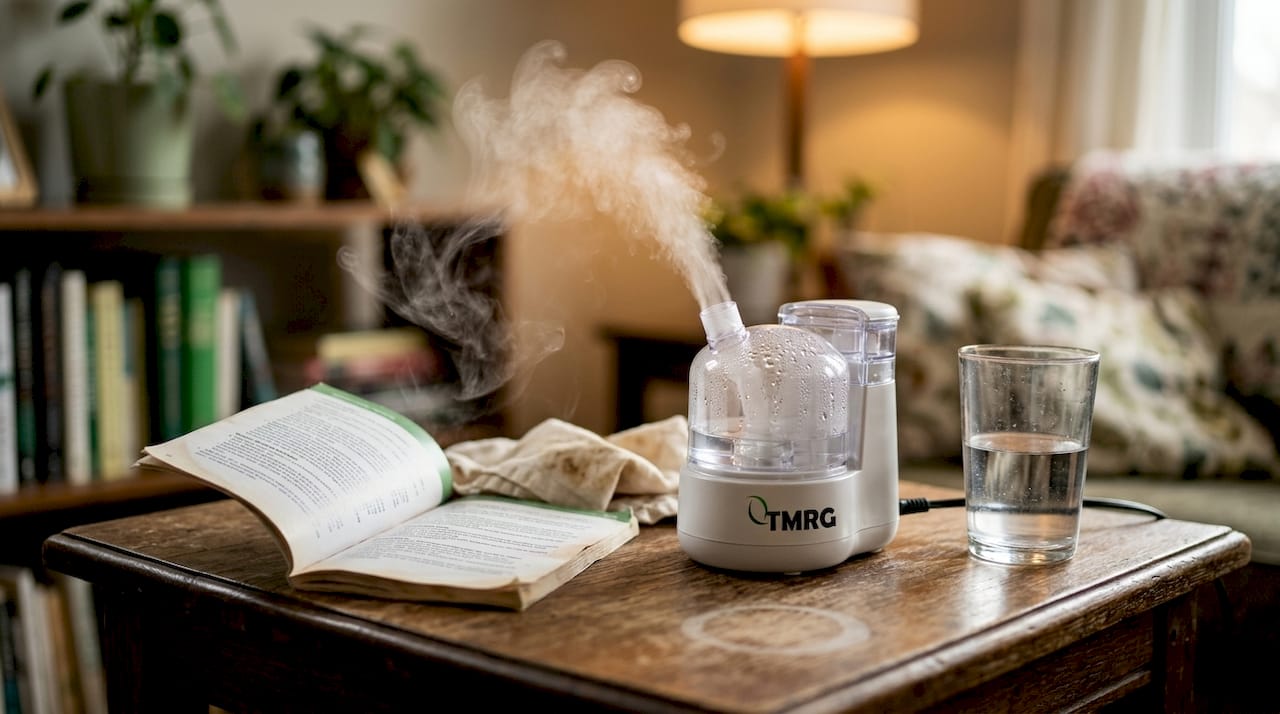
Saline mist versus standard throat spray: a direct comparison
| Feature | Nebulized isotonic saline | Standard throat spray |
|---|---|---|
| Particle size | Very fine (reaches vocal folds) | Larger droplets (coat upper throat) |
| Clinical evidence | Strong, peer-reviewed support | Limited to anecdotal |
| Safety profile | High; no vocal rest needed after use | Varies by ingredient |
| Mucus thinning effect | Yes, documented | Minimal or none |
| Cost | Affordable once nebulizer is owned | Ongoing cost per bottle |
| Portability | Requires device; portable models available | Easy, handheld |
The most evidence-supported option for singers seeking topical hydration is isotonic saline used via nebulization, because it provides direct moisture to the vocal folds and measurably reduces perceived effort and dryness-related strain. This is not a subtle distinction. It changes how you shop, how you prepare for performances, and how you recover from vocal fatigue.
From a practical standpoint, BAPAM advises that isotonic saline is the safest choice for nebulization in voice support. It can also thin sticky mucus, which is a real relief for singers who struggle with excessive mucus or the persistent urge to clear their throat before singing. Crucially, unlike some interventions, nebulization does not require vocal rest afterward, meaning you can use it during a break between sets or before stepping on stage without disrupting your performance schedule.
Incorporating nebulized saline into your practice becomes even more effective when paired with solid vocal maintenance tips and a structured effective voice care routine that supports all aspects of vocal health.
Pro Tip: A nebulizer is not the same as a facial steamer or a bowl of hot water. Nebulization converts liquid into a controlled fine mist at room temperature or slightly above, whereas steam inhalation uses heat. This distinction has real safety implications, which we address in the next section.
Understanding why nebulized saline stands apart, it’s also useful to compare it with another traditional strategy: steam inhalation.
Steam inhalation has been used by singers for generations. Lean over a bowl of hot water, cover your head with a towel, and breathe deeply. It feels good. The warm moisture can relieve a dry, irritated throat and temporarily ease congestion. But the clinical picture is more nuanced than the comfort it provides.
“Steam inhalation may help with airway humidity and comfort, but it carries burn and scald safety considerations and is generally less precise than nebulized saline for delivering topical moisture to the vocal folds.” BAPAM
Direct comparison: nebulized saline vs. steam inhalation
| Criteria | Nebulized saline | Steam inhalation |
|---|---|---|
| Precision of delivery | High (fine particles reach vocal folds) | Moderate (larger steam particles) |
| Safety | Very high; no burn risk | Moderate; burn/scald risk present |
| Appropriate setting | Home, backstage, on tour | Home primarily |
| Requires vocal rest after | No | Not typically |
| Evidence for vocal folds | Strong | Limited |
| Equipment needed | Portable nebulizer | Bowl, hot water, towel |
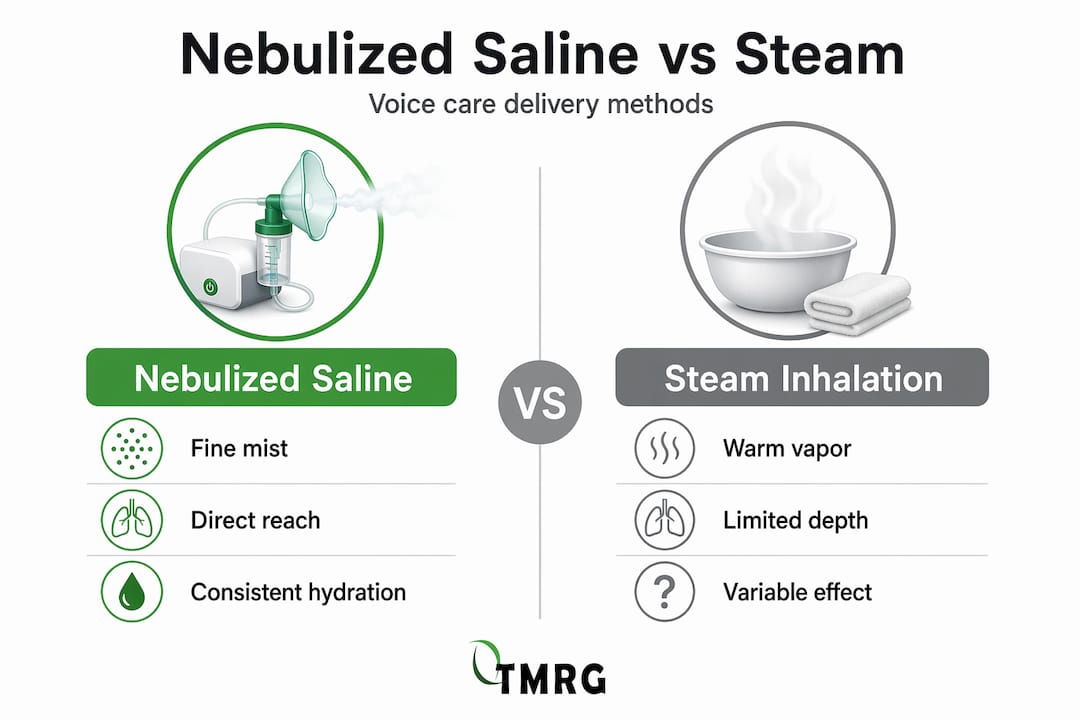
Steam still has value as a comfort measure and can help with overall airway humidity. But for targeted hydration of the vocal folds specifically, nebulized saline is the more precise and safer choice.
When each method makes sense:
Environmental factors also play a significant role in vocal dryness. Dry-air conditions, dust, and air conditioning are specifically identified as scenarios where topical humidification and nebulized saline are particularly helpful. Air-conditioned venues draw moisture from every surface, including your vocal fold tissue. If you perform regularly in such environments, building nebulization into your pre-performance routine is a practical, evidence-backed defense.
You can build this into broader voice care strategies and support it further with vocal health best practices that address everything from warm-up protocols to post-performance recovery.
As with any health strategy, it’s crucial to recognize the boundaries between effective self-care and situations that need professional input.
Nebulized saline and throat sprays are supportive tools. They manage surface moisture, thin mucus, and ease the mechanical friction on your vocal folds. What they cannot do is treat infection, heal structural damage to the vocal folds, manage acid reflux that is irritating your larynx, or resolve significant hoarseness from vocal nodules or polyps.
Signs that you need more than a spray:
If your symptoms go beyond dryness, including significant hoarseness, signs of infection, or reflux symptoms, throat sprays and nebulizers should be viewed as supportive moisture strategies only. The appropriate next step is to consult a qualified voice specialist or ENT (ear, nose, and throat physician) who can evaluate your vocal fold tissue directly.
Pro Tip: Two weeks is your threshold. If any vocal symptom, including hoarseness, unusual fatigue, or changes in pitch range, persists beyond two weeks despite rest and good hydration, book a professional voice assessment without delay. Catching structural issues early can be the difference between a short recovery and a long, difficult one.
The stepwise approach we recommend is simple: prioritize systemic hydration (drink plenty of water throughout the day), use nebulized saline for topical support when needed, rest your voice appropriately between heavy use, and escalate to a professional the moment symptoms suggest something more serious is going on.
After more than 25 years working with singers, actors, lecturers, and professional voice users, one pattern stands out clearly. The singers who take care of their voices best are not the ones chasing the newest product or the most exotic herbal formula. They are the ones who understand a small number of well-evidenced principles and apply them consistently.
Most guides you’ll find online are built around a different logic. They surface whichever products rank well commercially, wrap them in reassuring language about “natural” ingredients, and implicitly suggest that spraying something into your throat before a show will protect your voice. That’s not how vocal physiology works.
Your vocal folds are two thin bands of muscle and mucosa that vibrate hundreds of times per second during phonation. They are incredibly sensitive to dehydration, to mechanical overuse, and to irritants. What they need most is systemic hydration (the kind that comes from drinking water, not from spraying your throat), appropriate rest, careful warm-up practices, and, when topical hydration is specifically needed, the precision delivery that nebulized isotonic saline provides.
The discomforting truth is that the products with the biggest marketing budgets and most attractive packaging are often the least evidence-based. Mentholated sprays feel impressive because menthol activates cold receptors in the tissue, creating a vivid sensation of freshness. But that sensation tells you nothing about whether your vocal folds are actually better hydrated. It’s the equivalent of using a breath mint to treat a dental infection. It feels better momentarily; it doesn’t address the underlying need.
Checking what matters in voice care before investing in products is one of the most valuable things you can do. An informed singer who uses simple, evidence-backed tools will outperform, and outlast, one who cycles through trendy sprays hoping something will stick.
With a clear, evidence-based approach on your side, here’s where you can find natural, reliable support for your voice.
Understanding the evidence is only part of the picture. You also need products that are thoughtfully formulated, transparently described, and designed to complement the kind of careful vocal care routine the research supports.

At TMRG Solutions, we’ve spent over 25 years developing natural, research-aligned tools for professional voice users. Our basic voice therapy kit is an ideal starting point for singers who want a structured approach to vocal maintenance and recovery. For performers with more intensive needs, the standard voice therapy kit offers a broader set of natural solutions designed to support vocal resilience through demanding schedules. If you’re looking for targeted support, our voice enhancement drops are formulated to work alongside your hydration and care practices. Each product is designed to fit naturally into a sensible, evidence-informed routine.
Yes, isotonic saline via nebulization is regarded as safe for regular use by singers, and no vocal rest is required after application, making it easy to incorporate into any daily routine.
Most herbal or menthol sprays lack strong research backing for vocal fold hydration, and clinically grounded evidence consistently points to isotonic saline via nebulization as the effective choice for topical moisture.
Saline nebulization delivers immediate topical hydration to the vocal folds, reducing dryness and perceived vocal effort more quickly and precisely than steam inhalation alone.
If you experience persistent hoarseness, pain, bleeding, or long-term changes in vocal quality, the guidance is clear: consult an ENT or voice specialist, because sprays are supportive tools and not a substitute for professional evaluation.
Absolutely. Dryness from air-conditioned stages, dust, or dry performance venues is specifically identified as a scenario where nebulized saline provides meaningful topical relief for vocalists.
