Your Cart is Empty


TL;DR:
- Forcing a low voice causes vocal strain, fatigue, and reduces overall vocal health.
- Vocal variety and natural resonance are more effective for authority and engagement than speaking low constantly.
- Regular warm-ups, hydration, and voice training are essential for long-term vocal durability.
Many vocal professionals carry a persistent belief: speak low, sound authoritative. It feels logical. A deep, controlled voice seems to signal confidence and protect the cords from strain. But this common shortcut is oversimplified, and in practice, it can work against both your credibility and your vocal health. Forcing a low voice increases vocal fry and strain, especially under stress. If you are a speaker, lecturer, coach, or performer who relies on your voice daily, understanding the real science behind pitch is not optional. It is essential.
| Point | Details |
|---|---|
| Don’t force a low voice | Forcing your voice lower than natural increases strain and risks vocal fry. |
| Pitch variety boosts engagement | Changing pitch and tone improves listener attention and retention. |
| Vocal health needs routine | Daily warm-ups, hydration, and voice exercises prevent strain and injury. |
| Find your vocal sweet spot | Use your natural pitch range for maximum authority and comfort. |
| Professional tools help | Specialized kits and expert advice support ongoing vocal care for pros. |
Your voice has a natural pitch, often called your habitual pitch, which is the frequency your vocal folds (the two bands of muscle tissue inside your larynx) produce with the least effort. When you artificially push your voice below that range, you are asking your vocal folds to stretch and tighten in ways they were not designed to sustain. The result is predictable: tension builds, resonance thins out, and fatigue sets in faster.
One of the most common consequences is vocal fry. Vocal fry is that low, creaky, crackling sound you hear when someone speaks at the very bottom of their range. It happens because the vocal folds are pressed loosely together with insufficient airflow to sustain smooth vibration. While it may sound dramatic or authoritative to some ears, forced low pitch is clinically unsustainable and contributes directly to long-term vocal fatigue.
Stress makes everything worse. Under pressure, including a high-stakes presentation or a noisy room, the body tightens. Muscles contract. Breathing becomes shallower. When you are already fighting to hold an artificially low pitch, stress compounds the strain significantly. Your voice becomes less controlled, not more.
Here is what science tells us about the risks of forcing a low pitch:
The American Speech-Language-Hearing Association, known as ASHA, is clear in its ASHA voice care guidelines: vocal extremes, including shouting and whispering, should both be avoided. Forcing a pitch outside your natural range falls into the same category of harmful behavior.
“A voice that sounds full and resonant comes from ease, not force. Strain is the enemy of both power and endurance.”
Pro Tip: To find your approximate natural pitch, hum softly with your mouth closed. The pitch you land on with zero effort is close to your habitual speaking pitch. Start there when building technique. You can also explore protecting your speaking voice for a broader look at how to build a sustainable practice.
Understanding the physical impact, let’s look at how pitch affects perception and engagement. There is real research confirming that a lower pitch signals authority and confidence, but only when the voice is relaxed, resonant, and supported by proper breath. The key phrase is when it is natural. A naturally deep voice that resonates freely carries weight and warmth. A forced low voice that lacks resonance sounds flat and effortful.

Here is the engagement problem that most speakers overlook: a monotone voice, regardless of pitch, kills attention. Listener focus begins to drop within seconds of detecting repetitive tonal patterns. No amount of low pitch compensates for a voice that refuses to move.
Compare the two approaches side by side:
| Voice type | Authority perception | Listener fatigue | Vocal health risk |
|---|---|---|---|
| Natural low, resonant | High | Low | Low |
| Forced low, monotone | Medium initially, drops quickly | High | High |
| Varied pitch, well-supported | High and sustained | Very low | Very low |
The data points to one clear pattern. Vocal variety, not a fixed low tone, builds sustained authority. Pitch modulation, meaning deliberate shifts up and down within your range, keeps listeners engaged. It signals emotional investment. It signals intelligence. It signals that you, as the speaker, are thinking in real time rather than delivering a rehearsed monotone.
This is backed up by vocal variety research in public speaking contexts: speakers who modulate pitch are rated as more credible and more persuasive than those who maintain a flat delivery.
Key takeaways on pitch and engagement:
If you want to build on this, the vocal support tips resource covers exercises that strengthen resonance and breath control so your voice carries naturally, without force.
After reviewing what works for engagement, here is how you find and work with your ideal voice. Your vocal sweet spot is the pitch range where your voice sounds full, carries well, and feels effortless to produce. It is not the lowest note you can hit. It is the range where your resonance cavities, specifically your chest, throat, and head, amplify your sound with the least physical effort.
Here are practical steps to locate and develop your sweet spot:
Clinically, Vocal Function Exercises (VFEs) are one of the most well-supported tools for improving pitch range and vocal strength. VFEs are clinically proven to improve both range and muscular support, making them highly valuable for professional speakers. These are structured exercises involving sustained phonation and pitch glides that systematically strengthen the laryngeal muscles.
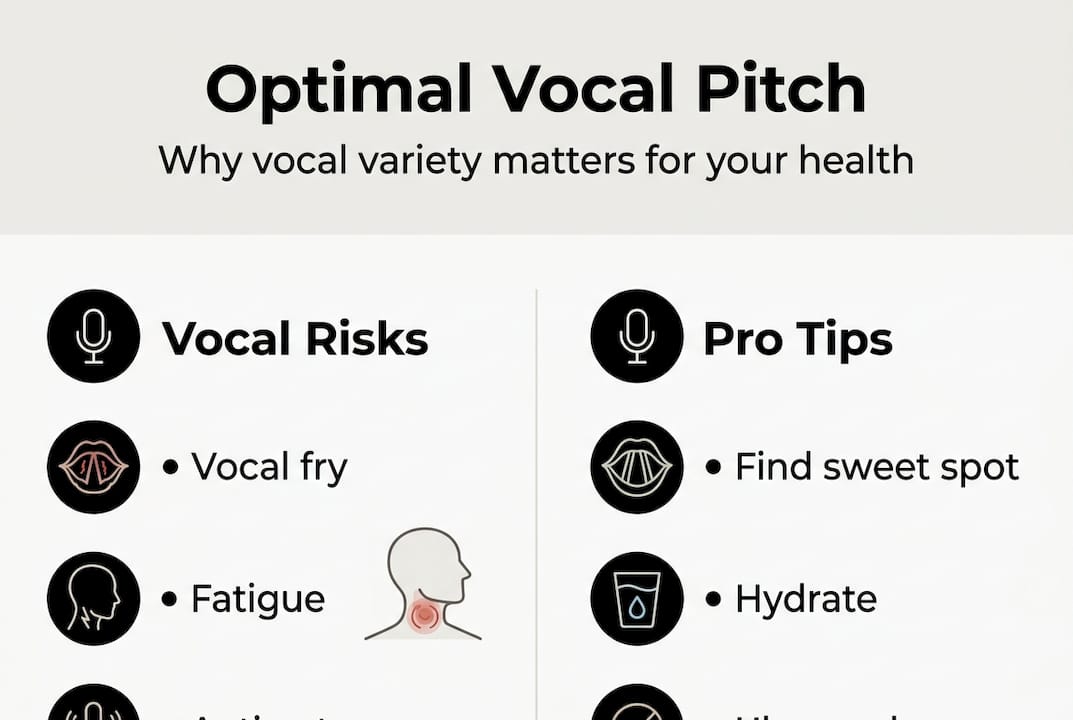
The table below summarizes key factors in maintaining your vocal sweet spot:
| Factor | Recommended approach | Why it matters |
|---|---|---|
| Hydration | 8+ cups of water daily | Keeps vocal folds pliable |
| Warm-up duration | 5 to 10 minutes before speaking | Reduces injury risk |
| Amplification | Use a microphone when possible | Eliminates need to push volume |
| Pitch range use | 20 to 30% variation around natural pitch | Maximizes engagement and health |
Pro Tip: If your voice feels tired after 30 minutes of speaking, it is a sign you are working outside your sweet spot. Try sustaining the “ee” vowel at a comfortable pitch for 5 seconds and notice where the vibration sits. That buzz in the front of your face is resonance. Build toward that feeling consistently. You can explore voice exercises for vocal health and what are vocal exercises to build a structured warm-up routine.
To put this all into practice, professional strategies can help you maintain vocal health for the long term. The most effective approach is not reactive, meaning you do not wait until your voice gives out to start caring for it. You build habits that protect it daily, so it shows up reliably when you need it most.
Core habits that support long-term vocal health:
One of the most overlooked truths in professional voice care is this: regular voice training reduces risk far more than sporadic effort does. Teachers and public speakers who practice vocal techniques daily build resilience in their laryngeal muscles, just as athletes condition their bodies over time. One-time vocal workshops or occasional exercises simply do not produce the same protective effect.
Pro Tip: If you frequently lose your voice after long sessions, try speaking at 70% of your normal volume during practice. This trains you to rely on resonance and projection technique rather than raw effort, and it dramatically reduces end-of-day fatigue.
For deeper guidance, explore preventing vocal strain, improving vocal strength, and relieving vocal strain naturally for a full picture of what consistent self-care looks like in practice.
Here is a practical take based on years of experience and research. The “always speak low” rule is one of those ideas that sounds credible on the surface but falls apart in real professional use. It oversimplifies what makes a voice commanding. Authority comes from control, not from pitch alone.
Decades of vocal coaching point to the same finding: monotone delivery reduces both attention and credibility, regardless of how low or polished the voice sounds. Audiences disengage from predictability. They connect with movement, with contrast, with a voice that reflects thought in motion.
The more honest advice is to develop pitch flexibility, not pitch uniformity. A speaker who can drop their voice low for emphasis and lift it higher for energy carries far more presence than one locked into a single register. Vocal variety is not a stylistic add-on. It is the mechanism through which sustained authority actually works. And for educators especially, resources like vocal care for educators offer field-tested guidance on balancing resonance with dynamic range across long teaching days.
Moving from theory to practice means having the right tools available when your voice needs support. At TMRG Solutions, we have spent over 25 years developing natural vocal health products specifically for professionals who rely on their voice daily.

Whether you are dealing with early fatigue, recurring hoarseness, or simply want to build long-term resilience, the TMRG Voice Therapy Kit Basic is a practical starting point. For singers and performers with more intensive needs, the Voice Therapy Kit for Singers offers a more specialized approach. If you are unsure where to begin, visit our vocal problems help page for guidance matched to your specific situation.
Constantly speaking in a forced low voice strains your vocal folds and raises the risk of vocal fry and fatigue. Speaking at your natural pitch is far healthier and more sustainable over time.
Yes. Monotone delivery reduces both retention and engagement, while deliberate pitch modulation keeps listeners focused and increases your perceived credibility.
Daily routines including warm-ups, consistent hydration, and proper amplification are the most effective prevention. Regular voice training builds resilience in ways that occasional practice simply cannot match.
Your natural habitual pitch, where your voice resonates freely without muscular tension, is your optimal range. Forcing it lower or higher adds strain without improving authority.
Yes. VFEs are clinically proven to improve vocal range, muscular strength, and endurance, making them one of the most effective tools available to voice professionals.
