Your Cart is Empty


TL;DR:
- Proper hydration, warm-up routines, and monitoring are essential for maintaining vocal health during performances.
- SOVT exercises, like straw phonation, reduce vocal effort and increase endurance for long sessions.
- Consistent daily habits such as sleep, hydration, and technique reinforce long-term vocal resilience.
Your voice is your most powerful professional tool, and losing clarity or stamina mid-performance can cost you the room. Whether you’re a singer preparing for a two-hour show, an actor running back-to-back rehearsals, or a keynote speaker addressing a packed auditorium, vocal fatigue and loss of presence are real risks that most people address too late. This article walks you through proven preparation strategies, science-backed warm-up routines, practical speaking techniques, and smart monitoring habits to help you deliver your best performance every time while keeping your voice resilient for the long term.
| Point | Details |
|---|---|
| Hydration is essential | Drinking water before and during speaking keeps your voice clear and reduces fatigue. |
| Use science-backed warm-ups | SOVT routines like straw phonation are proven to improve vocal efficiency for performers and speakers. |
| Master breathing technique | Rib cage breathing and speaking at the exhale’s onset increase vocal stamina and clarity. |
| Monitor your vocal health | Tracking symptoms, discomfort, and voice quality helps prevent long-term damage. |
| Consistency beats shortcuts | Daily voice care habits matter more than one-off tricks for lasting vocal power. |
Now that you know why vocal clarity matters, let’s ensure you have the basics before you step up to speak.
Before any warm-up begins, your setup matters more than most performers realize. Arriving at a speaking engagement without the right tools is like a surgeon walking into an operating room without gloves. The basics are non-negotiable, and skipping them is the fastest route to vocal fatigue.
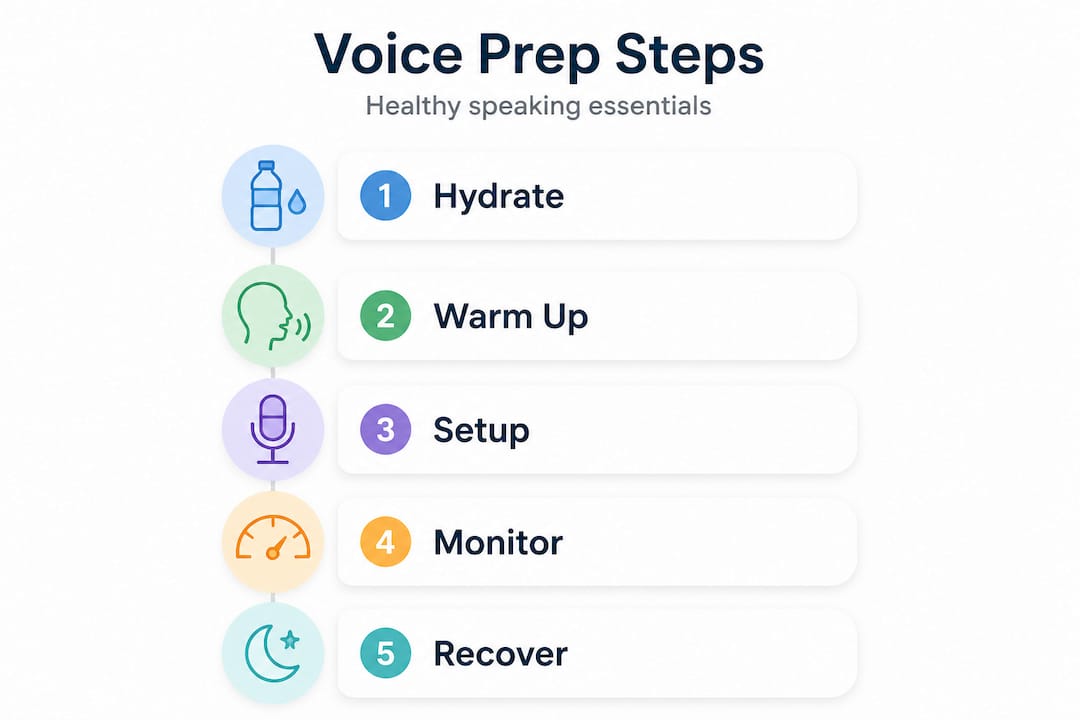
Here is what every professional voice user should have ready before speaking or performing:
Hydration tips for vocal health are foundational, not optional. The vocal folds (the two small muscles inside your larynx that produce sound) need consistent moisture to vibrate smoothly and efficiently. Dehydration, even mild, stiffens those folds and raises your phonation threshold pressure, meaning you have to work harder just to produce sound.

Warming up your voice before a performance is equally critical. Research confirms that hydration and warm-up routines are fundamental for vocal health, and professional voice users experience more fatigue symptoms without them. Think of your vocal folds the way a runner thinks about tendons before a sprint. You would not expect peak output from cold, dry, unprepared tissue.
| Preparation step | Time required | Priority level | Common mistake |
|---|---|---|---|
| Hydration (water intake) | All day, starting 2 hours before | Critical | Drinking only right before speaking |
| Vocal warm-up | 10 to 20 minutes | Critical | Skipping if “feeling fine” |
| Diaphragmatic breathing | 5 minutes | High | Shallow chest breathing |
| Physical stretching (neck, jaw) | 5 minutes | Moderate | Overlooking jaw and neck tension |
| Rest and sleep | Night before | Critical | Late-night social events before engagements |
Use this table as a quick-access checklist before any significant speaking event. It takes less than 30 minutes total and prevents the majority of avoidable vocal problems.
Once you’ve gathered your tools and fundamentals, effective warm-up is your next foundation for an empowered speaking voice.
SOVT exercises (Semi-Occluded Vocal Tract exercises) are arguably the most important warm-up category for singers, actors, and speakers alike. They work by partially narrowing the exit of the vocal tract, which creates back pressure that reduces the impact forces on the vocal folds during phonation. The result is a gentler, more efficient vibration that builds range, power, and endurance without strain.
Research confirms that SOVT exercises like straw phonation reduce phonation threshold pressure, improving vocal efficiency in normal-voiced adults. That means less vocal effort for more output. For long engagements, this translates directly into stamina.
For a visual demonstration,
| Condition | Phonation threshold pressure (kPa) | Vocal fold strain level |
|---|---|---|
| No warm-up, low hydration | 2.8 to 3.5 | High |
| Hydrated, no SOVT | 2.0 to 2.5 | Moderate |
| Hydrated + SOVT warm-up | 1.3 to 1.8 | Low |
Lower phonation threshold pressure means your voice activates more easily and sustains longer. The numbers above illustrate why skipping warm-up is never worth the time saved.
A dedicated warm-up guide for actors can help you tailor these routines for dramatic range, while cord relaxation exercises help manage tension before and after high-demand performances.
Pro Tip: Do not perform sirens at full volume. The point of the siren is a smooth, unbroken glide across your range. If you hear a crack or feel tightness, you are pushing too hard. Back off by 30% and repeat at a lighter effort level.
With your voice warmed up, the next step is mastering the actual delivery. Speaking well, breathing efficiently, and lasting longer onstage all depend on technique applied consistently, not just in rehearsal but in the room.
Expert techniques recommend even rib cage breathing, speaking on exhale onset, and varying loudness and pitch with intention to build a more powerful speaking voice.
“Always speak on the breath’s onset, not after pausing. Holding air between inhale and speech is one of the most common causes of vocal fold tension in professional speakers.”
For deeper voice support strategies, explore targeted exercises that reinforce the connection between breath control and vocal fold efficiency.
Pro Tip: During any break in a long speaking engagement, spend 60 seconds doing gentle lip trills and then sip water. This resets the vocal folds, reduces accumulated tension, and primes your voice for the next session. It takes less time than checking your phone and makes a measurable difference.
A vocal wellness guide provides broader context for performers who need sustainable habits built into their professional routine.
Preparation and execution will get you far, but vigilant monitoring during and after speaking is crucial for true voice sustainability.
Most vocal damage is not sudden. It builds gradually through repeated misuse or overuse, often unnoticed until the problem becomes serious. The good news is that your voice gives you clear signals if you know what to listen for.
If any of these appear, stop trying to push through. Pushing through early fatigue symptoms is the single most common cause of preventable vocal injury in professional performers.
Research on HNR variability shows that this acoustic measure (harmonics-to-noise ratio, a value that reflects how clean or rough a voice sounds) can distinguish between benign conditions like nodules and more serious lesions, making it a useful clinical monitoring tool. Some voice analysis apps can calculate HNR, giving you a simple way to track changes over time.
Pro Tip: Apps like Voice Analyst or VoiceSpy can give you a rough sense of HNR and pitch trends after performances. They are not medical diagnostic tools, but they help you notice patterns and identify when professional assessment is warranted.
Lasting voice care strategies are especially important for teachers and presenters who use their voice heavily every single week. Understanding when to involve a specialist through medical support for performers can prevent short-term strain from becoming a long-term limitation.
Having covered practical monitoring, it is time for a reality check about what actually drives lasting vocal performance.
Most voice tips you read online focus on technique. Breathe from the diaphragm. Project more. Vary your pitch. These are all valid, but here is what the wellness and performance world rarely says out loud: technique under stress collapses. When you are under pressure, nervous, physically tired, or running on poor sleep and caffeine, every carefully practiced technique tends to disappear. You revert to your default, and most people’s default is shallow breathing, throat pushing, and tightening through high notes or loud passages.
What actually protects your voice is not a technique you remember to use. It is a daily physical condition you maintain. Consistent hydration keeps phonation threshold pressure low so your folds respond easily. Regular SOVT exercises maintain elasticity in the vocal fold tissue. Adequate sleep allows the laryngeal muscles to recover from the day’s demands. These are not glamorous. They do not make for impressive workshop demonstrations. But they are what separates professional voice users who work for decades from those who burn out in a few seasons.
Most performers also underestimate how much monitoring matters. They wait until a symptom is loud before responding. By that point, rest alone may not be enough. The vocal support insights that make the biggest long-term difference are the quiet, consistent habits, the warm glass of water in the morning, the 10-minute straw session before rehearsal, the choice to stay silent for an hour after a demanding show.
True mastery is not in the moment of performance. It is built the night before, and the morning of, and the day after.
After learning what truly matters for voice longevity, practical resources are your next move.
Understanding the principles is the foundation, but having the right tools makes consistent care realistic for busy performers and speakers. TMRG Solutions has spent 25+ years developing natural, targeted vocal health solutions for exactly the situations this article covers.

If you are serious about protecting your voice through demanding schedules, the basic voice therapy kit is a smart starting point, providing core natural remedies and tools for everyday maintenance. For singers and actors with higher performance demands, the standard kit for singers offers a more complete solution built for professional use. If you are navigating a specific issue like hoarseness, chronic fatigue, or loss of range, the vocal problems support page connects you with targeted guidance tailored to your condition.
A combination of hydration, gentle jaw and neck stretching, and SOVT exercises like straw phonation is recommended for optimal voice prep. SOVT exercises improve vocal efficiency and reduce phonation threshold pressure in normal-voiced adults.
Watch for hoarseness, increasing effort to maintain volume, pitch cracking, and throat discomfort. HNR variability is a measurable acoustic signal that can also help distinguish vocal health conditions before they become serious.
Hydrate frequently throughout the event, use rib cage breathing before each phrase, and take short silence breaks whenever possible. Hydration and warm-up consistently reduce fatigue symptoms in professional voice users.
Yes, and the effect is immediate. Even rib cage breathing and speaking on the onset of exhale significantly improve vocal clarity, reduce strain, and help you sustain power across longer speaking sessions.
