Your Cart is Empty


TL;DR:
- Early recognition and gentle recovery are key to preventing long-term vocal damage.
- Hydration, vocal rest, and anti-inflammatory strategies support natural healing.
- Persistent or severe symptoms require professional evaluation to avoid lasting voice issues.
Vocal cord inflammation can sideline a singer or actor for weeks, even when symptoms feel minor at first. Many voice professionals assume a scratchy throat or tired voice is something you can push through with willpower alone. That assumption is one of the most damaging beliefs in the performing world. Even mild inflammation reduces vocal cord function and can turn a short-term problem into a long-term setback. This guide breaks down what vocal cord inflammation really is, why it happens, how to recognize it early, and which natural recovery strategies actually work.
| Point | Details |
|---|---|
| Cause and effect | Vocal cord inflammation disrupts normal voice production and can be triggered by overuse, infection, or environmental factors. |
| Early detection | Recognizing early symptoms allows for faster healing and avoids long-term damage. |
| Natural recovery | Hydration, rest, and steam are key to natural recovery and should be combined with prevention strategies. |
| Prevention is power | Daily habits and smart voice use dramatically lower your risk of future inflammation. |
| Get specialized help | If symptoms persist or get worse, consult a voice specialist to avoid lasting injury. |
Your vocal cords, also called vocal folds, are two small bands of muscle tissue inside your larynx (voice box). When you speak or sing, they vibrate together rapidly to produce sound. When they become swollen or irritated, that vibration becomes uneven, producing a voice that sounds rough, weak, or thin.
Vocal cord inflammation is a swelling of the tissues that produce voice, commonly referred to as laryngitis. The medical laryngitis overview confirms that acute laryngitis is one of the most frequent causes of voice change across all age groups. For voice professionals, even a small degree of swelling disrupts healthy phonation (the process of producing vocal sound).
Common causes include:
| Cause | Typical symptoms |
|---|---|
| Viral infection | Hoarseness, sore throat, fatigue |
| Bacterial infection | Severe throat pain, fever |
| Voice overuse | Vocal fatigue, loss of range |
| Acid reflux (GERD) | Morning hoarseness, throat clearing |
| Allergies | Mucus buildup, dry cough |
| Dry or polluted air | Throat irritation, breathiness |
Everyday habits that increase your risk:
Pro Tip: The first warning signs are often subtle. A slight roughness in your upper register, a need to clear your throat more than usual, or a feeling of “effort” when speaking normally are all early signals. Catching these within the first 24 hours gives you the best window for fast recovery.
Understanding the root helps, but the real power comes from spotting inflammation before serious downtime strikes. The core symptoms of vocal cord inflammation include hoarseness, vocal fatigue, throat pain, a dry cough, and a persistent urge to clear your throat. Hoarseness, voice fatigue, and throat clearing are classic indicators that something is wrong at the level of the folds.
The ASHA laryngitis guide notes that many people delay seeking help because early symptoms feel manageable. That delay is where the real damage happens.
“Most voice professionals miss the subtle signs because they normalize vocal discomfort as part of the job. By the time symptoms feel serious, the inflammation has already progressed.”
Signs you should never ignore:
Symptoms also vary by occupation. A singer may notice pitch instability or a sudden inability to hit high notes. A teacher or actor may feel their voice simply give out by midday, even without pain. These differences matter because they point to different patterns of overuse and different recovery timelines.
If symptoms include sudden weakness on one side of the throat or a voice that sounds consistently breathy without infection, it is worth exploring paralysis and paresis as a possible factor. Inflammation and structural issues can overlap, and missing that distinction delays the right treatment.
Spotting symptoms is only half the battle. Here is why acting quickly makes all the difference to your craft.
Inflammation changes how your vocal folds behave in two major ways. Short-term, the swelling prevents the folds from closing cleanly, producing a breathy or rough tone. Long-term, repeated inflammation leads to tissue changes, including nodules, polyps, or chronic thickening, that permanently alter voice quality. Even mild inflammation can sap vocal strength and increase fatigue dramatically.
| Voice characteristic | Healthy cords | Inflamed cords |
|---|---|---|
| Pitch range | Full, flexible | Narrowed, unstable |
| Tone quality | Clear, resonant | Rough, breathy |
| Endurance | Hours of use | Fatigues quickly |
| Recovery after rest | Fast | Slow or incomplete |
| Volume control | Precise | Effortful |
Consider a soprano preparing for a two-week run of performances. After three consecutive nights of heavy singing, she notices her upper register thinning. She pushes through. By night five, the top four notes of her range are gone. That is not bad luck. That is what laryngitis research consistently shows: continued use during inflammation accelerates tissue damage.
For teachers and lecturers, the pattern is different but equally damaging. The voice may sound fine in the morning, then collapse to a rough whisper by 2 p.m. This is vocal fatigue compounded by inflammation, and it is one of the most common reasons professional voice users lose workdays.
Chronic cases often connect to underlying issues. Acid reflux effects on vocal cords are frequently underdiagnosed because the reflux itself may be silent, meaning no heartburn, just persistent morning hoarseness. Similarly, paralysis and vocal function issues can mimic or worsen inflammation-related symptoms, making accurate identification critical.
Knowing how inflammation harms your voice is motivating. But actual healing depends on what you do next.

Hydration, vocal rest, steam inhalation, and anti-inflammatory nutrition are the mainstays of natural recovery. The WebMD laryngitis guide also supports these as first-line approaches for most cases. The key is applying them consistently and in the right order.
Daily recovery routine for voice professionals:
What to avoid during recovery:
Pro Tip: If you must perform during recovery, use treating stiff or floppy cords strategies to support fold pliability beforehand, and reduce your set length or speaking demands wherever possible.
As recovery takes hold, shifting focus from treatment to prevention sets up lifelong vocal resilience.
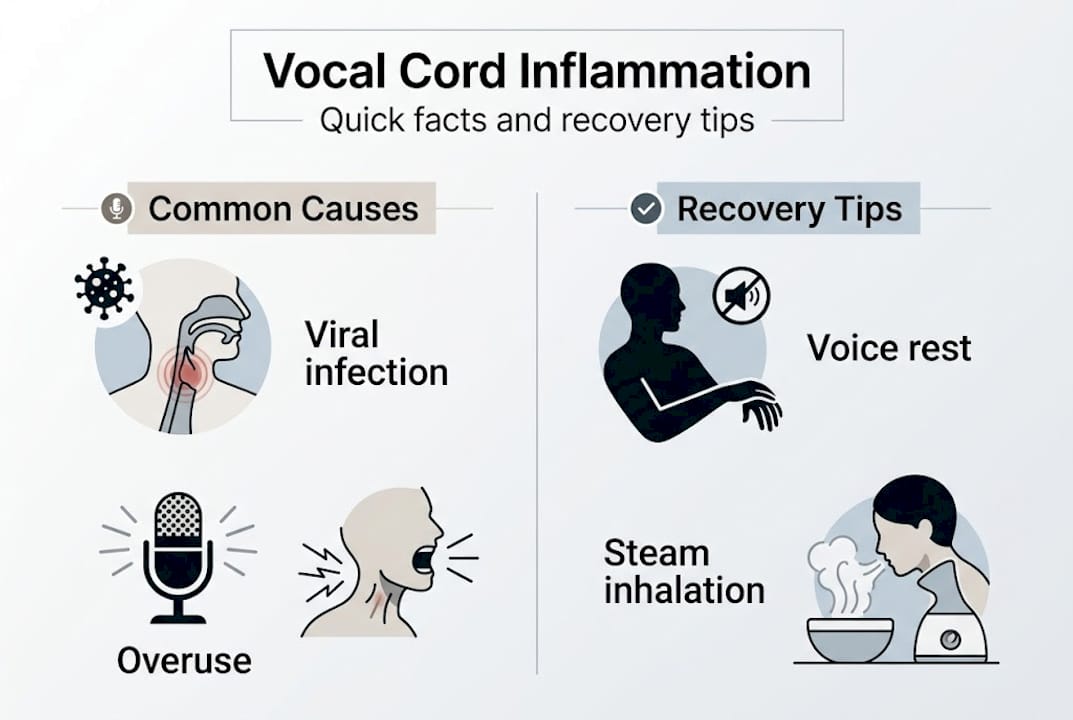
Simple daily practices can significantly reduce future inflammation risk. Prevention is not complicated, but it requires consistency.
Top habits to prioritize:
Pro Tip: Build a 10-minute pre-performance warm-up into every show or teaching day. Start with breathing exercises, move to gentle humming, then lip trills, then light sirens (gliding smoothly from low to high pitch). This primes the folds and reduces injury risk significantly. Check the guide on how to prepare for vocal effort for a structured routine.
Singers, teachers, and actors each have specific risk profiles. Singers face the most acute overuse risk during intensive rehearsal periods. Teachers often develop chronic low-grade inflammation from sustained loud speech in noisy classrooms. Actors face a combination of both, especially during long runs. The ENT laryngitis guide recommends regular voice check-ins with a specialist for anyone using their voice professionally, even when symptoms are absent.
Monitor your own warning signs and keep a simple vocal journal. Note when fatigue starts, which environments feel hardest, and how quickly you recover after rest. Patterns emerge quickly, and those patterns are your best prevention tool.
Here is something most guides will not tell you: the biggest mistake voice professionals make is not ignoring inflammation. It is the recovery pattern they fall into afterward.
The typical cycle looks like this. Symptoms appear, the performer rests until they feel better, then returns to full voice use immediately. Within days, symptoms return. This is not bad luck. It is a predictable biological response to tissue that was never fully restored before being loaded again.
What actually works is micro-dosed vocal exercise during recovery, not complete silence followed by a sudden return to full performance. Gentle, low-effort phonation keeps the folds mobile, promotes circulation, and reduces the risk of stiffness. Strict voice rest beyond 48 to 72 hours, without any gentle reintroduction, can actually slow recovery in some cases.
We have seen this pattern repeatedly with performers who extend a theater run successfully, not because they rested perfectly, but because they followed a disciplined, graduated return-to-voice protocol. Explore the full picture of vocal issues insights to understand how this applies across different voice conditions.
Prevention also starts long before symptoms appear. The voice that stays healthy through a grueling season is one that was maintained daily, not rescued in crisis.
If you are ready to take long-term action on your vocal health, there are specialized resources designed just for you.

At TMRG Solutions, we have spent over 25 years developing targeted tools for singers, actors, and voice professionals who need more than generic advice. Whether you are in active recovery or focused on prevention, our vocal problems solutions page covers the full range of conditions and matching remedies. For those who want a structured recovery plan, the voice therapy kit brings together herbal support, hydration tools, and step-by-step guidance in one place. You can also browse our vocal health FAQs for quick answers tailored to professional voice users.
Most acute cases resolve in 7 to 14 days, but voice professionals who continue performing may need two weeks or more of careful, graduated healing before returning to full capacity.
Voice rest is the primary recommendation for laryngitis. Minimize all voice use, and avoid both shouting and whispering until core symptoms like hoarseness and pain have clearly improved.
Steam inhalation and fluids are widely recommended as effective supportive aids. Most natural remedies are safe when used appropriately and can meaningfully shorten recovery time alongside proper vocal rest.
See a voice specialist if symptoms last longer than two weeks, worsen despite rest, or include severe pain or any blood. Persistent symptoms warrant ENT evaluation to rule out structural issues like nodules, polyps, or paralysis.
