Your Cart is Empty


A great performance starts long before you step on stage. This guide breaks down the exact voice maintenance workflow professional performers follow — what to do in the hours before a show, how to protect your voice during performance, and the recovery steps to take immediately after.
Show-day checklist (copy and use now):
Drink plenty of room-temperature water throughout the day
Begin gentle warm-ups well in advance before curtain
Avoid dairy, alcohol, and heavy meals within two hours of performing
Apply your post-show cool-down and recovery product within 30 minutes of leaving the stage
Log perceived effort, hoarseness, and rehearsal minutes regularly before bed
Tmrgsolutions brings 25+ years of vocal-health expertise to every product and protocol on this page, with formulations aligned to clinical guidance from ENT specialists and speech-language pathologists (SLPs).
What does a daily vocal maintenance routine actually look like?
What are the most effective post-performance recovery steps?
How do you monitor vocal health and know when to see a specialist?
Which products and tools belong in each step of the workflow?
Copy-paste workflow templates for rehearsal, show day, and travel
How do you adopt this routine without disrupting your schedule?
Consistency is what separates performers who last decades from those who burn out in a single season. Your daily vocal health steps should feel as automatic as brushing your teeth.
Morning hydration: Drink a moderate amount of room-temperature water before speaking. Cold water constricts the tissues around your vocal folds.
Gentle warm-up (10–15 minutes): Lip trills on a comfortable pitch, sustained hums moving from chest to head voice, and slow sirens across your comfortable range. Keep volume low.
Micro-rests: Set regular timers to remind yourself to rest during heavy vocal use. Rest for 5 minutes in complete silence.
Throat-care products: Apply a protective spray or oil formulation during high-demand days.
Evening check: Note any hoarseness, throat clearing, or fatigue before sleep.
Nutrition and sleep matter more than most performers admit. Acid reflux, even silent reflux, inflames the posterior larynx and mimics vocal fatigue. Elevate your head slightly when sleeping during heavy performance weeks, and limit caffeine after 2 PM.
Pro Tip: Speak at your lowest comfortable volume during non-performance hours. Loud conversational speech off-stage accumulates load just as rehearsal does, and most performers never count it.

A warmup that starts too late leaves your vocal folds cold; one that starts too early lets fatigue set in before the first note. The sweet spot is a progressive warmup routine beginning 90 minutes before curtain.
About 90 minutes before curtain: Drink some water. Begin diaphragmatic breathing: inhale for 4 counts, hold for 2, exhale for 6. Repeat 8 times.
About 60 minutes before curtain: Lip trills and tongue trills across your comfortable range in multiple sets. Add sustained “mmm” hums, feeling resonance in the mask of your face.
About 30 minutes before curtain: Move into light range work: gentle scales on “nay” or “mum,” staying below 80% of maximum intensity. Add articulation drills (rapid consonant sequences) for clarity.
About 10 minutes before curtain: Run several lines from your most demanding material at performance volume. This is your real-environment vocal check before going live. Sip water, breathe, and set your mental pacing cue.
What to avoid before a show:
Dairy (thickens mucus, reduces glide across the vocal folds)
Alcohol (dehydrates mucosal tissue)
Whispering (creates more laryngeal tension than soft phonation)
Cough drops with menthol or numbing agents (mask pain signals you need to hear)
Heavy sugary foods (can cause post-meal reflux)
Recovery begins the moment you leave the stage, not the next morning. Inflammation in the vocal folds peaks within the first hour after heavy use, so acting quickly matters.
Gentle cool-down phonation (5 minutes): Descend slowly through your range on a soft “mmm,” letting the voice settle rather than stopping abruptly.
Hydrate immediately: 16 oz of room-temperature water within 15 minutes of finishing.
Steam or warm saline inhalation: Inhale steam for 5–10 minutes to restore mucosal moisture. A personal steam inhaler works well backstage.
Apply recovery drops or spray: Use TMRG Loud & Clear drops or TMRG Shine Bright spray directly after cool-down to soothe inflamed tissue and support mucosal recovery.
Voice rest: Aim for a substantial period of complete vocal rest after a full show. Texting beats talking.
Pro Tip: Keep a small insulated bag in your stage bag with your recovery products and a thermos of warm (not hot) water. The 20 minutes between curtain call and the cast party are your highest-leverage recovery window. Use them.
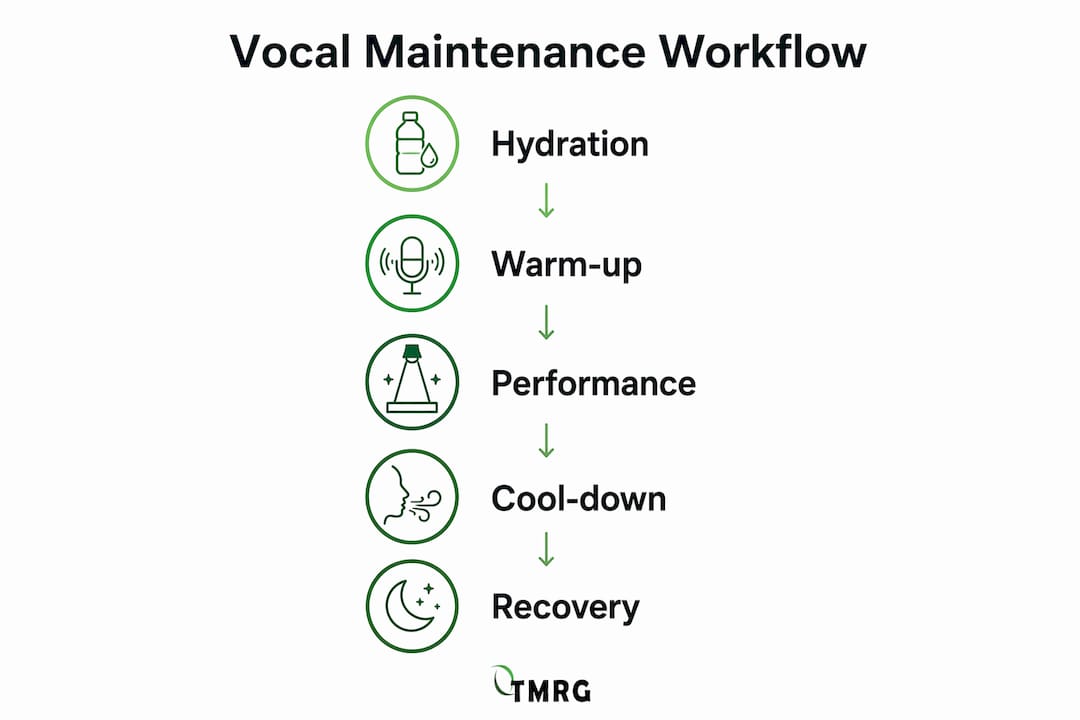
Tracking your vocal load over time is what turns reactive care into proactive management. A weekly review cadence catches problems before they compound into injury.
What to log daily:
Perceived vocal effort assessment
Hoarseness: present or absent, and for how long
Throat-clearing frequency (high, medium, low)
Total rehearsal and performance minutes
Pain or discomfort: location and intensity
Red flags that require prompt evaluation by an ENT or SLP:
Hoarseness lasting an extended period of time
Complete or near-complete voice loss
Pain during or after phonation
Changes in swallowing
A pitch break or register shift that is new and unexplained
Coughing up blood
For professional voice assessment guidance, connect with a qualified clinician rather than waiting for symptoms to resolve on their own.
Copyable weekly log template (paste into your phone notes):
Review this log every Sunday. If effort scores trend upward across three consecutive days without a corresponding increase in scheduled load, reduce volume and add a rest day.
Choosing the right product for the right moment prevents overuse and maximizes benefit. Targeted, well-timed use of a quality formulation outperforms applying more product indiscriminately, much as replacing outdated technique examples improves outcomes more than simply adding more practice volume.
Product categories and their workflow roles:
Voice therapy kits: Comprehensive daily and recovery support; best for performers in active seasons
Recovery drops: Fast-acting mucosal support immediately post-show
Throat sprays: Hydration and soothing during warmup and between sets
Saline and oil sprays: Protective barrier for high-exposure environments (dry venues, touring)
Humidifiers: Passive overnight hydration; essential during winter or air travel
Pro Tip: Never use a topical numbing spray before a performance. Numbing agents mask the pain signals that tell you when your vocal folds are being overworked. You can cause serious injury without feeling it.
| TMRG Product | Workflow Stage | Primary Use |
|---|---|---|
| TVT-S (Standard Kit) | Daily + recovery | Full maintenance and recovery set for active performers |
| Basic Kit | Daily maintenance | Entry-level daily care; students and light-use professionals |
| Powerful Vocal Recovery Kit (N) | Post-show acute recovery | High-potency support after heavy use or extended runs |
| Loud & Clear drops | Post-show, immediate | Fast mucosal soothing within 30 minutes of performing |
| Shine Bright spray | Pre-show, backstage | Quick hydration and throat comfort between warmup and curtain |
| Defense oils/saline spray | Daily, travel, exposure | Protective barrier in dry or high-demand environments |
7:00 AM: 16 oz water, no speaking for 30 minutes
9:00 AM: 10-minute gentle warmup before first rehearsal block
Every 45 minutes: 5-minute vocal micro-rest
Post-rehearsal: cool-down hums, 8 oz water, Defense spray if environment was dry
Evening: complete log entry
Morning: 64 oz water target set; light, non-dairy breakfast
T-90 min: breathing exercises, first hydration check
T-60 min: lip trills, hums, range work
T-30 min: articulation drills, light performance material
T-10 min: real-environment audio check, Shine Bright spray, mental pacing cue
Post-show (within 30 min): cool-down phonation, Loud & Clear drops, 16 oz water, 2-hour voice rest
Carry-on kit: Shine Bright spray, Loud & Clear drops, Defense spray, personal steam inhaler, insulated thermos
In-flight: Sip water every 30 minutes; avoid alcohol; use Defense spray every 2 hours
On arrival: 10-minute steam session; log any hoarseness before sleeping
Condensed warmup (15-minute triage): 3 minutes breathing, 5 minutes lip trills and hums, 4 minutes light range work, 3 minutes articulation
Start with three changes, not all of them at once. Overloading a new routine is the fastest way to abandon it.
Week 1–2: Add the daily log and the micro-rest timer. Nothing else changes yet.
Week 3–4: Introduce the full pre-show warmup timeline. Adjust start times with your stage manager.
Day 30 review: Check your log. If effort scores dropped or hoarseness frequency decreased, add the post-show recovery protocol.
Day 90 review: Assess load trends, recovery time, and perceived effort. Adjust product use or rest windows based on what the log shows.
Phrases to use with directors and stage management:
“I need 90 minutes before curtain for warmup. Can we schedule sound check before that window?”
“I’m managing vocal load this week. I’ll mark the heavy passages in rehearsal and take the rest at 70%.”
“I need 2 hours of voice rest after tonight’s show. I’ll be available by text.”
Naming a vocal-care owner, whether that is you, your vocal coach, or your manager, and assigning them the weekly log review prevents the slow drift that turns minor strain into a serious injury.
A structured voice maintenance workflow, applied daily and reviewed weekly, is the single most reliable way to protect vocal health across a full performance season.
| Point | Details |
|---|---|
| Daily consistency beats occasional overhauls | Micro-rests, hydration, and gentle warm-ups every day prevent cumulative strain. |
| Timed pre-show warmup is non-negotiable | Begin 90 minutes before curtain; run a real-environment check at T-10 minutes. |
| Post-show recovery window is critical | Apply recovery products and begin voice rest within 30 minutes of leaving the stage. |
| Red flags require prompt clinical evaluation | Hoarseness lasting an extended period of time, pain, or voice loss warrants ENT or SLP referral. |
| Tmrgsolutions products map to each workflow stage | From the Basic Kit for daily care to the Powerful Vocal Recovery Kit (N) for acute recovery, each product has a defined role. |
Most vocal-health advice treats the voice as something to fix after it breaks. This workflow treats it as a system to maintain continuously, with daily inputs, regular monitoring, and clear escalation paths. That framing matters because vocal injury rarely announces itself loudly. It accumulates quietly across weeks of suboptimal hydration, missed rest windows, and ignored early signals.
The structure here reflects what Tmrgsolutions has observed across 25+ years of working with singers, actors, and voice professionals: cadence and ownership drive outcomes more than any single product or technique. Performers who assign themselves a weekly review, keep a log, and act on early signals consistently outperform those who rely on intuition alone. The templates in this article are starting points. Adapt them to your voice type, your schedule, and the guidance of your own clinician.

Tmrgsolutions offers a product for every stage of the routine described here, from the TMRG Voice Therapy Kit Standard for performers who want a complete daily and recovery set, to the Powerful Vocal Recovery Kit (N) for acute post-show support after heavy use. The Loud & Clear drops and Shine Bright spray are designed specifically for the backstage recovery window, while the Defense oils and saline spray protect your vocal folds during travel and high-exposure environments. Every formulation draws on 25+ years of vocal-health expertise and natural herbal ingredients aligned with clinician-recommended care principles. Browse the full range and choose the right kit for your performance schedule today.
Voice care best practices for performers — Tmrgsolutions’ practical guide to daily and preventative vocal care
Professional voice assessments — when and how to seek ENT or SLP evaluation
Professional voice care: remedies, routines, and science — evidence-aligned routines for deeper clinical context
Voice care trends for vocal professionals — evolving practices and product considerations for touring performers
American Academy of Otolaryngology (AAO-HNS) — primary clinical resource for ENT referral criteria and vocal-health standards
Every performance day, without exception. Even a condensed 15-minute version protects the vocal folds from cold-start strain.
Complete vocal rest immediately after a full performance for a sufficient duration is the baseline. Extended runs or back-to-back shows may require longer rest windows, guided by your log and a clinician.
Hoarseness persisting beyond 2 weeks, or any hoarseness accompanied by pain, swallowing changes, or voice loss, requires prompt evaluation by an ENT or speech-language pathologist.
The TMRG Powerful Vocal Recovery Kit (N) and the Defense oils and saline spray are the strongest combination for touring, covering both acute post-show recovery and daily protective care in dry or demanding environments.
Skipping the cool-down increases the risk of post-performance inflammation. Even 5 minutes of descending hums and immediate hydration is significantly better than stopping abruptly.
This article is general educational information, not medical advice. Consult an ENT specialist or speech-language pathologist for guidance specific to your vocal condition.
