Your Cart is Empty


TL;DR:
- Voice recovery depends on the cause, severity, and daily vocal demands.
- Rest, hydration, and avoiding irritants are key natural remedies for faster healing.
- Seek medical evaluation if voice loss persists beyond two weeks or if symptoms worsen.
Most singers and speakers assume a lost voice will bounce back in a day or two. It rarely does. The truth is that recovery time depends heavily on what caused the voice loss in the first place, how severe the damage is, and how much vocal demand your daily life or career places on your instrument. Whether you’re a professional singer facing a canceled show or a teacher who can barely whisper through a lecture, understanding realistic recovery timelines and the most effective natural remedies can make the difference between a full return to form and a setback that lingers for weeks.
| Point | Details |
|---|---|
| Voice recovery varies | Timelines differ based on the cause, ranging from days to several weeks or even months. |
| Rest and hydration work | Giving your voice a true break and keeping hydrated are the fastest ways to recover. |
| Monitor warning signs | See a doctor if you can’t speak, have pain, or symptoms last beyond two weeks. |
| Natural remedies matter | Lifestyle habits—like avoiding irritants and using vocal therapy—aid both quick and lasting recovery. |
Before you can plan your recovery, you need to understand what you’re recovering from. Voice loss is not a single condition. It’s a symptom that can arise from several different causes, each with its own healing curve.
The most common triggers include:
Severity varies enormously. A mild case of laryngitis after a cold is very different from a vocal nodule that has been building for months. Acute laryngitis typically resolves in 1 to 2 weeks with voice rest and hydration. A structural lesion on the vocal fold, however, can take weeks to months of therapy to resolve, and in rare cases requires surgical intervention.
Important: Vocal professionals, including singers, actors, and public speakers, are at significantly higher risk for prolonged recovery. Their vocal folds are under greater daily stress, and the threshold for returning to full performance demand is much higher than for the average person.
Understanding the cause of your voice loss is the first step toward restoring lost voice naturally and setting a realistic recovery plan. Skipping this step and jumping straight to remedies is one of the most common mistakes we see.
With causes clarified, it’s essential to know how long you might expect to wait for your voice to return. The honest answer is: it depends. But evidence-backed timelines can give you a reliable framework.
| Cause | Typical recovery time | Notes |
|---|---|---|
| Acute laryngitis (viral) | 1 to 2 weeks | Rest and hydration are key |
| Vocal overuse or fatigue | 3 to 7 days | Reduce demand immediately |
| Professional vocal recovery | 3 to 4 weeks | Full performance capacity takes longer |
| Vocal nodules (with therapy) | Weeks to months | Consistent voice therapy required |
| Post-surgical voice rest | 5 days to 2 weeks | Strict silence often required |
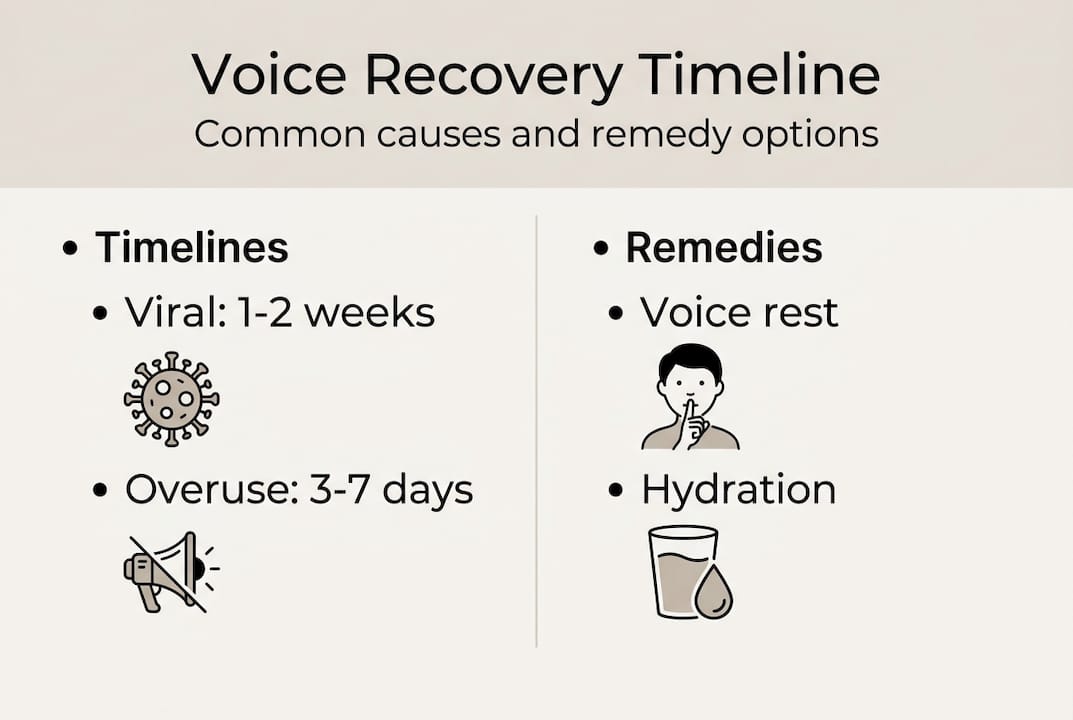
Full vocal fold recovery for professionals can take 3 to 4 weeks, even when the underlying cause is relatively minor. This is because returning to performance demands before the folds have fully healed risks re-injury and a longer overall setback.
For those dealing with vocal nodules recovery, the picture is more nuanced. Nodules and polyps often resolve with structured voice therapy over weeks to months. Surgery is rare, occurring in fewer than 5% of cases, and when it does happen, it is followed by a strict voice rest period of 5 days to 2 weeks.
Statistic to know: The vast majority of singers and speakers with vocal nodules never need surgery. Consistent therapy and behavioral change are usually enough.
Pro Tip: Track your vocal symptoms daily. If your voice feels worse after a period of rest, that’s a signal the issue may be structural rather than simple fatigue. This distinction matters when deciding whether to recover from hoarseness at home or seek professional evaluation.
Knowing how long recovery generally takes, these proven methods help you get your voice back sooner. Natural remedies work best when applied consistently and early, not as a last resort after days of continued strain.
Here are the most effective steps, in order of priority:
Voice rest and hydration are foundational for recovery from laryngitis and vocal fatigue, and no other remedy replaces them.

| Remedy | Benefit | Ease of use |
|---|---|---|
| Complete voice rest | Reduces fold strain immediately | High |
| Hydration | Lubricates and heals tissue | High |
| Steam inhalation | Directly moisturizes larynx | Medium |
| Humidifier use | Sustains overnight healing | High |
| Avoiding irritants | Prevents further inflammation | Medium |
Pro Tip: Herbal teas with honey and ginger can soothe the throat and reduce inflammation, but make sure they are not too hot. Scalding liquids cause additional irritation.
For a broader set of vocal recovery strategies tailored to professionals, and for guidance on how to restore your voice naturally using a structured daily routine, consistency is the variable that separates fast recoveries from prolonged ones.
Even with the best natural care, some cases need a professional’s help to prevent long-term damage. Knowing when to stop self-treating and seek expert evaluation is not a sign of failure. It’s smart vocal management.
Watch for these red flag symptoms:
Warning: If you are a professional voice user and your voice has not returned to at least 70% of normal function within 10 days of rest, do not wait. Early intervention prevents minor issues from becoming chronic conditions.
For conditions like vocal polyps, non-surgical vocal polyp recovery is possible in many cases, but only when addressed early and with the right therapeutic support. Waiting too long reduces the chances of a conservative outcome.
Surgery is rare for nodules, occurring in fewer than 5% of cases, but it becomes necessary when voice therapy and behavioral change have not produced results. The earlier you get an accurate diagnosis, the more options you have.
A laryngologist, a physician who specializes in voice disorders, can perform a laryngoscopy to view your vocal folds directly. This removes the guesswork. For guidance on managing vocal fold ailments before and after a medical consultation, having a clear picture of your condition is essential to choosing the right path forward.
After 25 years of working with singers, actors, and professional speakers, we’ve noticed a pattern. The people who recover fastest are not always the ones using the most remedies. They’re the ones who listen most carefully to their bodies.
The most common mistake we see is returning to full vocal demand too soon. Professionals feel pressure, from schedules, from audiences, from their own identity as performers, and they interpret a slight improvement as clearance to go full throttle. It almost never works out that way.
Real progress comes from respecting subtle signs of fatigue: a voice that tires more quickly than usual, a slight roughness at the top of your range, or a feeling of effort where there used to be ease. These are not minor annoyances. They are signals that the folds are still healing.
Small daily habits, consistent hydration, disciplined voice rest, and a gradual return to demand, compound over time. They outperform aggressive remedies applied inconsistently every time. For professionals ready to build a structured return-to-performance plan, our advanced vocal recovery guide walks you through each phase with the precision your career demands.
You now have a clear picture of recovery timelines and the natural habits that accelerate healing. The next step is putting that knowledge into a daily practice that actually holds.

At TMRG, we’ve spent over 25 years developing natural, science-informed tools specifically for vocal professionals. Our TMRG Voice Therapy Kit Basic gives you a structured starting point, while the TMRG Standard Kit offers a more complete recovery program for singers and speakers with higher demands. If you’re unsure where to start, our help for vocal problems page matches your symptoms to the right solution. Recovery is not passive. Let’s make it intentional.
Yes, mild voice loss from laryngitis or overuse commonly lasts 1 to 2 weeks, but symptoms persisting beyond two weeks warrant a professional evaluation to rule out structural issues.
Resting your voice completely, staying well hydrated, and removing irritants like caffeine and smoke are the most effective steps. Hydration and voice rest remain the foundation of any recovery plan.
Seek medical attention if you cannot speak, experience pain, or symptoms persist beyond two weeks, particularly if you rely on your voice professionally. Early diagnosis expands your treatment options significantly.
No. Nodules and polyps resolve with voice therapy in the vast majority of cases, and surgery is only needed in fewer than 5% of situations when conservative treatment has not worked.
