Your Cart is Empty


TL;DR:
- Many vocal polyps can improve with voice therapy without surgery.
- Early diagnosis and proper vocal hygiene are crucial for successful recovery.
- Addressing underlying habits prevents recurrence and promotes long-term vocal health.
If you’ve been told a vocal polyp means surgery is your only option, you’re not alone in that fear. Many singers, actors, and voice professionals hear that diagnosis and immediately imagine weeks off stage and a scalpel near their most valuable instrument. The reality is more encouraging. Vocal polyps are common in singers and may not always require surgical intervention. Evidence-based treatments, including voice therapy and targeted vocal hygiene, resolve a significant number of cases, especially when caught early. This guide walks you through what vocal polyps are, how to recognize them, how diagnosis works, and which treatments, both medical and natural, actually deliver results for working voice professionals.
| Point | Details |
|---|---|
| Not all polyps need surgery | Voice therapy and vocal hygiene can resolve many cases, especially for professionals. |
| Early action is crucial | Seeking timely specialized evaluation maximizes the chance for natural recovery. |
| Natural remedies support, not cure | Herbs and steam soothe symptoms but should always complement evidence-based treatment. |
| Technique is prevention | Consistent vocal technique and therapy prevent recurrence and protect your career. |
| Long-term health matters | Recovery includes ongoing habits, hydration, and monitoring for best voice outcomes. |
A vocal polyp is a soft, benign growth that forms on one of your vocal folds. Unlike a callus or a scar, polyps tend to be fluid-filled and can vary in size, shape, and location along the fold. They are not cancerous, but they do disrupt the smooth vibration your voice depends on, which is exactly why they feel so career-threatening.
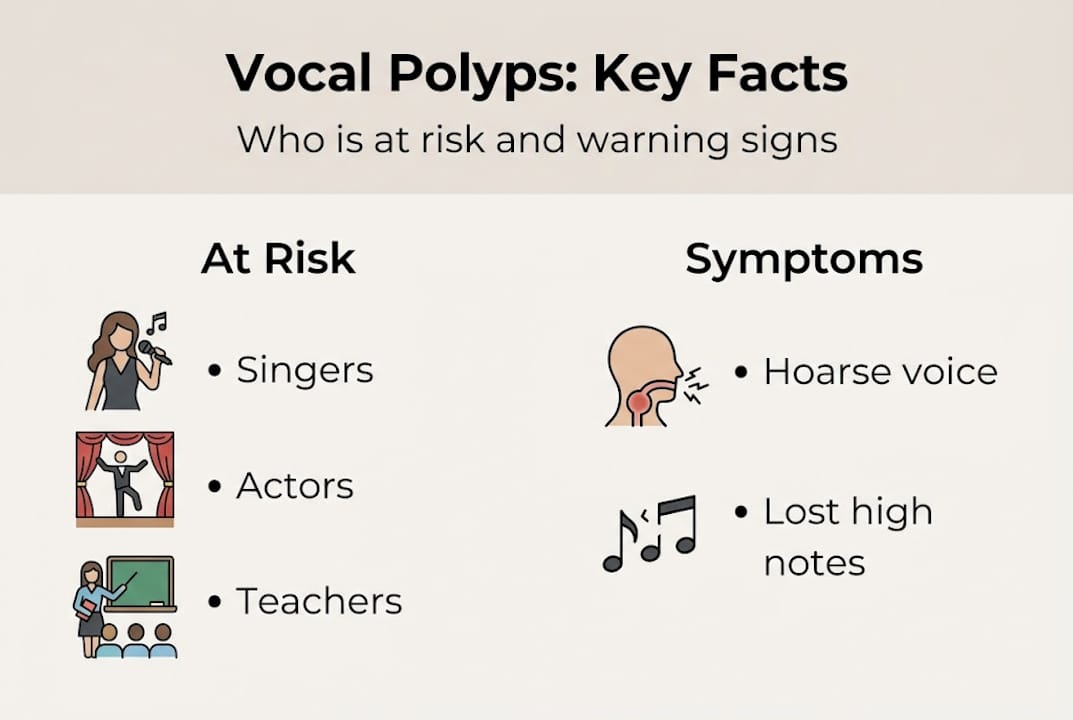
Vocal polyps are benign growths caused by vocal trauma, overuse, or chronic irritants. Singers performing high-intensity shows, actors projecting in large theaters, teachers lecturing for hours, and broadcasters working under pressure are all in the high-risk category. The physical demands placed on vocal folds in these professions create the perfect conditions for polyp formation.
One of the most common points of confusion is the difference between polyps and nodules. Understanding nodules vs polyps in singers matters because the treatment approach differs. Nodules are typically bilateral, meaning they form on both folds simultaneously, and are closely linked to chronic misuse. Polyps are usually unilateral, forming on a single fold, and often trace back to a specific traumatic event like a vocal hemorrhage or a single night of extreme overuse.
Common causes of vocal polyps include:
These vocal risk factors are well-documented and often overlap in professional voice users. A singer who performs while dehydrated, manages uncontrolled reflux, and rarely warms down is stacking multiple risks simultaneously.
| Feature | Vocal polyp | Vocal nodule |
|---|---|---|
| Location | Usually one fold | Both folds |
| Texture | Soft, fluid-filled | Firm, fibrous |
| Primary cause | Trauma or acute overuse | Chronic misuse |
| Typical patient | Any voice professional | High-use vocalists |
“A single traumatic vocal event, like a blown-out performance, can trigger a polyp even in a well-trained singer with perfect technique.”
Recognizing symptoms early is one of the most protective things you can do for your career. Vocal polyps don’t always announce themselves dramatically. Sometimes the first sign is subtle, a slight roughness at the top of your range, a note that used to feel effortless now requiring extra push.
Hoarseness, raspy voice, and voice fatigue are the main signs, and you should seek evaluation if symptoms persist beyond two weeks. For voice professionals, that window is shorter. If something feels wrong for more than two days, take it seriously.
Cardinal symptoms to watch for:
For singers and actors, the warning signs that matter most are changes in your high notes, a voice that worsens progressively with use, and persistent cracks that don’t resolve with rest. These are not signs of a bad vocal day. They are signals your folds are struggling.

Understanding the full picture of polyp symptoms helps you distinguish between normal vocal fatigue and something that needs clinical attention. Waiting it out is a common mistake. Polyps can grow, and continued vocal use without treatment can convert a manageable condition into one that genuinely requires surgery.
Pro Tip: Keep a simple voice journal for two weeks. Note when symptoms appear, how long they last, and what activities preceded them. This data is invaluable when you see a laryngologist.
If your symptoms point toward a polyp, the next step is a proper clinical evaluation. Not all diagnostic tools are equal, and this matters more than most patients realize.
A basic laryngoscopy gives your doctor a static view of your vocal folds. It can detect obvious abnormalities, but it misses the dynamic picture. Videostroboscopy is the gold standard for voice professionals. It uses a strobe light synchronized to your vocal frequency, which creates a slow-motion effect that reveals how your folds vibrate, open, and close. Diagnosis confirmed by videostroboscopy rather than basic laryngoscopy gives a far more accurate picture, and aerodynamic changes in airflow and pressure also occur with polyps, providing additional diagnostic data.
| Diagnostic tool | What it shows | Best for |
|---|---|---|
| Flexible laryngoscopy | Basic fold structure | Initial screening |
| Videostroboscopy | Fold vibration and mucosal wave | Confirmed diagnosis |
| Aerodynamic testing | Airflow, pressure, efficiency | Severity assessment |
| Voice range profiling | Pitch and intensity limits | Performance impact |
“Ask your doctor specifically for videostroboscopy. A basic scope alone may not reveal the full extent of a polyp’s impact on your vocal fold vibration.”
Your evaluation may also include aerodynamic measures such as maximum phonation time, mean airflow rate, and subglottic pressure estimates. These tests reveal how efficiently your voice is working and help track recovery progress over time. Understanding voice recovery timelines starts with accurate baseline data from these assessments.
For singers and actors, a laryngologist with experience in professional voice is preferable to a general ENT. The clinical needs of a performer differ from those of a non-vocal patient, and treatment recommendations should reflect that. Exploring non-surgical polyp recovery options begins with a diagnosis that captures the full functional picture.
Once a polyp is confirmed, the treatment path depends on size, severity, and your professional demands. The good news is that conservative treatment works well for many cases.
Voice therapy improves or resolves most cases and outperforms short-term steroid or surgical intervention for long-term success. A qualified speech-language pathologist will work with you on resonance placement, breath support, reducing hyperfunction, and eliminating the vocal behaviors that caused the polyp in the first place. This is not just rest. It is active retraining.
Evidence-based first-line treatments include:
Natural remedies occupy a supportive role. Natural remedies like herbs and steam may relieve symptoms but lack strong clinical evidence for curing vocal polyps. That said, they are genuinely useful as part of a broader recovery plan. Steam inhalation reduces mucosal irritation. Herbal teas with anti-inflammatory properties can soothe the throat. Proper herbal medicine for vocal health supports the body’s own healing capacity when used alongside therapy, not instead of it.
For voice therapy for pros, the combination of professional guidance and daily natural support tends to produce the best outcomes. Surgery or corticosteroid injections are reserved for polyps that do not respond to conservative care, are very large, or are causing airway concerns. Exploring natural herbal relief as a complement to therapy is a practical and well-supported approach.
Pro Tip: Drink at least 2 liters of plain water daily during recovery. Systemic hydration keeps your vocal fold mucosa supple and reduces the friction that slows healing.
Recovery from a vocal polyp is not a passive process. It requires structure, patience, and consistent professional support.
Voice professionals usually recover fully within weeks with therapy, but recurrence is a real risk if the underlying misuse patterns continue. The polyp may resolve, but if your technique, habits, and lifestyle remain unchanged, you are setting yourself up for a repeat injury.
A structured recovery approach for professionals:
For stepwise recovery for pros, the timeline typically looks like this: noticeable improvement within 2 to 4 weeks, significant functional recovery by 6 to 8 weeks, and full resolution in 2 to 3 months for most cases.
“Recovery is not just about the polyp disappearing. It is about building a voice that is resilient enough not to form another one.”
Statistic: Studies suggest that up to 80% of small vocal polyps in professional voice users respond positively to conservative management when therapy is initiated early and consistently followed.
Celebrities have recovered with combined surgery, rest, and therapy. Adele, Björk, and Keith Urban all faced serious vocal fold injuries and returned to full performance capacity. Their recoveries shared one common thread: professional guidance combined with sustained behavioral change. Explore the full framework for peak voice health recovery to build your own long-term plan.
After working with voice professionals for over 25 years, one pattern stands out clearly. Most relapse cases are not failures of treatment. They are failures of follow-through.
Surgery removes a polyp. It does not fix the vocal behavior that created it. Singers who go straight back to their old technique after a surgical procedure often find themselves back in the clinic within a year. The polyp was a symptom. The cause was never addressed.
Natural remedies have real value, but they are not a cure. Treating a polyp with herbal tea and steam alone is like treating a stress fracture with a warm compress. It soothes, but it does not heal the underlying structural problem. Understanding the honest scope of non-surgical recovery truths means accepting that technique correction and sustained therapy are not optional extras. They are the core of lasting recovery.
The professionals who stay healthy long-term are the ones who develop self-awareness about their own vocal patterns, seek guidance early, and treat their voice like the precision instrument it is.
You now have a clear, evidence-grounded picture of vocal polyps, from cause to recovery. The next step is putting that knowledge into action with tools designed specifically for professional voice users.

At TMRG, we have spent 25+ years developing solutions that support voice professionals at every stage of recovery. Whether you are managing early symptoms or rebuilding after treatment, the TMRG Standard Voice Therapy Kit provides a structured starting point, while the Herbal Vocal Recovery Kit offers targeted natural support to complement your therapy. Your career voice deserves more than generic advice. Explore all TMRG vocal solutions and find the right fit for where you are right now.
Many small vocal polyps improve or resolve with voice therapy, rest, and vocal hygiene, and voice therapy can resolve many small polyps without surgery ever being necessary.
Natural remedies like herbal teas and steam can soothe symptoms but cannot cure vocal polyps on their own. Natural remedies soothe but do not replace medical therapy.
Professional voice users often see significant improvement within 2 to 4 weeks of starting therapy, with full recovery typical in 2 to 3 months for most cases.
Vocal polyps are usually caused by vocal overuse, trauma, dehydration, GERD, or irritants like smoking and allergies. Vocal trauma and overuse are among the most common contributing factors.
